
The Enterpise TLC Storage Era Begins: Rounding Up 13 SSDs With Samsung, Intel, and Memblaze
- Posted in
- SSDs
- Storage
- Intel
- Samsung
- SATA
- Enterprise
- Enterprise SSDs
- M.2
- NVMe
- U.2
- Memblaze
- PBlaze5
- 860 DCT
- 883 DCT
- 983 DCT
Conclusion
The enterprise SSD market has undergone major shifts from a few years ago. PCIe SSDs have expanded from an expensive niche to include a broad range of mainstream products. It's no longer possible to carve the market up into just a few clear segments; the enterprise SSD market is a rich spectrum of options. We're further than ever from having a one size fits all approach to storage.
But at the same time, we're as close as we'll ever get to seeing the market dominated by one kind of memory. TLC NAND has pushed MLC NAND out of the market. QLC, 3D XPoint and Z-NAND are all still niche memories compared to the vast range that TLC currently covers. We tested enterprise SSDs from a variety of market segments: two tiers of SATA SSD and a range of NMVe from a low-power 1TB M.2 up to power-hungry multi-TB U.2 and add-in card drives.
The latest Samsung enterprise SATA drives show that SATA is far from a dying legacy technology. The SATA drives often come out on top of our power efficiency ratings: with power draw that largely stays in the 2-3W range, they can compete in IOPS per Watt even when the raw performance is much slower than the NVMe drives. And the SATA drives aren't always far behind on performance: the smaller and slower NVMe drives don't have a huge advantage in steady-state write performance compared to SATA drives of the same capacity. Granted, most of these drives are intended for heavily read-oriented workloads, and it no longer makes sense to make a high-endurance write-oriented SATA drive because then the interface would be more of a bottleneck than the NAND flash itself.
Where the NVMe drives shine is in delivering read performance far beyond what a single SATA link can handle, and this carries over to relatively read-heavy mixed workloads. The downsides of these drives are higher cost and higher power consumption. Their power efficiency is only competitive with the SATA drives if the NVMe drives are pushed to deliver the most performance their controllers can handle. That usually means higher queue depths than needed to saturate a SATA drive, and it often means that a higher capacity drive is needed as well: the 1TB and 2TB NVMe drives often don't have enough flash memory to keep the controller busy. The big, power-hungry controllers used in high-end NVMe SSDs are most worthwhile when paired with several TB of flash. Samsung's 983 DCT uses the same lower-power NVMe controller as their consumer NVMe drives, and its sweet spot is clearly at lower capacities than the ideal for the Intel P4510 or Memblaze PBlaze5.
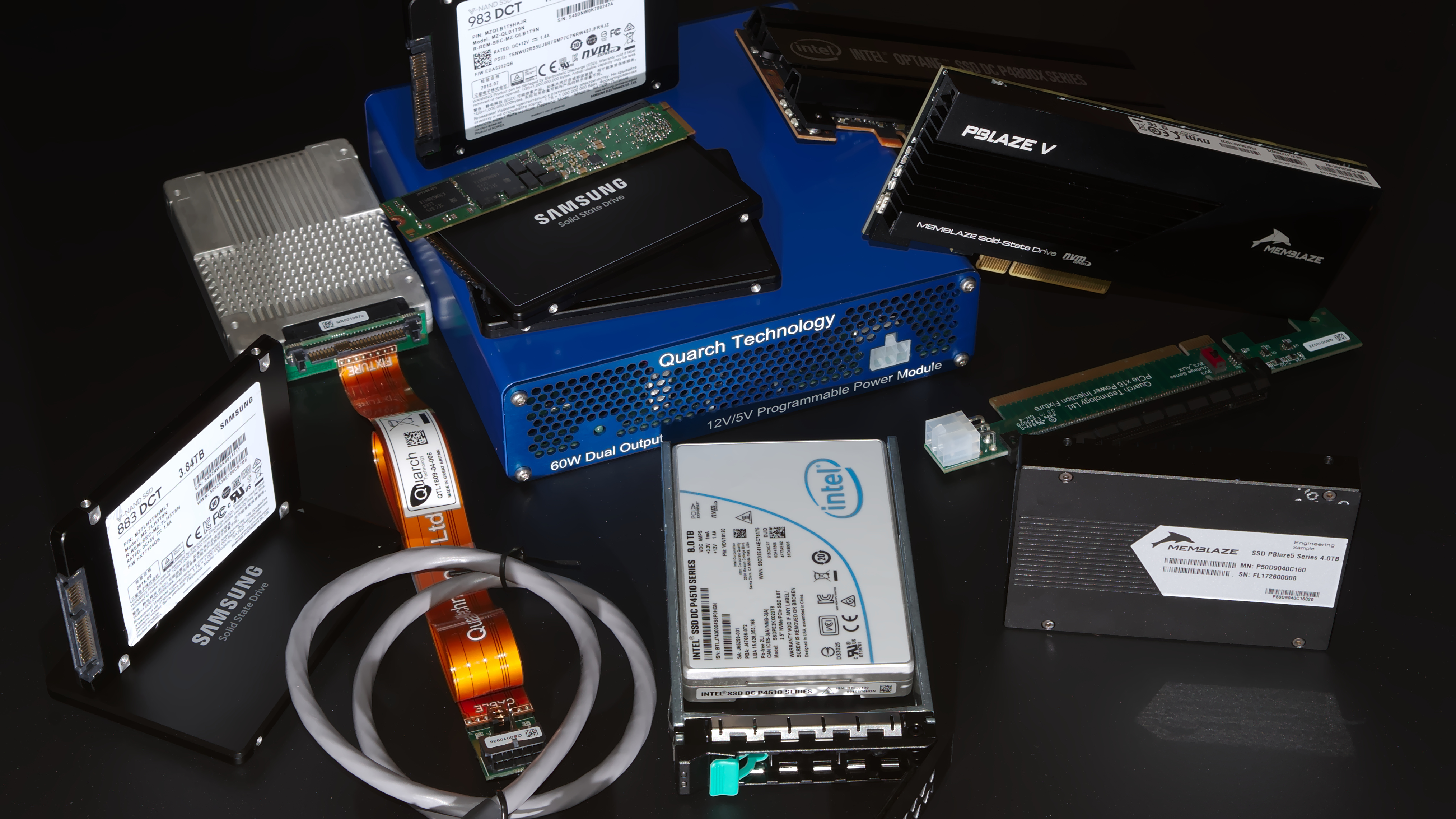
The choice between SATA, low-power NVMe and high-end NVMe depends on the workload, and each of those market segments has a viable use case in today's market. The SATA drives are by far the cheapest way to put the most TB of flash into a single server, and in aggregate they can deliver high performance and great performance per Watt. Their downside is in applications requiring high performance per TB: datasets that aren't very large, but are very hot. It takes hours to read or write the entire capacity of a 4TB SATA SSD. A handful of 4TB SATA SSDs can easily be large enough while not offering enough aggregate performance. In those cases, splitting the same dataset across 1TB SATA SSDs won't provide as much performance boost as moving to multi-TB NVMe drives.
The most powerful NVMe SSDs like the Memblaze PBlaze5 have shown that modern 3D TLC NAND can outperform older MLC-based drives in almost every way. With a sufficiently high queue depth, the PBlaze5 can even approach the throughput of Intel's Optane SSDs for many workloads: the PBlaze5 offers similar sequential write performance and better sequential read performance than the Intel Optane P4800X. The random write speed of the PBlaze5 is slower by a third, but for random reads it matches the Optane SSD and with careful tuning it can provide substantially more random read throughput than a single Optane SSD. All of this is from a drive that's high-end even by enterprise standards, but is actually a generation behind the other flash-based SSDs in this review.
Overall, there's no clear winner from today's review, and no obvious sweet spot in the enterprise SSD market. Samsung still puts out a very solid product lineup, but they're not the only supplier of good 3D NAND anymore. Intel's 64-layer 3D TLC is just as fast and power efficient, though Intel's current use of it the P4510 suggests that they're still a bit behind on the controller side of things—the Samsung 983 DCT's QoS is much better even if the throughput is a bit lower. And the Memblaze PBlaze5 shows that the brute force power of the largest SSD controllers can overcome the disadvantage of being a generation behind on the flash memory; we look forward to testing their more recent models that upgrade to 64-layer 3D TLC.
We're still feeling our way with how we want to present future Enterprise SSD reviews, so if you have comments on what you'd like to see, either product wise or testing methodology, then please leave a comment below.
Originally published at https://www.anandtech.com/show/13704/enterprise-ssd-roundup-intel-samsung-memblaze (Wayback Machine).