
Double Height DDR4: 32GB Modules from G.Skill and ZADAK Reviewed
Power Analysis
One of the interesting aspects of the double height memory is how it affects power consumption. It would be natural to assume that double the number of chips and EPROMs would result in double the power draw of a standard capacity module, and the power per GB should be similar.
To measure the power consumption, we ran Intel's Power Gadget 3.5.0 utility during benchmark runs in our POV-Ray 3.7.1 test and in our Memory Latency Checker. POV-Ray 3.7 is a rendering based benchmark which stresses a system - It's a good indicator of memory stability and overall performance so it made it a natural choice for a power point of view. Our second test involves our MLC2 memory benchmark which is purely memory focused and loads the memory with high workloads as well as testing latency.
POV-Ray 3.7: link
The Persistence of Vision Ray Tracer, or POV-Ray, is a freeware package for as the name suggests, ray tracing. It is a pure renderer, rather than modeling software, but the latest beta version contains a handy benchmark for stressing all processing threads on a platform. We have been using this test in motherboard reviews to test memory stability at various CPU speeds to good effect – if it passes the test, the IMC in the CPU is stable for a given CPU speed. As a CPU test, it runs for approximately 1-2 minutes on high-end platforms.
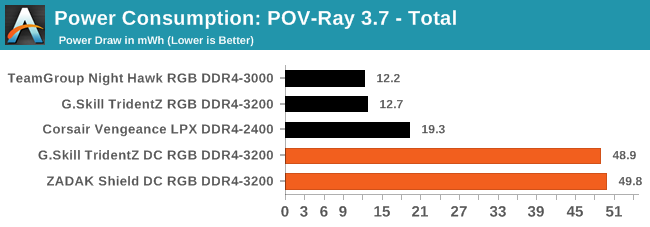
On average when directly comparing the G.Skill TridentZ and TridentZ DC RAM, the power consumption on average in POV-Ray was 285% higher. This is a noticeable jump over two sticks and more than double in terms of overall power used. If we convert this down to average energy per gigabyte:
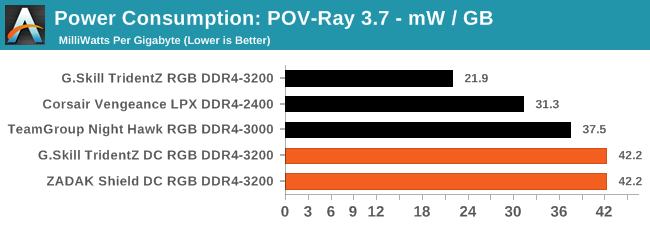
There is still an additional penalty in energy for using the new modules per GB.
Memory Latency Checker: link
Intel's Memory Latency checker is a tool designed to measure memory latency and bandwidth. MLC measures multiple aspects of DRAM with idle and load latencies, cache to cache data transfer latencies and peak memory bandwidth. The benchmark focuses purely on the memory and is influenced by higher clock speeds and latency timings.
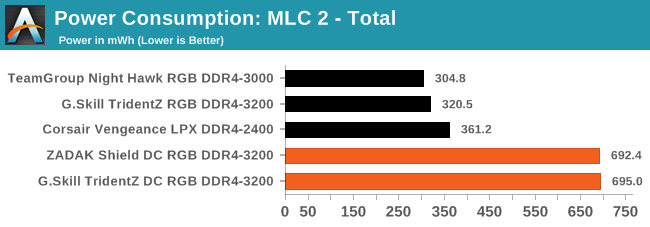
Over a longer duration and in a high memory weighted benchmark such as MLC2, the power variation from the double capacity to the standard was more consistent with what was initially expected; double the power consumption for double capacity RAM. For what it's worth, the Corsair Vengeance LPX kit at 1.2 V was no better off from a power consumption standpoint than the 1.35 V kits tested.
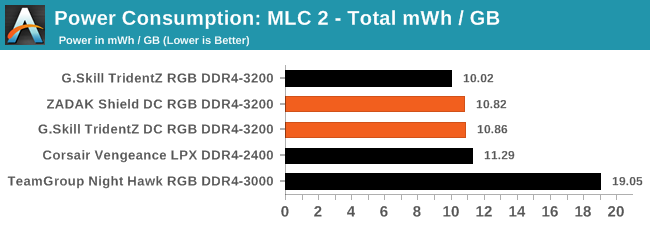
If we compare energy per gigabyte, it is actually very competitive compared to the smaller kits. Here, the 2x8GB kit is actually consuming the most energy per GB, which suggests that the static power is a significant proportion of this analysis.
Originally published at https://www.anandtech.com/show/13694/double-height-ddr4-gskill-zadak-2x32gb-ddr4-3200 (Wayback Machine).