
The $60 CPU Question: AMD Athlon 200GE or Intel Pentium Gold G5400? A Review
Gaming: Integrated Graphics
Despite being the ultimate joke at any bring-your-own-computer event, gaming on integrated graphics can ultimately be as rewarding as the latest mega-rig that costs the same as a car. The desire for strong integrated graphics in various shapes and sizes has waxed and waned over the years, with Intel relying on its latest ‘Gen’ graphics architecture while AMD happily puts its Vega architecture into the market to swallow up all the low-end graphics card sales. With Intel poised to make an attack on graphics in the next few years, it will be interesting to see how the graphics market develops, especially integrated graphics.

An AMD APU Base Layout
The two processors on test today have very different attitudes towards integrated graphics. The AMD Athlon 200GE uses the latest Vega architecture, designed for high performance, even if AMD only uses 192 streaming processors in this design. Intel on the other hand is using its older Gen 9 graphics architecture, built for mobile processors, and is using a baseline GT1 configuration when most Intel desktop processors have GT2.
| AMD vs Intel at ~$60 | ||
| AMD Athlon 200GE |
Intel Pentium Gold G5400 |
|
| Cores / Threads | 2 / 4 | 2 / 4 |
| Microarchitecture | Zen | Coffee Lake |
| Motherboards | X470, X370, B450 B350, A320, A300 |
Z390, Z370, Q370 H370, B360, H310 |
| CPU Frequency | 3.2 GHz | 3.7 GHz |
| L2 Cache | 512 KB/core | 256 KB/core |
| L3 Cache | 2 MB / core | 2 MB / core |
| Integrated Graphics | Vega 3 192 SPs |
UHD 610 12 EUs (96 ALUs) |
| DDR4 Support | DDR4-2933 | DDR4-2666 |
| GPU Frequency | Up to 1000 MHz | 350-1050 MHz |
| TDP | 35 W | 54 W (2-core die version) 58 W (4-core die version)* |
| Price | $55 (SRP) | $64 (1k/u) |
| * Intel harvests both 2+2 and 4+2 dies to make G5400 parts. It's impossible to know which one you have without removing the lid and measuring the die area. | ||
Intel does have a small ray of hope here – caches are important when it comes to integrated graphics, so while the 200GE has a bigger L2 cache (512KB vs 256KB) and faster main memory (DDR4-2666 vs DDR4-2400), the AMD L3 cache is a victim cache whereas the Intel L3 cache is a fully inclusive cache that can pre-fetch data. It’s a slim chance, but Intel should take what it can.
For our integrated graphics testing, we take our ‘IGP’ category settings for each game and loop the benchmark round for five minutes apiece, taking as much data as we can from our automated setup.
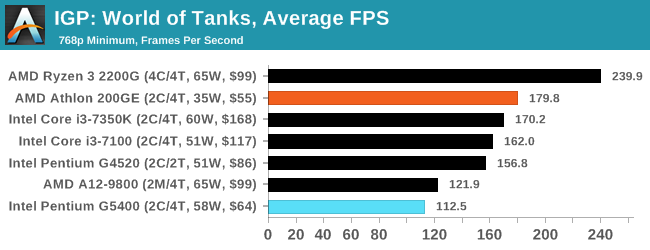
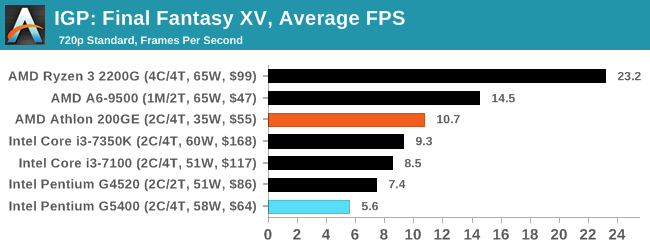
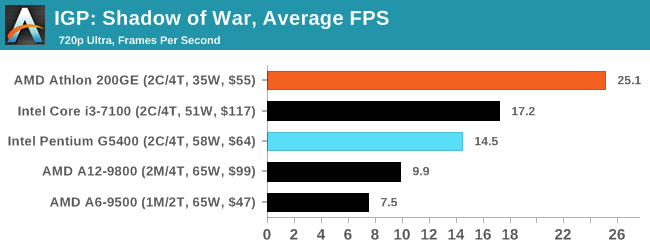
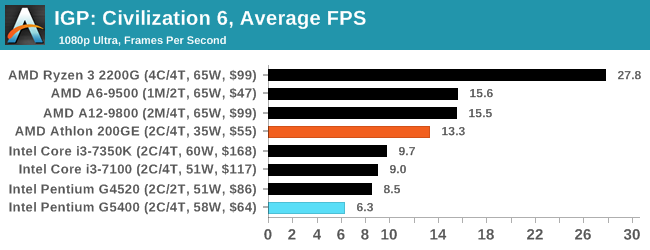
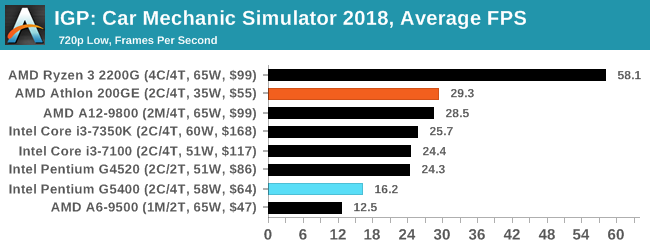
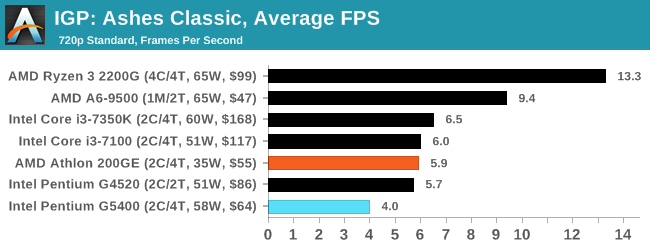
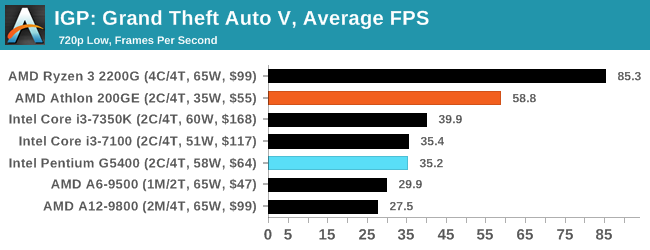
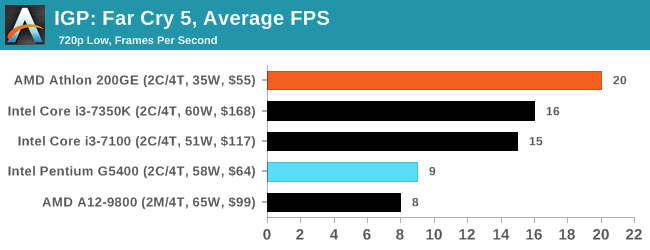
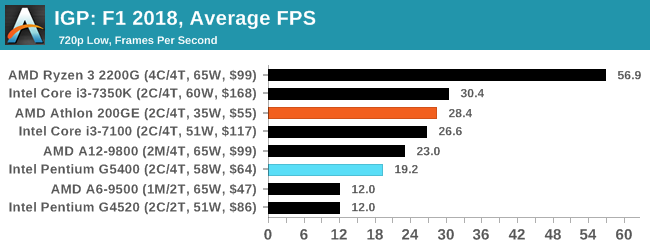
That was a white wash. AMD’s worst win was 48% in both Ashes and F1 2018, while its best wins were in Far Cry 5 at 122.2% and Civilization 6 at 112.1%.
Originally published at https://www.anandtech.com/show/13660/amd-athlon-200ge-vs-intel-pentium-gold-g5400-review (Wayback Machine).