
The $60 CPU Question: AMD Athlon 200GE or Intel Pentium Gold G5400? A Review
Power Consumption: TDP Doesn't Matter
Regular readers may have come across a recent article I wrote about the state of power consumption and the magic 'TDP' numbers that Intel writes on the side of its processors. In that piece, I wrote that the single number is often both misleading and irrelevant, especially for the new Core i9 parts sitting at the top of Intel's offerings. These parts, labeled 95W, can go beyond 160W easily, and motherboard manufacturers don't adhere to Intel official specifications on turbo time. Users without appropriate cooling could hit thermal saving performance states very quickly.
Well, I'm here to tell you that the TDP numbers for the G5400 and 200GE are similarly misleading and irrelevant, but in the opposite direction.
On the official specification lists, the Athlon 200GE is rated at 35W - all of AMD's GE processors are rated at this value. The Pentium G5400 situation is a bit more complex, as it offers two values: 54W or 58W, depending on if the processor has come from a dual-core design (54W) or a cut down quad-core design (58W). There's no real way to tell which one you have without taking the heatspreader off and seeing how big the silicon is.
For our power tests, we probe the internal power registers during a heavy load (in this case, POV-Ray), and see what numbers spit out. Both Intel and AMD have been fairly good in recent memory in keeping these registers open, showing package, core, and other power values. TDP relates to the full CPU package, so here's what we see with a full load on both chips:
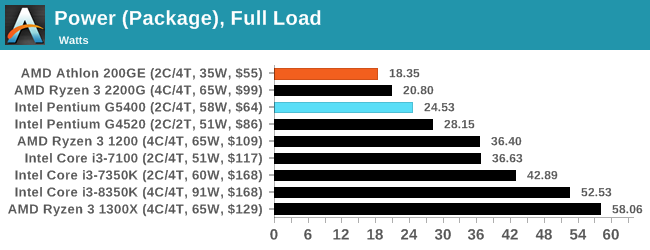
That was fairly anticlimactic. Both CPUs have power consumption numbers well below the rated number on the box - AMD at about half, and Intel below half. So when I said those numbers were misleading and irrelevant, this is what I mean.
Truth be told, we can look at this analytically. AMD's big chips have eight cores with hyperthreading have a box number of 105W and a tested result of 117W. That's at high frequency (4.3 GHz) and all cores, so if we cut that down to two cores at the same frequency, we get 29W, which is already under the 200GE TDP. Scale the frequency back, as well as the voltage, and remember that it's a non-linear relationship, and it's quite clear to see where the 18W peak power of the 200GE comes from. The Intel chip is similar.
So why even rate it that high?
Several reasons. Firstly, vendors will argue that TDP is a measure of cooling capacity, not power (technically true), and so getting a 35W or 54W cooler is overkill for these chips, helping keep them cool and viable for longer (as they might already be rejected silicon). Riding close to the actual power consumption might give motherboard vendors more reasons to cheap out on power delivery on the cheapest products too. Then there's the argument that some chips, the ones that barely make the grade, might actually hit that power value at load, so they have to cover all scenarios. There's also perhaps a bit of market expectation: if you say it's an 18W processor, people might not take it seriously.
It all barely makes little sense but there we are. This is why we test.
Originally published at https://www.anandtech.com/show/13660/amd-athlon-200ge-vs-intel-pentium-gold-g5400-review (Wayback Machine).