
NV45 Preview: On Package HSI
- Posted in
- GPUs
NV45's on Package PCIe to AGP HSI
Our discussion brings us to the conclusion that an external bridge is not going to incur a tangible performance hit, but it may cause headaches and added cost on the OEM's side due to complications with additional component layout and parallel bus routing (which certainly complicates pricing and profitability). And the solution is to move the bridge off of the card and onto the GPU package.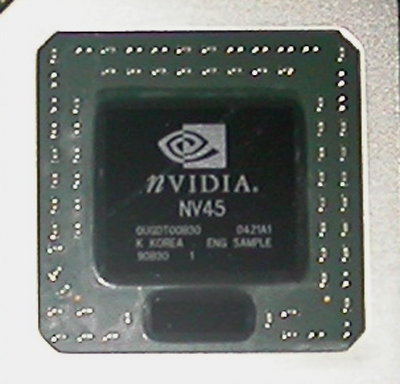
The tiny rectangle underneath the GPU is the HSI.
Now, not only is the HSI out of the vendors' hair, but it will also be cooled by the same HSF that sits on the GPU. This GPU looks and feels like a native solution to vendors (and by our benchmarks, it even acts very much like a native solution).
Dropping this thing on the package may seem out of left field, but even Intel has gone the additional-component-on-package route in the past; the original Pentium Pro had on package cache. A precedent like this begs the question: why didn't anyone think of this in the first place? This really makes perfect sense, especially if rumors are true that it's difficult to get a hold of HSI components unless bundled with a GPU.
So what's the down side? Well, there's still the issue of having less than PCIe bandwidth. This isn't going to be an issue for games in their current state, and won't likely be an real bottleneck in the future. Even on AGP, framebuffer read speed was only a couple of hundred MB/s on NVIDIA cards (and even less on ATI). The ability to get good traffic back over the bus has more to do with the GPU than the availability of bandwidth at this point.
The real thing that NVIDIA loses out on with a bridge is the ability to run multiple video streams up and down the PCIe bus with as much theoretical ease as ATI has. We are working hard to come up with some up and downstream PCIe benchmarks that will tell the real story about what is possible with framebuffer reads, and what is possible with video I/O on native and bridged PCIe GPUs.
But for now, we have NV45. No tangible performance impact under current games due to bridging (though a few odd numbers here and there with our current beta drivers), and now no added headache or extra development cost to OEMs over the ATI solution. With all that cleared up, let's head on to the tests.
Originally published at https://www.anandtech.com/show/1366 (Wayback Machine).