
The Samsung 860 QVO (1TB, 4TB) SSD Review: First Consumer SATA QLC
AnandTech Storage Bench - The Destroyer
The Destroyer is an extremely long test replicating the access patterns of very IO-intensive desktop usage. A detailed breakdown can be found in this article. Like real-world usage, the drives do get the occasional break that allows for some background garbage collection and flushing caches, but those idle times are limited to 25ms so that it doesn't take all week to run the test. These AnandTech Storage Bench (ATSB) tests do not involve running the actual applications that generated the workloads, so the scores are relatively insensitive to changes in CPU performance and RAM from our new testbed, but the jump to a newer version of Windows and the newer storage drivers can have an impact.
We quantify performance on this test by reporting the drive's average data throughput, the average latency of the I/O operations, and the total energy used by the drive over the course of the test.
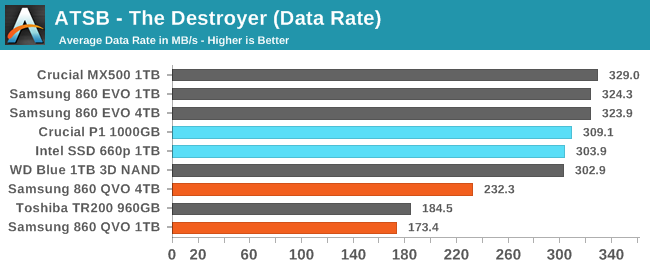
The 1TB Samsung 860 QVO does not handle The Destroyer very well, with an average data rate that is slightly slower than the DRAMless TLC drive. By comparison, the NVMe QLC drives from Intel and Micron are only slightly slower than the 860 EVO and MX500.
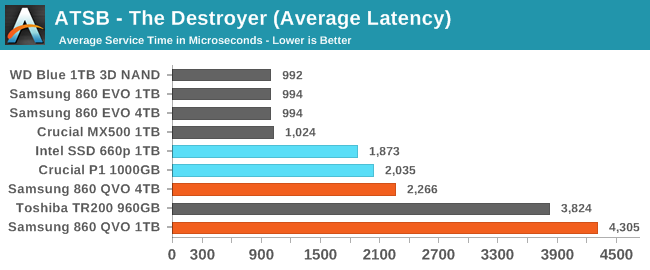
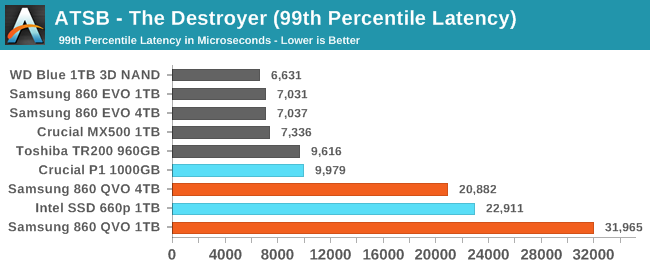
The QLC drives in general stand out more when looking at latency metrics than throughput, and especially when looking at 99th percentile latencies. The 1TB 860 QVO comes in last place for both average and 99th percentile latency, and all three QLC drives have worse 99th percentile latency than the DRAMless TLC drive.
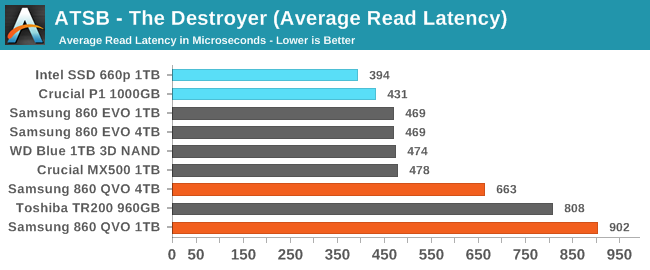
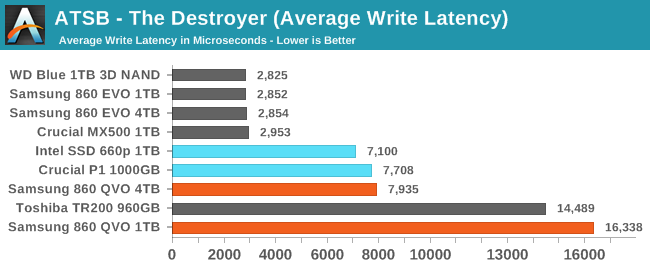
The average read and write latencies of the 860 QVO are both only slightly worse than the DRAMless TLC SSD. The NVMe QLC drives are slightly faster than the mainstream SATA drives for read latency but fall behind in average write latency.
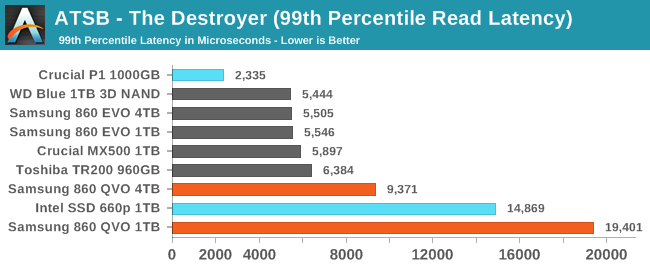
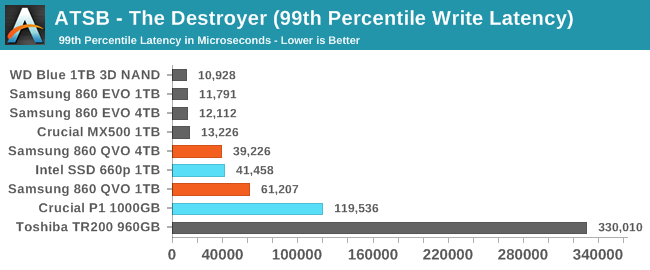
The 860 QVO actually doesn't come in last place for 99th percentile write latency, and in fact scores far better than the DRAMless TLC drive. However, the QLC drives are all still far worse off than the mainstream TLC SATA drives.
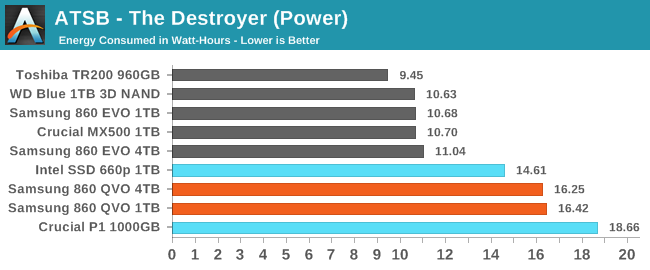
With low performance dragging out the test to a far longer duration, it's no surprise that the QLC drives all use much more energy over the course of The Destroyer than most SATA drives. The DRAMless Toshiba TR200 is an impressive exception that manages to be very efficient despite its low overall performance.
Originally published at https://www.anandtech.com/show/13633/the-samsung-860-qvo-ssd-review (Wayback Machine).