
Memory Frequency Scaling in SFF Systems: An Investigation with SO-DIMMs and Coffee Lake
Final Words
Improvements in memory bandwidth and reductions in latency are the performance benefits provided by the usage of high-performance SO-DIMM kits. In the previous pages, we looked at the performance of four different SO-DIMM configurations in a SFF desktop PC. Power / energy consumption is one of the last remaining aspects to consider.
In addition to performance, idle power consumption is also an important metric – particularly for usage in battery-constrained systems such as workstation notebooks. The higher the DRAM operating frequency, the greater the power consumption. Some high-frequency kits use 1.35V (instead of the 1.2V standard), which tends to drive up the power consumption further. Fortunately, all our tested configurations had SO-DIMMs that operated at 1.2V.
To get a full view of the impact of different memory kits on this aspect, we monitored the power consumed at the wall by the ASRock DeskMini Z370 GTX with an idle desktop and averaged it over a duration of 1 hour.
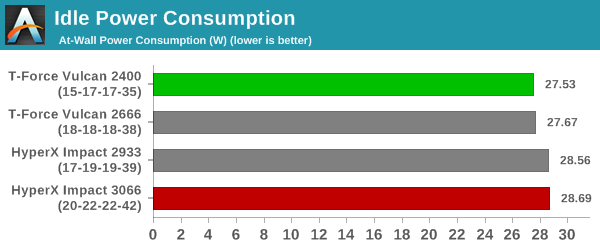
As expected, the higher-frequency operating points consumer more power, but not by a huge margin. While considering the above graph, it is also helpful to keep in mind the energy consumption for typical workloads. Kits that help get work done faster may consume less energy compared to the kits that consume less power even during operation.
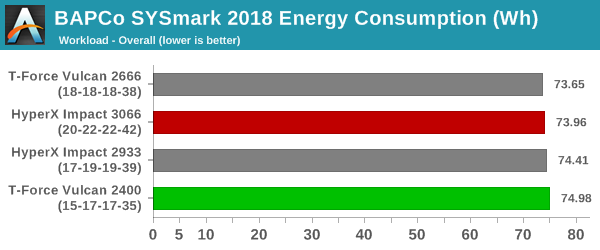
Coming to the business end of the article, it is clear that the choice of memory is dictated by the expected workloads. For most common workloads, the differences between DDR4-2400 and DDR4-3066 are minimal. However, there are cases where the memory characteristics can play a significant role - 7-Zip compression is a real-world example where the kits with lower latencies deliver better compression rates.

For the average user who keeps the system idle most of the time, it is probably better to save money and have lower idle power in the long run. On the other hand, power users who keep their systems busy may want to opt for kits that deliver low latencies (and, in the case of some workloads, just higher speeds).
| DRAM Options for the ASRock DeskMini GTX (Z370) | |||
| Memory Kit | Tested Frequency (MT/s) |
Tested Timing (tCL-tRCD-tRP-tRAS-tRFC) |
Price (USD) |
| Kingston HyperX Impact HX432S20IB2K2/16 |
3066 | 20-22-22-42-560 | $168 |
| 2933 | 17-19-19-39-514 | ||
| Team Group T-Force Vulcan TLRD416G2666HC18FDC-S01 |
2666 | 18-18-18-38-467 | $130 |
| Team Group T-Force Vulcan TLRD416G2400HC15BDC-S01 |
2400 | 15-17-17-35-421 | $130 |
Our tests have also shown that a higher speed-grade kit is not necessarily better – the HyperX Impact DDR4 operating at 2933 MT/s has the best latency numbers. It edges out the same kit operating at 3066 MT/s with different timing parameters in almost all of the benchmarks. Conversely, the Team Group T-Force Vulcan SO-DIMMs offer good value for money and can boast of better idle power characteristics.
Originally published at https://www.anandtech.com/show/13627/memory-frequency-scaling-in-sff-systems-an-investigation-with-sodimms-and-coffee-lake (Wayback Machine).