
The AMD Radeon RX 590 Review, feat. XFX & PowerColor: Polaris Returns (Again)
Ashes of the Singularity: Escalation (DX12)
A veteran from both our 2016 and 2017 game lists, Ashes of the Singularity: Escalation remains the DirectX 12 trailblazer, with developer Oxide Games tailoring and designing the Nitrous Engine around such low-level APIs. The game makes the most of DX12's key features, from asynchronous compute to multi-threaded work submission and high batch counts. And with full Vulkan support, Ashes provides a good common ground between the forward-looking APIs of today. Its built-in benchmark tool is still one of the most versatile ways of measuring in-game workloads in terms of output data, automation, and analysis; by offering such a tool publicly and as part-and-parcel of the game, it's an example that other developers should take note of.

Settings and methodology remain identical from its usage in the 2016 GPU suite. To note, we are utilizing the original Ashes Extreme graphical preset, which compares to the current one with MSAA dialed down from x4 to x2, as well as adjusting Texture Rank (MipsToRemove in settings.ini).
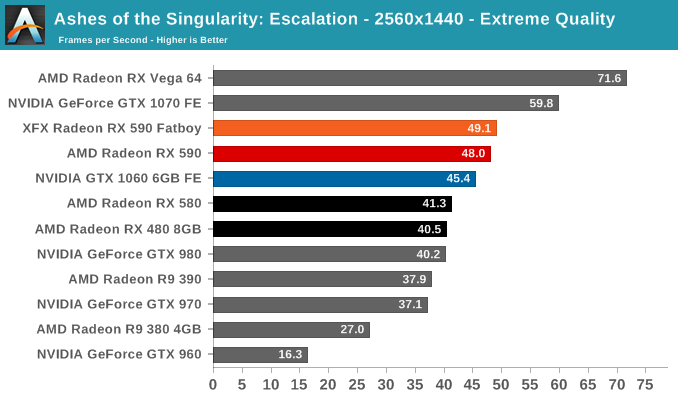
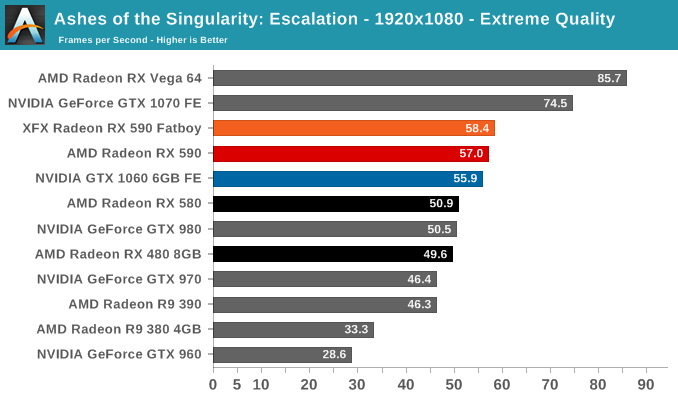
With Ashes, the RX 590 performance uplift over the RX 580 pays off in terms of beating its main competition, the GTX 1060 6GB. The lead is slim enough, however, that custom GTX 1060 6GB cards could easily make up the difference. With the price premium the RX 590 has over the GTX 1060 6GB, the reference GeForce is a little too close for comfort.
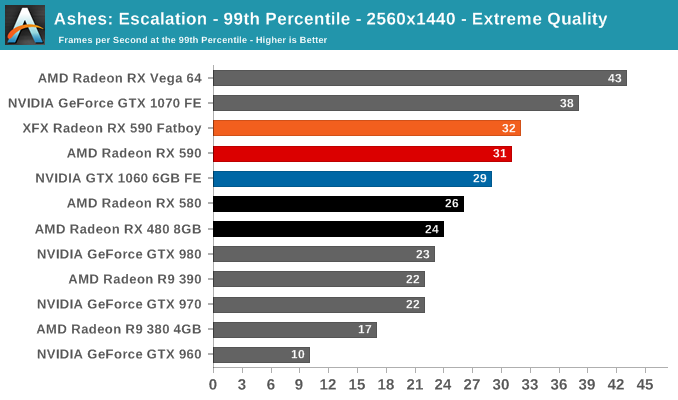
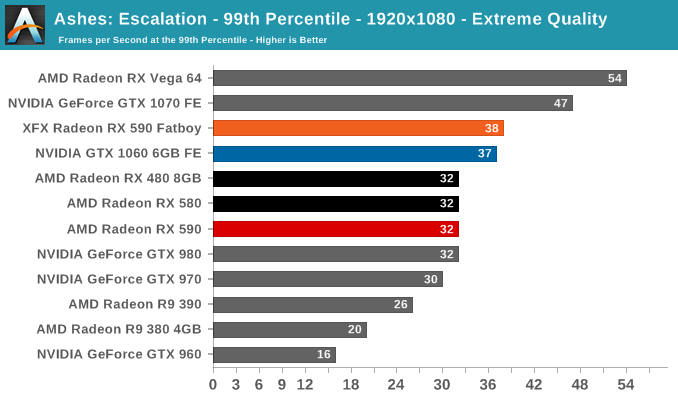
While not particularly known as a VRAM-eater, Ashes at 1440p brings down the GTX 960 and its anemic 2GB framebuffer, though it wouldn't be managing playable framerates anyhow.
Originally published at https://www.anandtech.com/show/13570/the-amd-radeon-rx-590-review (Wayback Machine).