
Q2 2004 Desktop Hard Drive Comparison: WD Raptor vs the World
- Posted in
- Storage
Overall System Performance - SYSMark
SYSMark 2004 is divided into two separate suites: Internet Content Creation and Office Productivity. What makes SYSMark an ideal hard disk benchmark is that its scores are totals of response times, meaning that the benchmark measures how long the system takes to respond to a task (e.g. how long before a search and replace is completed after it is initiated) and sums up all such response times to generate a score. This score is generated for six total subcategories, three under Internet Content Creation and three under Office Productivity.
For the most part, SYSMark is CPU/platform bound, but we will see some variations in performance according to disk speed; at the same time, there are a couple of benchmarks within SYSMark that are heavily disk dependent.
First, we start with Internet Content Creation performance; the first category that we will deal with is 3D Content Creation. The tests that make up this benchmark are described below:
"The user renders a 3D model to a bitmap using 3ds max 5.1, while preparing web pages in Dreamweaver MX. Then the user renders a 3D animation in a vector graphics format."
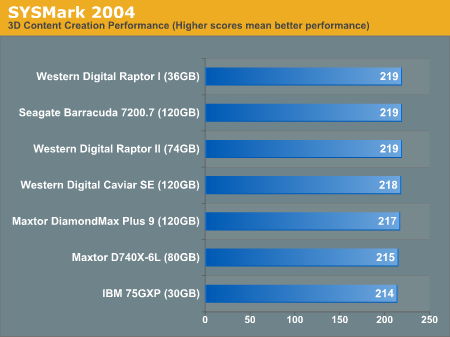
Generally speaking, 3D rendering is not a disk intensive task as your system is mostly CPU bound; we see proof of this in the SYSMark performance. While keeping in mind that SYSMark is more of a CPU test than a disk test, there's still very little variation between all of the drives in this test.
Next, we have 2D Content Creation performance:
"The user uses Premiere 6.5 to create a movie from several raw input movie cuts and sound cuts and starts exporting it. While waiting on this operation, the user imports the rendered image into Photoshop 7.01, modifies it and saves the results. Once the movie is assembled, the user edits it and creates special effects using After Effects 5.5."
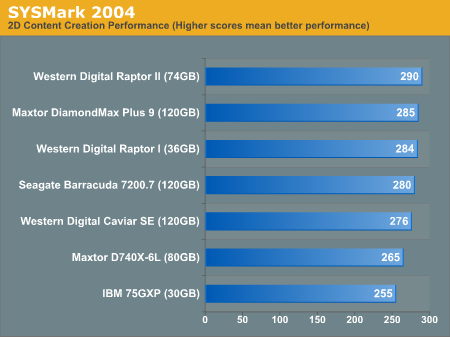
Here, we see that hard disk performance has a much bigger impact; the 2MB 7200RPM drives just don't cut it, with the current generation 8MB 7200RPM drives pulling close to a 10% advantage over the older drives. What is very important to note is that all three of the 8MB 7200RPM drives featured here perform about the same, lending support to the theory that current drives with similar specifications will perform similarly. Out of the bunch, the Maxtor DiamondMax Plus 9 manages to hold a small lead, with the new Raptor enjoying a slight lead over even that drive.
The Internet Content Creation suite is rounded up with a Web Publishing performance test:
"The user extracts content from an archive using WinZip 8.1. Meanwhile, he uses Flash MX to open the exported 3D vector graphics file. He modifies it by including other pictures and optimizes it for faster animation. The final movie with the special effects is then compressed using Windows Media Encoder 9 series in a format that can be broadcast over broadband Internet. The web site is given the final touches in Dreamweaver MX and the system is scanned by VirusScan 7.0."
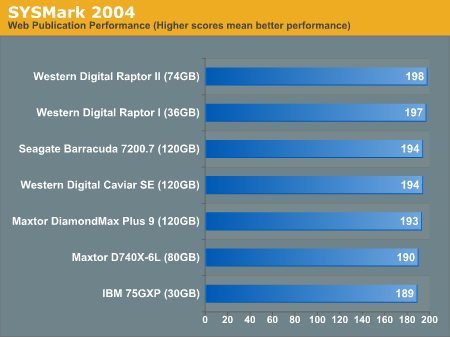
Here, we see that performance is quite similar between all of the contenders, with the Raptors taking the slight lead and the remaining 8MB cache drives all offering similar performance.
Originally published at https://www.anandtech.com/show/1343 (Wayback Machine).