
The Team Group Delta RGB SSD Review: Lite Performance, Light Drive
Random Read Performance
Our first test of random read performance uses very short bursts of operations issued one at a time with no queuing. The drives are given enough idle time between bursts to yield an overall duty cycle of 20%, so thermal throttling is impossible. Each burst consists of a total of 32MB of 4kB random reads, from a 16GB span of the disk. The total data read is 1GB.
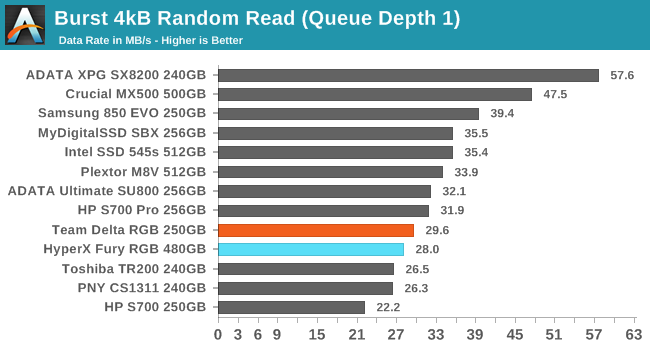
The Team Delta RGB's burst random read performance is a bit slower than other drives using the same NAND and controller, but it is still faster than the DRAMless drives, and the HyperX Fury RGB.
Our sustained random read performance is similar to the random read test from our 2015 test suite: queue depths from 1 to 32 are tested, and the average performance and power efficiency across QD1, QD2 and QD4 are reported as the primary scores. Each queue depth is tested for one minute or 32GB of data transferred, whichever is shorter. After each queue depth is tested, the drive is given up to one minute to cool off so that the higher queue depths are unlikely to be affected by accumulated heat build-up. The individual read operations are again 4kB, and cover a 64GB span of the drive.
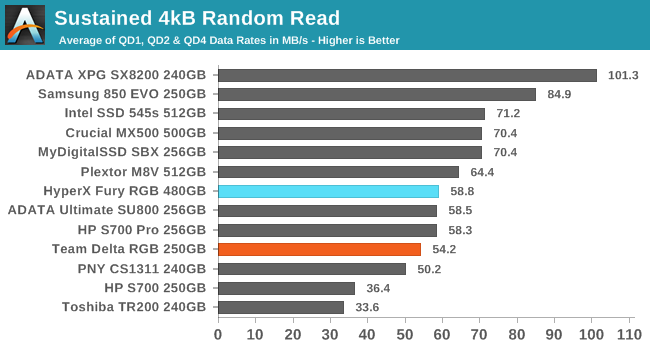
On the longer random read test, the Delta RGB's standing doesn't change: it outperforms the entry-level DRAMless SSDs but falls a bit short of the performance a mainstream SATA drive should be offering these days.
 |
|||||||||
| Power Efficiency in MB/s/W | Average Power in W | ||||||||
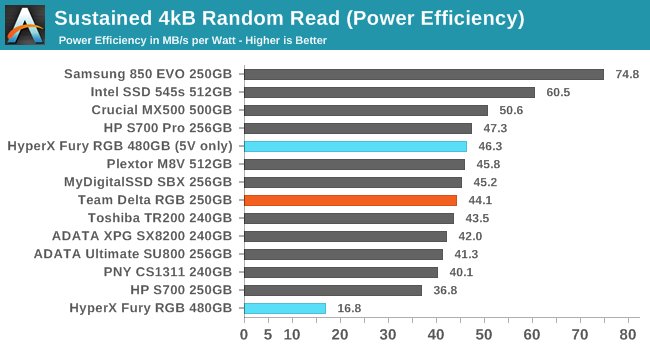
The power efficiency of the Delta RGB during random reads is just a little bit below average for this bunch of drives. The SATA drives using newer 64L TLC mostly beat the Delta RGB's power efficiency, but the sluggish Toshiba TR200 is slightly less efficient than the Delta RGB.
 |
|||||||||
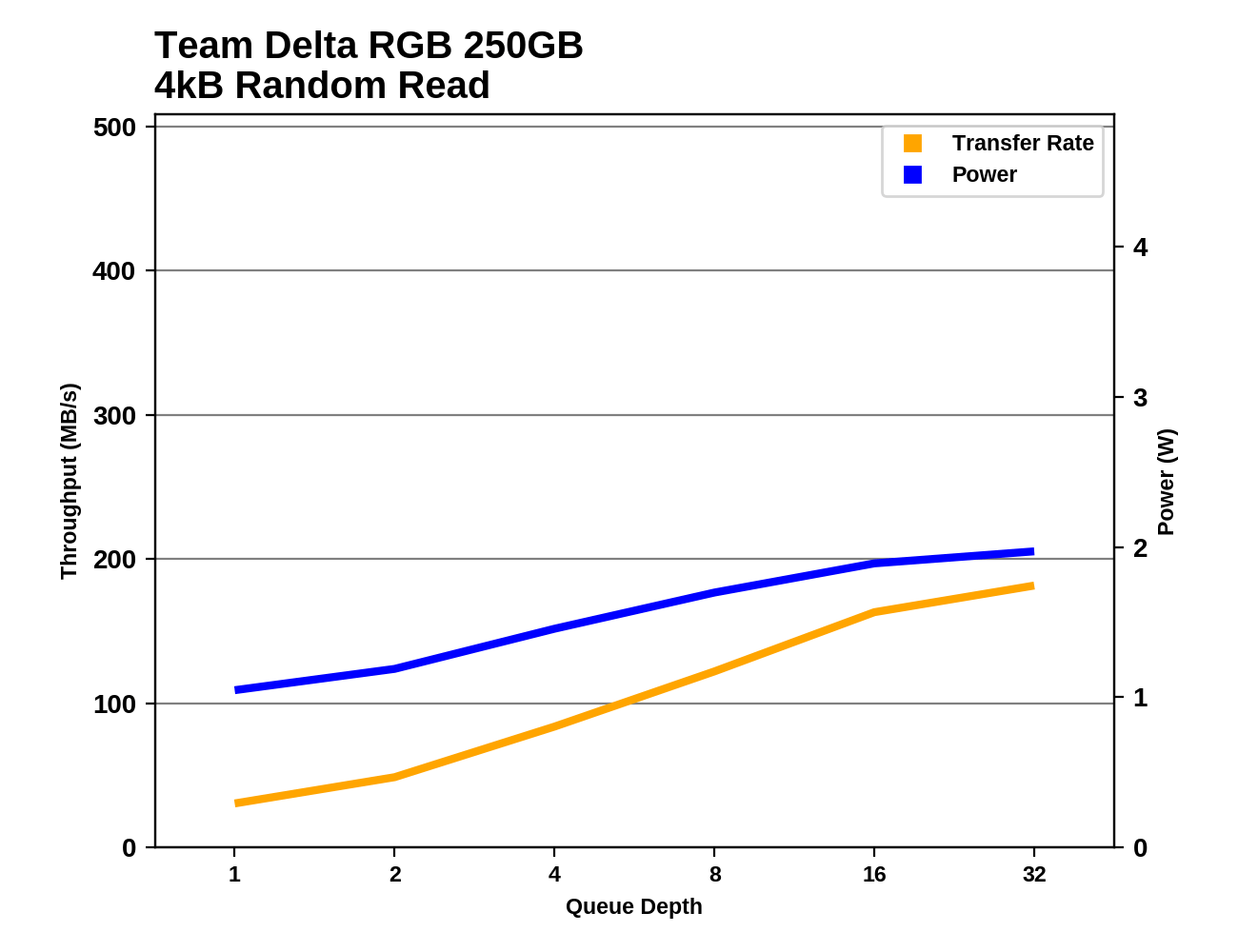
The Delta RGB shows subpar performance scaling as queue depths increase, leaving it slower than even the Toshiba TR200 by QD32. However, the power consumption stays reasonably low throughout the test, and the performance at the more important low queue depths isn't as big a problem.
Random Write Performance
Our test of random write burst performance is structured similarly to the random read burst test, but each burst is only 4MB and the total test length is 128MB. The 4kB random write operations are distributed over a 16GB span of the drive, and the operations are issued one at a time with no queuing.
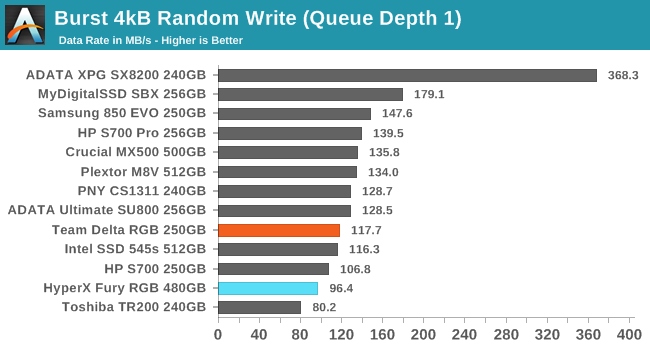
The burst random write performance of the Delta RGB is a bit on the slow side, but the overall spread among small SATA SSDs isn't very wide, especially when the DRAMless drives are excluded.
As with the sustained random read test, our sustained 4kB random write test runs for up to one minute or 32GB per queue depth, covering a 64GB span of the drive and giving the drive up to 1 minute of idle time between queue depths to allow for write caches to be flushed and for the drive to cool down.
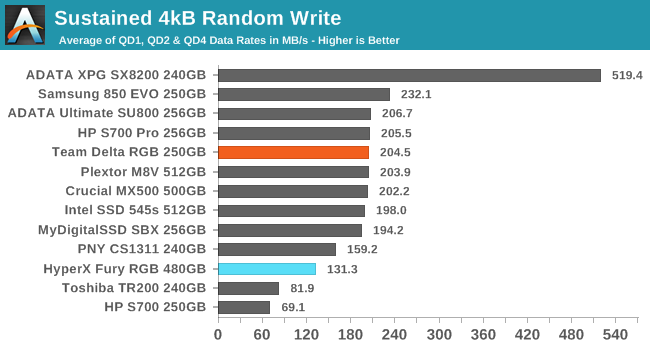
The Delta RGB's performance on the sustained random write test is nothing to complain about—even the larger SATA drives with newer 64L 3D NAND perform the same as the Delta RGB.
 |
|||||||||
| Power Efficiency in MB/s/W | Average Power in W | ||||||||
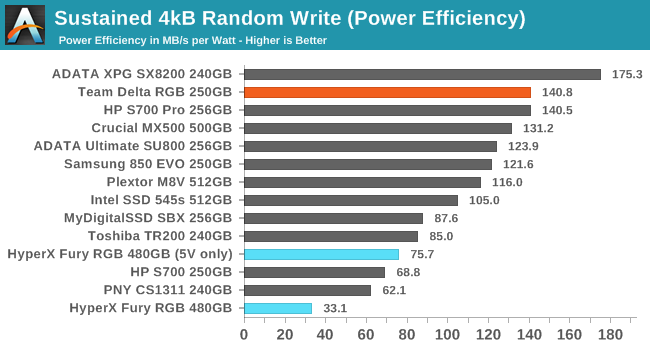
The power efficiency of the Delta RGB during the random write test is best in class. Micron's 3D NAND turns in all of the top efficiency scores here, with the ADATA SX8200 NVMe SSD leading with 25% higher performance per Watt than the Delta RGB.
 |
|||||||||
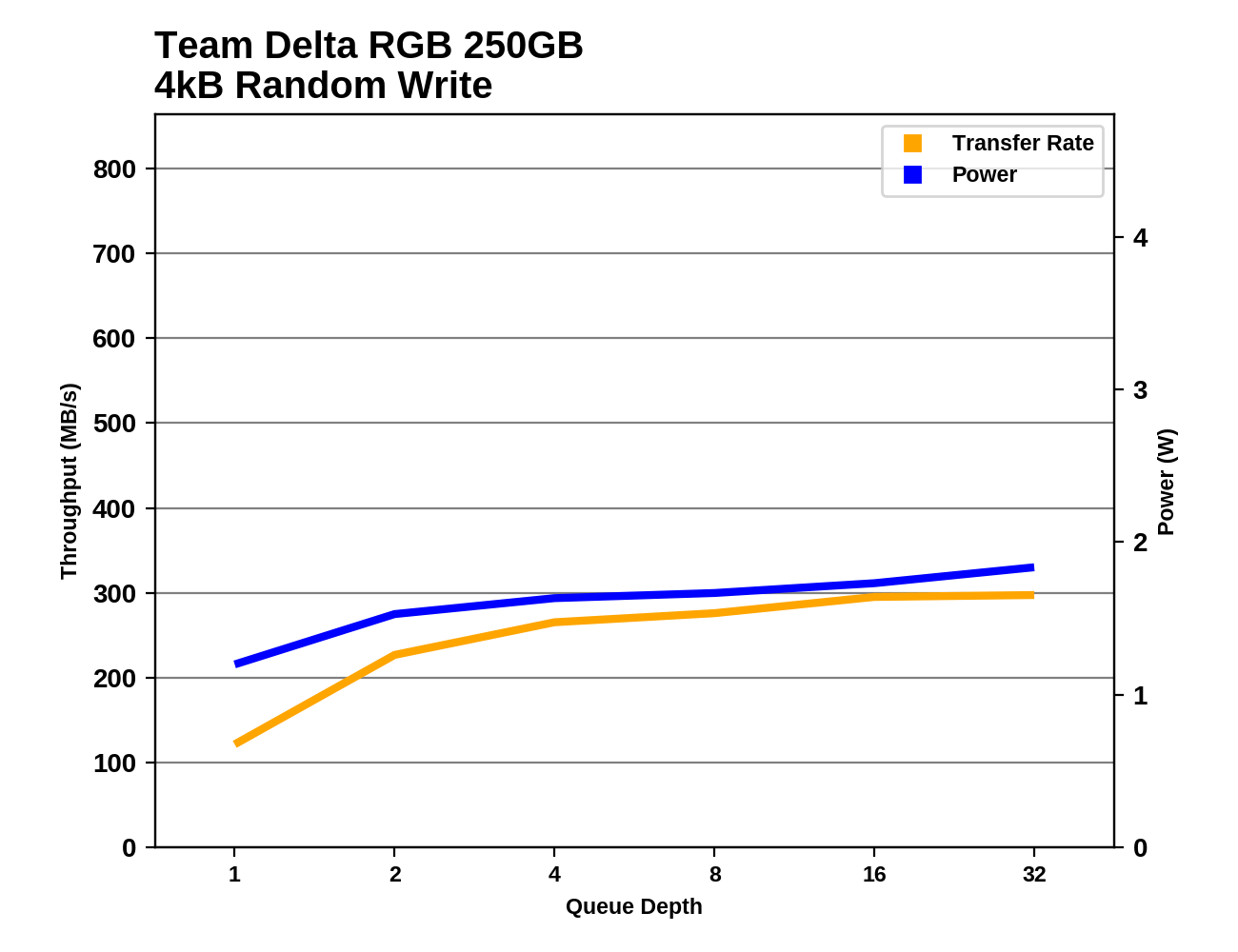
Both the HP S700 Pro and ADATA SU800 show a drop in performance at the end of the random write test, indicating that their SLC caches ran out. The Delta RGB manages to avoid that fate despite using the same NAND and controller, so it appears that the firmware has been tuned so that it flushes the cache faster during the idle time between test phases. The ADATA SX8200 NVMe SSD has serious issues with its SLC cache running out during this test, but even at its worst it is still the fastest drive in this bunch.
Originally published at https://www.anandtech.com/show/13374/the-team-group-delta-rgb-ssd-review (Wayback Machine).