
The Team Group Delta RGB SSD Review: Lite Performance, Light Drive
AnandTech Storage Bench - The Destroyer
The Destroyer is an extremely long test replicating the access patterns of very IO-intensive desktop usage. A detailed breakdown can be found in this article. Like real-world usage, the drives do get the occasional break that allows for some background garbage collection and flushing caches, but those idle times are limited to 25ms so that it doesn't take all week to run the test. These AnandTech Storage Bench (ATSB) tests do not involve running the actual applications that generated the workloads, so the scores are relatively insensitive to changes in CPU performance and RAM from our new testbed, but the jump to a newer version of Windows and the newer storage drivers can have an impact.
We quantify performance on this test by reporting the drive's average data throughput, the average latency of the I/O operations, and the total energy used by the drive over the course of the test.
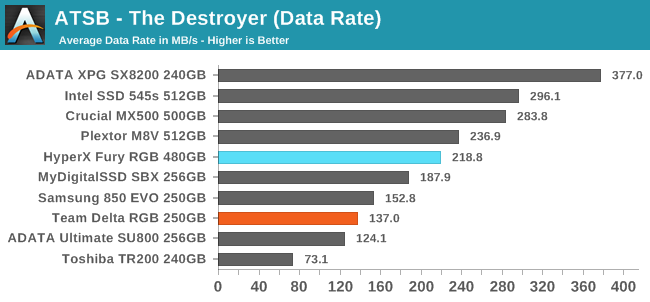
The Team Delta RGB averages about 10% higher overall performance on The Destroyer than the ADATA SU800 that uses the same NAND and controller, but the Delta still falls well short of the fastest SATA drives in this capacity class. The 500GB class drives show that the small drives are all at a huge disadvantage when running such a long and intense test, save for the ADATA SX8200 high-end NVMe SSD.
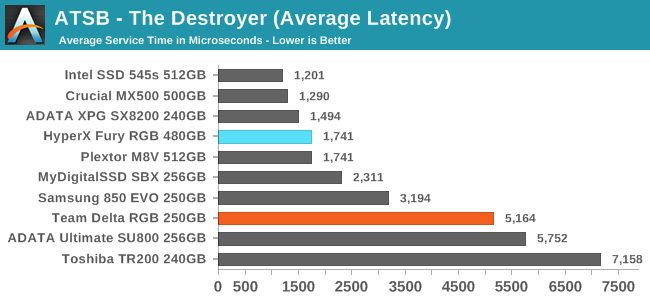
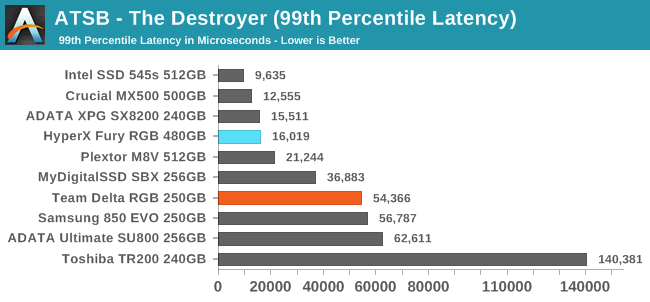
The average latency of the Delta RGB on The Destroyer is much worse than the Samsung 850 EVO of similar capacity, but the 99th percentile latency scores of the small SATA drives are fairly similar and much worse than the larger drives or the high-end NVMe alternative.
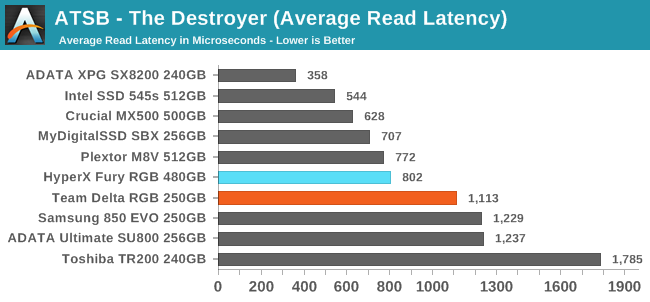
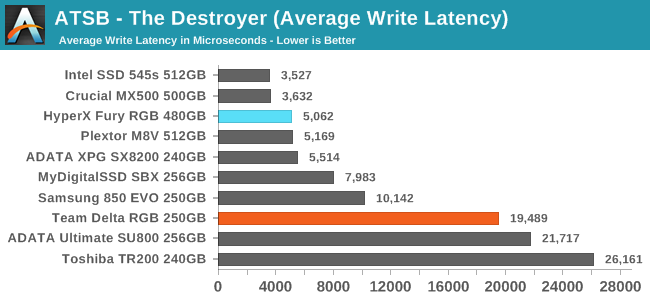
The average read latency scores are much lower and not quite as widely varied than the average write latency. The Delta RGB and ADATA SU800 have write latencies in the 20ms range, about twice that of the fastest SATA drives in this capacity class.
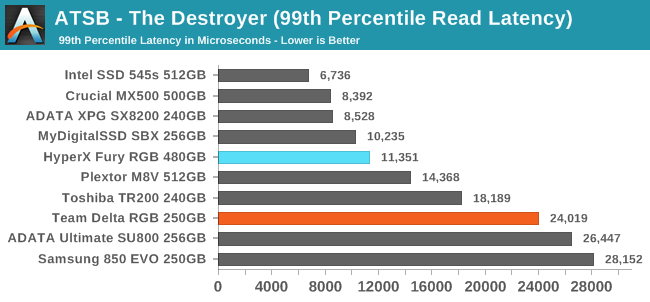
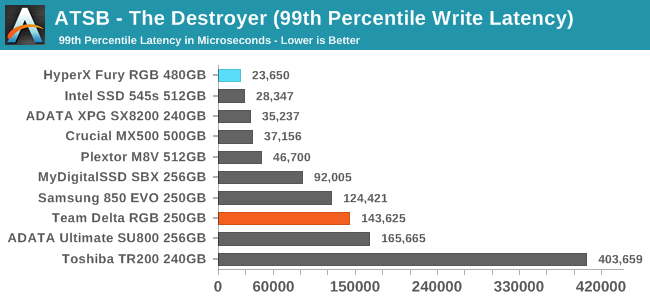
The 99th percentile read and write latency scores show that moving beyond 256GB (or to NVMe) matters much more than the differences between SATA drives within the same capacity class. The 99th percentile write latencies are far larger than the read latencies, and at over 100ms all of these 256GB-class drives are potentially subject to noticeable stuttering.
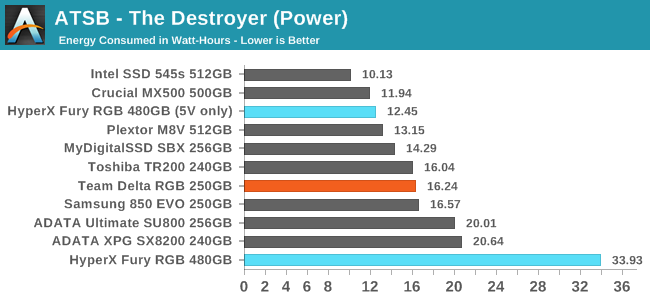
The Delta RGB has fairly good energy usage for a drive that's a bit on the slow side. It uses much less energy than the similarly-equipped ADATA SU800, and the difference is larger than can be explained by just the higher data rate from the Delta RGB. The Delta RGB is actually more efficient than the SU800 despite using the same controller and NAND. The MyDigitalSSD SBX shows that a NVMe drive tuned for efficiency rather than top performance can beat the SATA drives of similar capacity, but even here the larger drives come out ahead.
Originally published at https://www.anandtech.com/show/13374/the-team-group-delta-rgb-ssd-review (Wayback Machine).