
The NVIDIA GeForce RTX 2080 Ti & RTX 2080 Founders Edition Review: Foundations For A Ray Traced Future
Grand Theft Auto V (DX11)
Now a truly venerable title, GTA V is a veteran of past game suites that is still graphically demanding as they come. As an older DX11 title, it provides a glimpse into the graphically intensive games of yesteryear that don't incorporate the latest features. Originally released for consoles in 2013, the PC port came with a slew of graphical enhancements and options. Just as importantly, GTA V includes a rather intensive and informative built-in benchmark, somewhat uncommon in open-world games.

The settings are identical to its previous appearances, which are custom as GTA V does not have presets. To recap, a "Very High" quality is used, where all primary graphics settings turned up to their highest setting, except grass, which is at its own very high setting. Meanwhile 4x MSAA is enabled for direct views and reflections. This setting also involves turning on some of the advanced rendering features - the game's long shadows, high resolution shadows, and high definition flight streaming - but not increasing the view distance any further.
| GTA V | 1920x1080 | 2560x1440 | 3840x2160 |
| Average FPS | 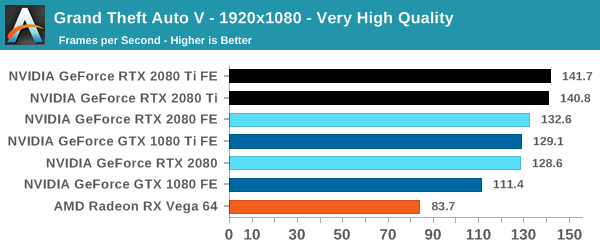 |
 |
|
| 99th Percentile | 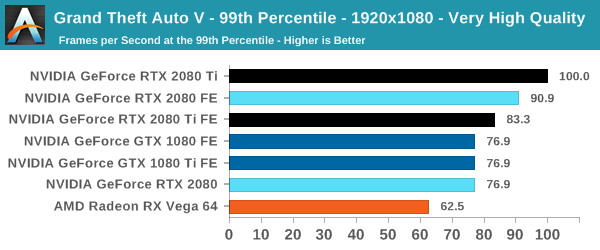 |
 |
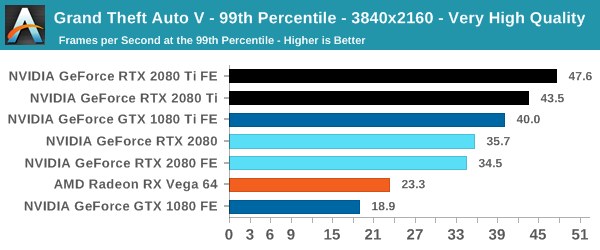 |
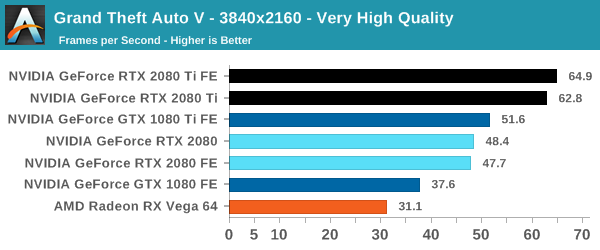
There was an interesting issue during testing that affected the RTX cards at 4K; running the benchmark would result in a blank screen for the entirety of the run. The image would appear with Alt+Enter to put it in windowed mode, but disappear again back in fullscreen. An external overlay resolved the issue, but performance results were identical either way. We really didn't have time to investigate thoroughly, but GTA V, especially with Social Club, can be quite finicky and I hesitate to call it a driver bug without digging into it more.
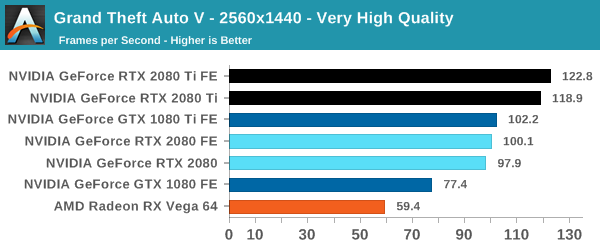
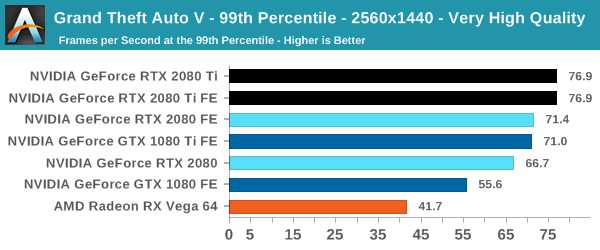
It's a testament to both GTA V and the nature of graphics optimization work that a GeForce card can only now average 60fps. Even still, it's restricted to the RTX 2080 Ti performance tier, which is roughly where the Titan V stands as well. Regardless, the results represent the performance scenario that NVIDIA is ultimately hoping to avoid: the 1080 Ti exceeding the 2080 in performance even with the Founders Edition tweaks. At this point, the 1080 Ti is a mature card and the offerings will skew towards tried-and-true halo custom cards, factory overclocked and well-cooled. Plain performance regression in reference settings is not something the RTX 2080 can easily afford with the higher price - Founders Edition or otherwise.
Originally published at https://www.anandtech.com/show/13346/the-nvidia-geforce-rtx-2080-ti-and-2080-founders-edition-review (Wayback Machine).