
Buyer's Guide: High End System - May 2004
- Posted in
- Guides
CPU and Motherboard Alternatives
CPU: Intel Pentium 4 3.4C (512K L2 cache) NorthwoodMotherboard: DFI (875P chipset)
Price: CPU - $416 shipped (retail heatsink and fan). Motherboard - $174 shipped
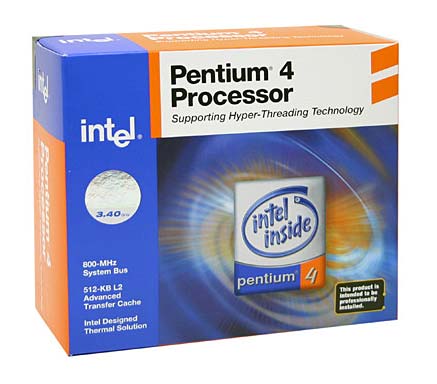
Despite the fact that cost is a secondary concern in recommendations for a High End system, it is still difficult to recommend the $1100 3.4GHz Pentium4 EE when the 3.4GHz P4C (Northwood) is 60% less with the same core and 512KB cache instead of 2.5MB. 250% seems a hefty premium for the extra cache when the impact on performance is fairly small. If you want the bragging rights that come with the top Intel CPU, then get the P4EE, but the 3.4C is our recommendation at about the same price as the AMD Athlon 64 3400+. Both offer similar performance in today's applications depending on exactly which applications you use. For Desktop Applications, the 3.4C and 3400+ are virtually equal. If you do a lot of encoding, then the pendulum tilts toward the 3.4C over the 3400+ for now. If you're a gamer, the Athlon 64 3400+ is a better performer in most games. If 64-bit capabilities matter to you, then the AMD Athlon 64 is your only option. We suggest that you research which processor fits you best. A good place to start is at AnandTech's latest CPU article.
One advantage of a Pentium 4 is Hyper Threading, which makes a single processor behave like two multiple processors in some ways. Hyper Threading can increase performance substantially in multi-tasking situations, but the impact is less noticeable as clock speed increases. In today's applications, HT does not offer much benefit, though this may change in some future applications.
Intel seemed to design their labeling system to utterly confuse the buyer, so it is worth some efforts to clear the misunderstandings. An Intel Pentium 4 labeled with a "C" after its core clock speed (3.4C, in this case) is based on the Northwood core, has 512K of L2 cache, and is built on (mostly) 0.13-micron technology. A Pentium 4 labeled with an "E" after its core clock speed (3.4E for example) is based on the Prescott core, has 1MB of L2 cache, and is built on (mostly) 0.09-micron technology. Finally, a Pentium 4 labeled with an "EE" after its core clock speed (3.4EE, for example) is based on the Northwood core, has 512K of L2 cache plus 2MB of L3 cache, and is built on (mostly) 0.13-micron technology. The C, E, and EE Pentium 4 processors all run at 800MHz FSB and are dual channel DDR capable. While the future for Intel is slated to be the Prescott CPU, the slower speed and heat make the Prescott a difficult choice over the Northwood at current speeds. Performance becomes less an issue as speed increases and the heat issue is also improving. Next month's Socket 775 CPU from Intel will be Prescott-based and we have already seen that Prescott optimizations in the chipset can provide a big boost on Prescott Performance. The point here is this: Intel is constantly refining the Prescott, as they did with the original Pentium 4, so Prescott must be considered a work-in-progress that is getting better every day.
One of the most amazing turnarounds in the computer industry has been DFI. The large OEM partner decided to go after the enthusiast market with their own brand and transformed themselves from "Diamond Flower International" into "Designed For Innovation". It takes real performance to achieve this kind of transition and DFI has delivered this in spades in their LAN Party motherboard series.
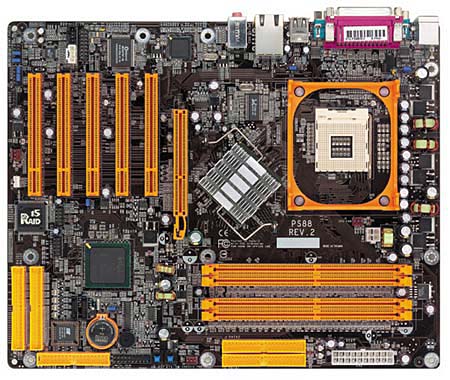
The LAN Party 875B is an excellent and flexible home for a 3.4C, particularly in the latest Rev. B version. The Asus P4C800-E and DFI 875B LAN Party seems to make every recommended list as the top two motherboards for Intel enthusiasts because they are both solid performers at stock speeds and they both are capable of incredible performance with the fastest memory and Intel processors on the market. Our nod for top end system goes to the DFI because high end systems should stand out in some way, such as incredible performance or incredible looks. The DFI has both and you certainly will notice this motherboard as it is also unique to look at, particularly under black light. The 875B LAN Party also does the eye-candy trick without giving up anything in performance or flexibility.
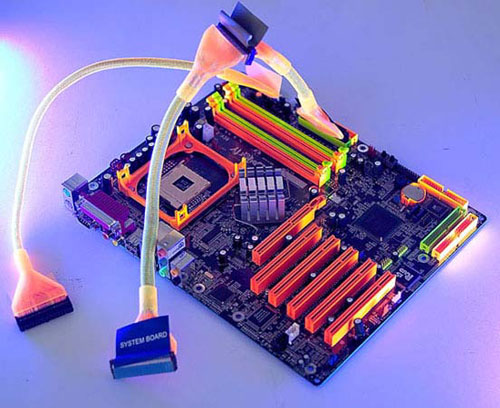
While the price of the DFI is toward the high end, it includes matching glowing cables, a Front-X box for front ports, and a PC Transport to carry your PC. All these features would cost quite a bit extra if you had to buy them on the side, so there is definitely value in the DFI 875B. If the extras don't matter much to you, the same basic board is available as the DFI 875P Infinity for about $40 less. Revision B of the DFI has a greater range of adjustments than the original LAN Party and it also sports CMOS reloaded, a unique feature allowing several custom BIOS setups to be saved and selected in CMOS. All the top-end features are here with the notable exception of Firewire, so if you require Firewire, choose another board or add a Firewire PCI card. In addition to all the high-end goodies in the LAN Party box, there is an impressive feature list that includes Intel SATA RAID, Intel Gigabit CSA LAN, High Point 4-device IDE RAID supporting RAID 0, 1, 0+1, and 1.5 (a method to stripe and mirror using just 2 drives), 6-channel audio featuring the CMedia CMI9739A chip and a SPDIF IO bracket, and 8 USB 2.0 ports. End users who own the 875 LAN Party tell us that it is bullet-proof and one of the most stable motherboards they have ever owned - always a great recommendation for a high end motherboard.
Listed below is part of our RealTime pricing engine, which lists the lowest prices available on the Intel CPUs and motherboards from many different reputable vendors:
If you cannot find the lowest prices on the products that we've recommended on this page, it's because we don't list some of them in our RealTime pricing engine. Until we do, we suggest that you do an independent search online at the various vendors' web sites. Just pick and choose where you want to buy your products by looking for a vendor located under the "Vendor" heading.
Originally published at https://www.anandtech.com/show/1331 (Wayback Machine).