
The Silicon Motion SM2262EN SSD Controller Preview: Good And Bad Amplified
Power Management Features
Real-world client storage workloads leave SSDs idle most of the time, so the active power measurements presented earlier in this review only account for a small part of what determines a drive's suitability for battery-powered use. Especially under light use, the power efficiency of a SSD is determined mostly be how well it can save power when idle.
For many NVMe SSDs, the closely related matter of thermal management can also be important. M.2 SSDs can concentrate a lot of power in a very small space. They may also be used in locations with high ambient temperatures and poor cooling, such as tucked under a GPU on a desktop motherboard, or in a poorly-ventilated notebook.
| SM2262EN Reference Design NVMe Power and Thermal Management Features |
|||
| Controller | Silicon Motion SM2262EN | ||
| Firmware | SVN112 | ||
| NVMe Version |
Feature | Status | |
| 1.0 | Number of operational (active) power states | 3 | |
| 1.1 | Number of non-operational (idle) power states | 2 | |
| Autonomous Power State Transition (APST) | Supported | ||
| 1.2 | Warning Temperature | 70 °C | |
| Critical Temperature | 80 °C | ||
| 1.3 | Host Controlled Thermal Management | Not Supported | |
| Non-Operational Power State Permissive Mode | Not Supported | ||
The pre-production firmware on our SM2262EN sample doesn't implement any of the NVMe 1.3 power or thermal management features, even though the current retail SM2262 drives support Host Controlled Thermal Management. The supported power states are unchanged from those on retail SM2262 drives.
| SM2262EN Reference Design NVMe Power States |
|||||
| Controller | Silicon Motion SM2262EN | ||||
| Firmware | SVN112 | ||||
| Power State |
Maximum Power |
Active/Idle | Entry Latency |
Exit Latency |
|
| PS 0 | 9.0 W | Active | - | - | |
| PS 1 | 4.6 W | Active | - | - | |
| PS 2 | 3.8 W | Active | - | - | |
| PS 3 | 45 mW | Idle | 2 ms | 2 ms | |
| PS 4 | 4 mW | Idle | 6 ms | 8 ms | |
Note that the above tables reflect only the information provided by the drive to the OS. The power and latency numbers are often very conservative estimates, but they are what the OS uses to determine which idle states to use and how long to wait before dropping to a deeper idle state.
Idle Power Measurement
SATA SSDs are tested with SATA link power management disabled to measure their active idle power draw, and with it enabled for the deeper idle power consumption score and the idle wake-up latency test. Our testbed, like any ordinary desktop system, cannot trigger the deepest DevSleep idle state.
Idle power management for NVMe SSDs is far more complicated than for SATA SSDs. NVMe SSDs can support several different idle power states, and through the Autonomous Power State Transition (APST) feature the operating system can set a drive's policy for when to drop down to a lower power state. There is typically a tradeoff in that lower-power states take longer to enter and wake up from, so the choice about what power states to use may differ for desktop and notebooks.
We report two idle power measurements. Active idle is representative of a typical desktop, where none of the advanced PCIe link or NVMe power saving features are enabled and the drive is immediately ready to process new commands. The idle power consumption metric is measured with PCIe Active State Power Management L1.2 state enabled and NVMe APST enabled if supported.
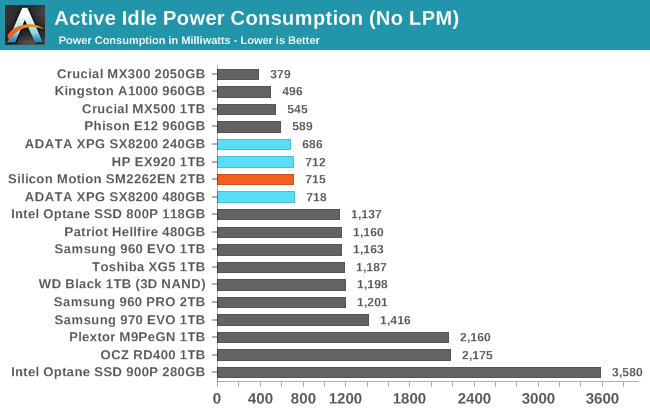
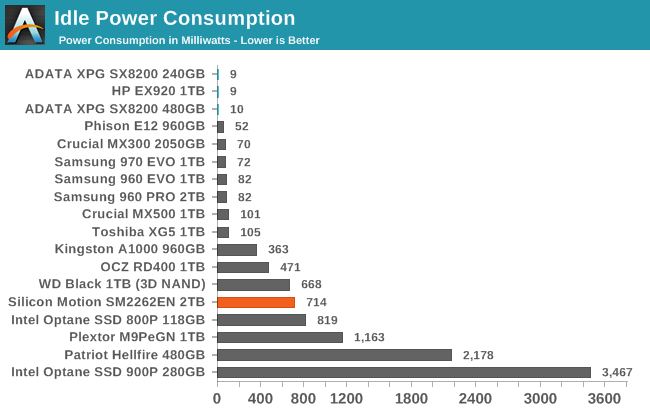
The active idle power consumption of the SM2262EN is the same as the SM2262, which is still pretty good by the standards of NVMe SSDs. However, the idle sleep states are broken on this drive, so turning on APST or even manually instructing the drive to enter one of its non-operational power states has no effect. This is a disappointing regression from the excellent power management we've seen from the SM2262, but I'm confident this issue can be fixed before drives hit the market.
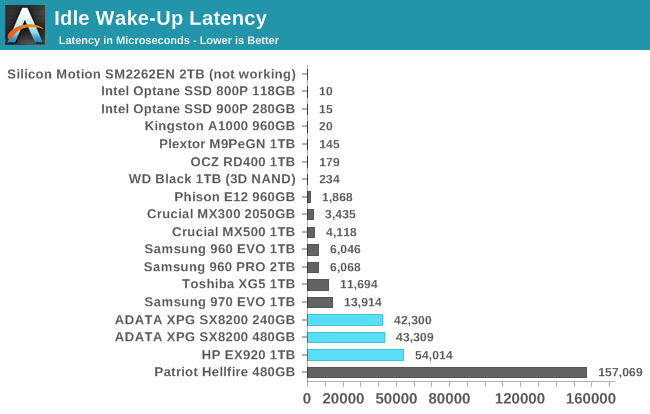
With idle power management currently broken on the SM2262EN, we can't see whether Silicon Motion has improved the wake-up latency. It's a bit high for the SM2262 drives, but since they also offer the best idle power on our testbed that can probably be forgiven.
Originally published at https://www.anandtech.com/show/13131/the-silicon-motion-sm2262en-ssd-controller-preview (Wayback Machine).