
The Silicon Motion SM2262EN SSD Controller Preview: Good And Bad Amplified
Random Read Performance
Our first test of random read performance uses very short bursts of operations issued one at a time with no queuing. The drives are given enough idle time between bursts to yield an overall duty cycle of 20%, so thermal throttling is impossible. Each burst consists of a total of 32MB of 4kB random reads, from a 16GB span of the disk. The total data read is 1GB.
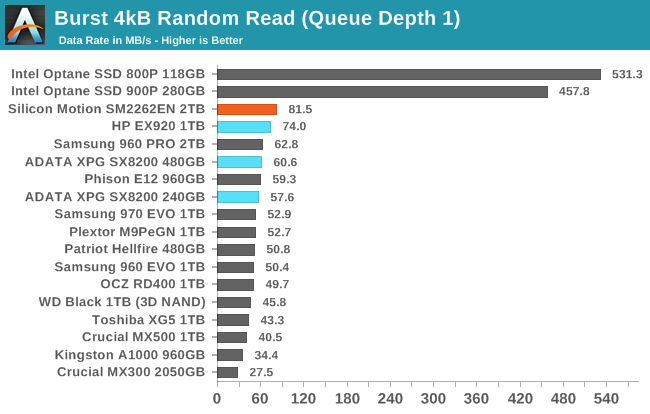
The 2TB SM2262EN drive expands on Silicon Motion's lead in random read performance with a 10% increase over the 1TB HP EX920's QD1 burst performance.
Our sustained random read performance is similar to the random read test from our 2015 test suite: queue depths from 1 to 32 are tested, and the average performance and power efficiency across QD1, QD2 and QD4 are reported as the primary scores. Each queue depth is tested for one minute or 32GB of data transferred, whichever is shorter. After each queue depth is tested, the drive is given up to one minute to cool off so that the higher queue depths are unlikely to be affected by accumulated heat build-up. The individual read operations are again 4kB, and cover a 64GB span of the drive.
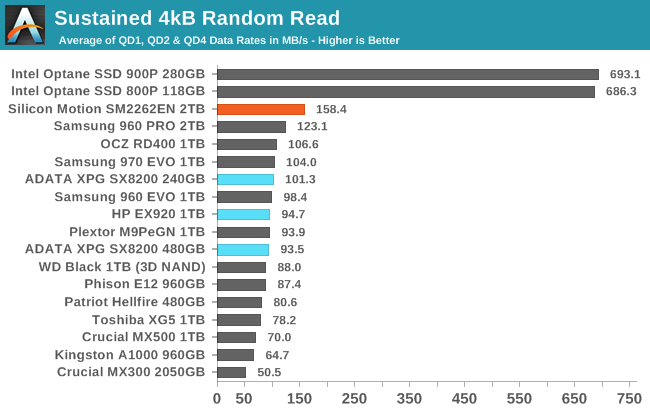
On the sustained random read test, the SM2262EN's standing is even better. Its predecessors were not able to beat the Samsung 970 PRO or MLC drives on the longer random read test, but the -EN does so with ease.
 |
|||||||||
| Power Efficiency in MB/s/W | Average Power in W | ||||||||
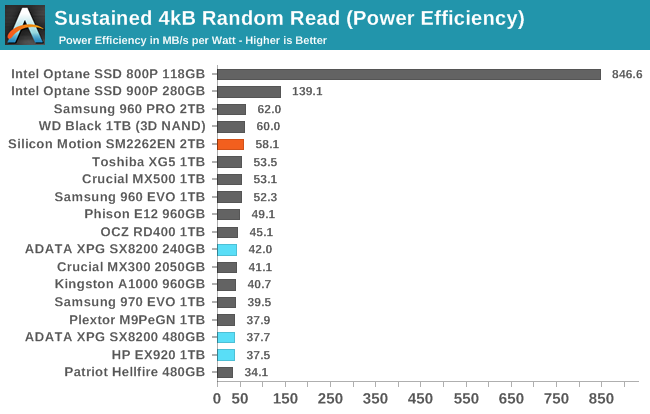
The power consumption of the SM2262EN is a bit higher than for the SM2262 drives, which makes it the most power-hungry M.2 drive in this batch. But the performance is high enough that the efficiency score climbs to almost tie the best flash-based SSDs while the older SM2262 drives had quite poor scores here.
 |
|||||||||
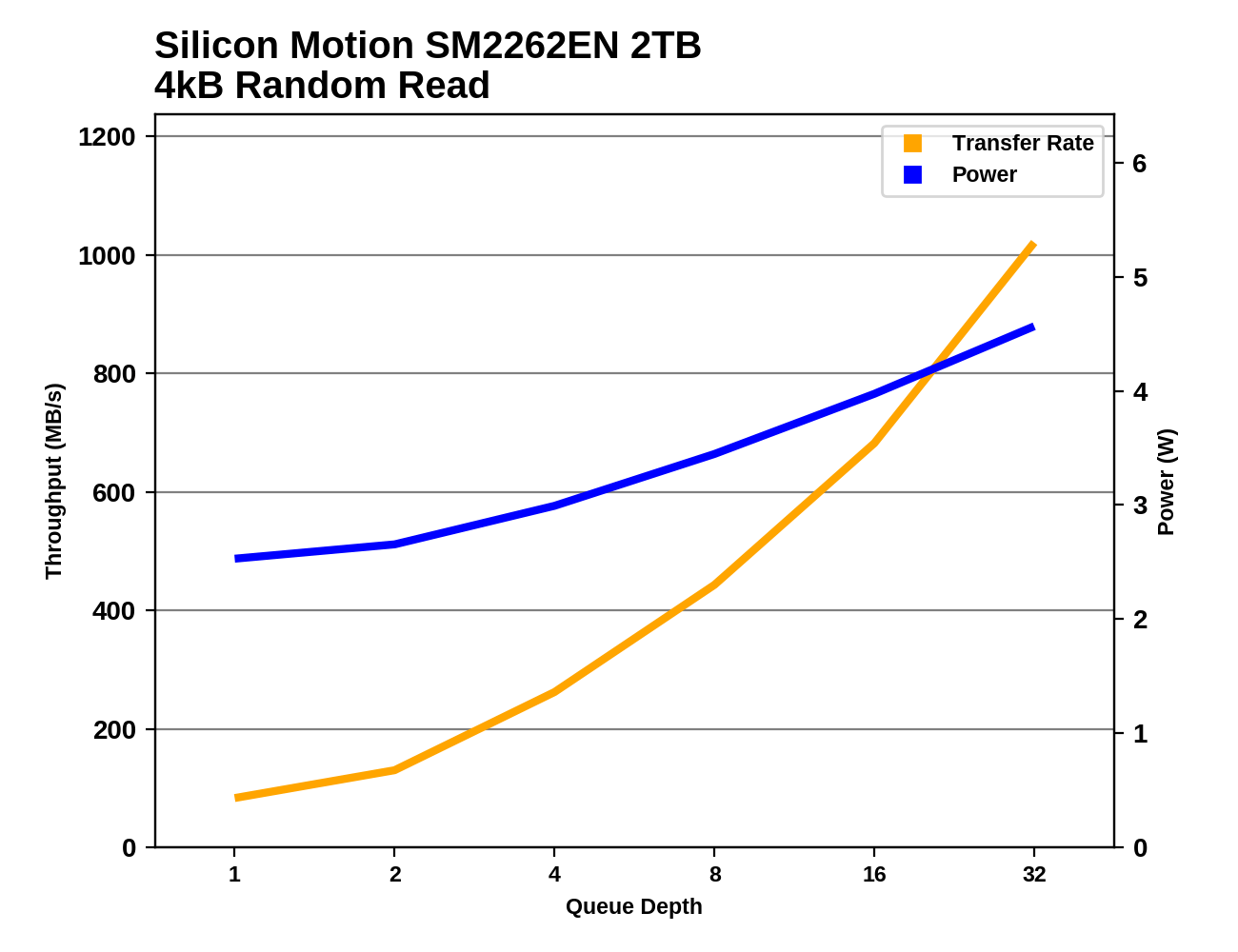
The SM2262EN's lead seems to be strongest at low queue depths, which is what's most important for consumer workloads. The Samsung 960 PRO passes the SM2262EN at QD8 and the 970 EVO and WD Black are closing in at higher queue depths. By QD32 the SM2262EN is approaching the throughput of Intel's Optane SSDs.
Random Write Performance
Our test of random write burst performance is structured similarly to the random read burst test, but each burst is only 4MB and the total test length is 128MB. The 4kB random write operations are distributed over a 16GB span of the drive, and the operations are issued one at a time with no queuing.
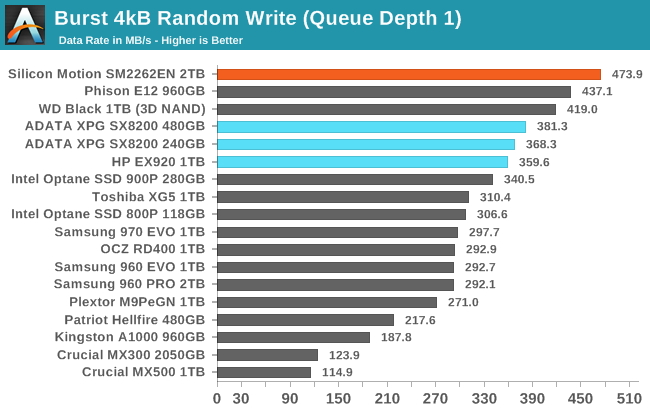
The SM2262EN takes first place in the burst random write test, showing that it has the fastest SLC write cache. It is 8% faster than the Phison E12 engineering sample we tested and 25-30% faster than the SM2262 drives we have tested.
As with the sustained random read test, our sustained 4kB random write test runs for up to one minute or 32GB per queue depth, covering a 64GB span of the drive and giving the drive up to 1 minute of idle time between queue depths to allow for write caches to be flushed and for the drive to cool down.
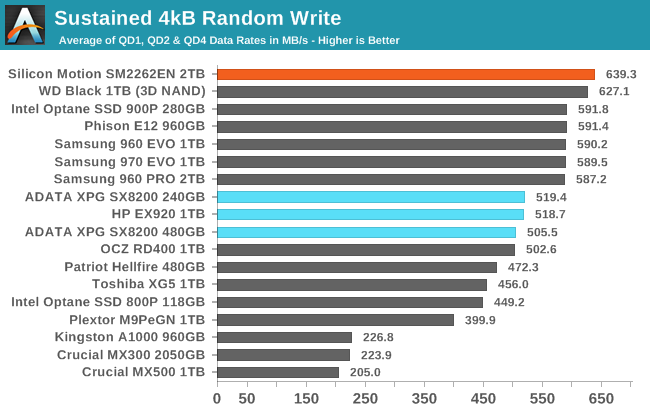
On the longer random write test, the SM2262EN hangs on to first place, though with a much narrower lead of about 2% over the WD Black. The test is still short enough to be working only with the SLC write cache for the 2TB SM2262EN drive.
 |
|||||||||
| Power Efficiency in MB/s/W | Average Power in W | ||||||||
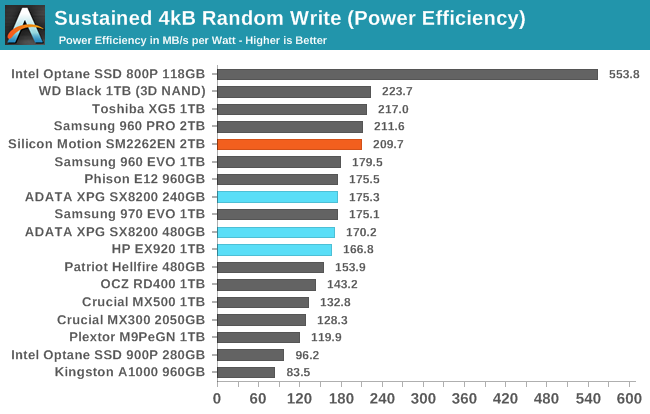
The performance boost the SM2262EN brings is enough to boost its efficiency score into the top tier, though it still isn't quite matching the efficiency of the WD Black. In absolute terms, power consumption is actually slightly lower than the 1TB HP EX920.
 |
|||||||||
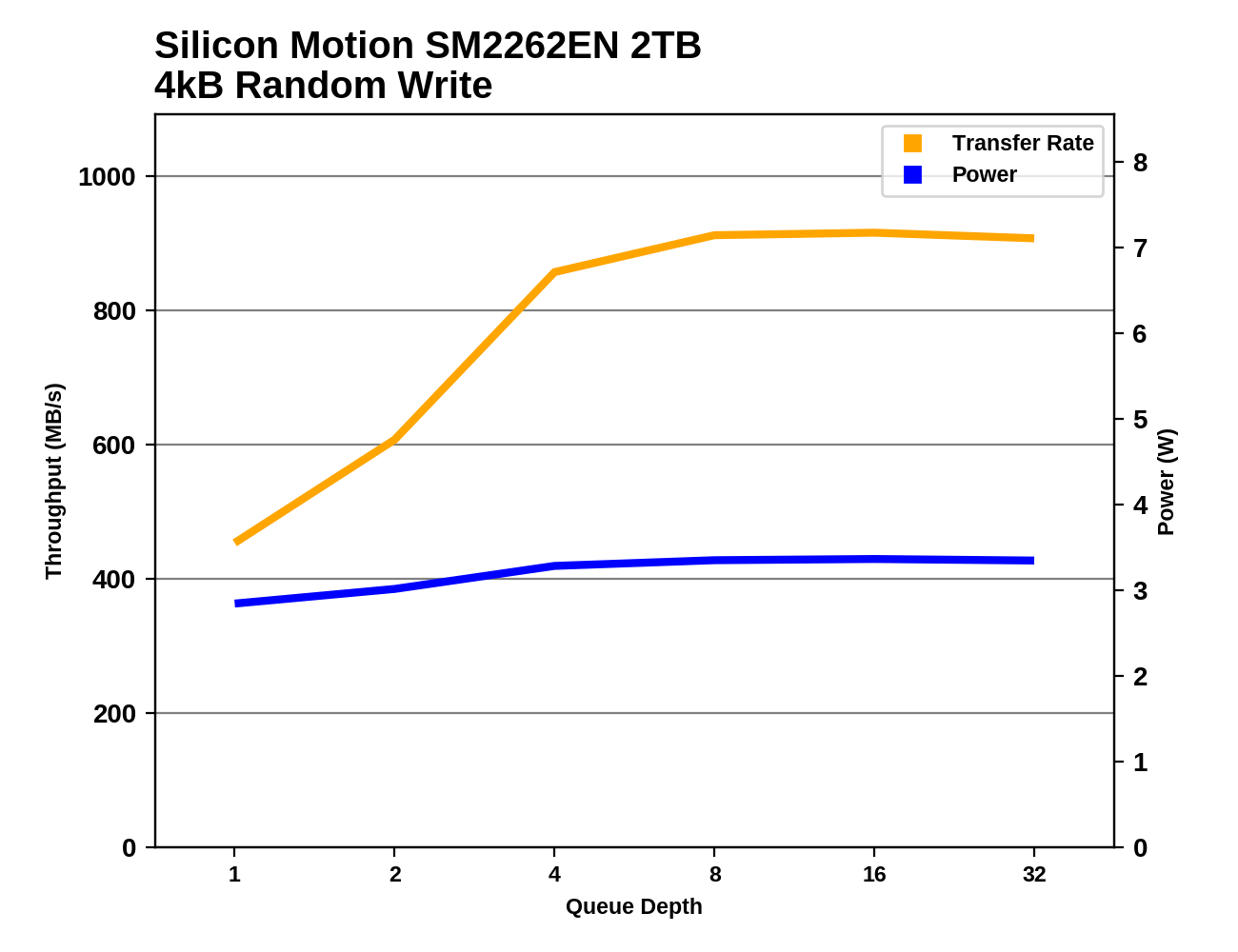
The SM2262EN has the best random write performance at low queue depths, but by QD4 the other top NVMe SSDs have caught up or slightly surpassed it. At QD8 and higher, performance holds steady and the SLC cache never gets entirely filled during this test.
Originally published at https://www.anandtech.com/show/13131/the-silicon-motion-sm2262en-ssd-controller-preview (Wayback Machine).