
The Phison E12 Reference Design Preview: A Next-Gen NVMe SSD Controller
AnandTech Storage Bench - The Destroyer
The Destroyer is an extremely long test replicating the access patterns of very IO-intensive desktop usage. A detailed breakdown can be found in this article. Like real-world usage, the drives do get the occasional break that allows for some background garbage collection and flushing caches, but those idle times are limited to 25ms so that it doesn't take all week to run the test. These AnandTech Storage Bench (ATSB) tests do not involve running the actual applications that generated the workloads, so the scores are relatively insensitive to changes in CPU performance and RAM from our new testbed, but the jump to a newer version of Windows and the newer storage drivers can have an impact.
We quantify performance on this test by reporting the drive's average data throughput, the average latency of the I/O operations, and the total energy used by the drive over the course of the test.
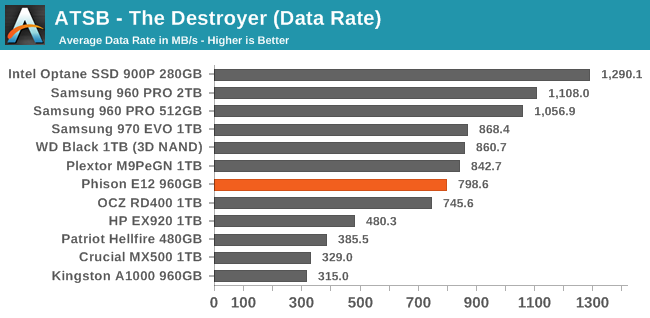
Starting off, the Phison E12 delivers a much higher average data rate on The Destroyer than their previous controllers, but it's not quite enough to match the top TLC-based drives on the market. Even the Plextor M9Pe with its aging Marvell 88SS1093 controller is a bit faster. On the other hand, the HP EX920 shows that Silicon Motion also has a lot of catching up to do with their next controller.
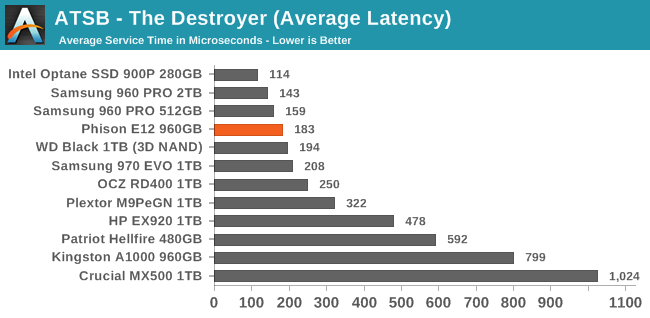
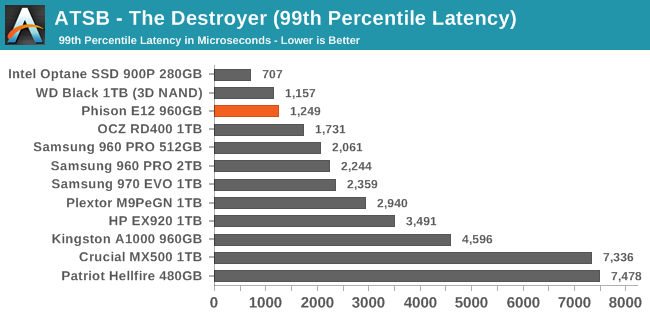
Average and 99th percentile latencies from the Phison E12 are among the best we've seen from a TLC-based SSD. Premium drives using 3D MLC or Intel's Optane SSDs can be a bit better, but with even 99th percentile latency approaching 1ms for TLC drives, there's not much room left for meaningful improvement on these scores.
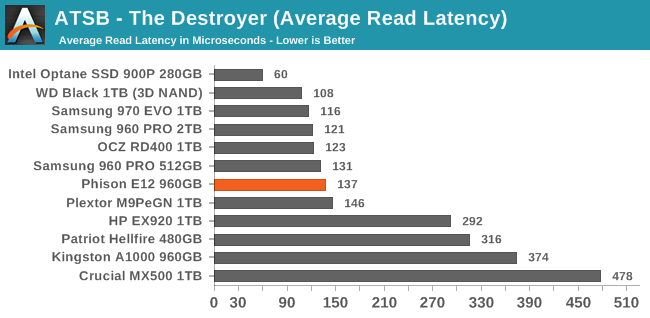
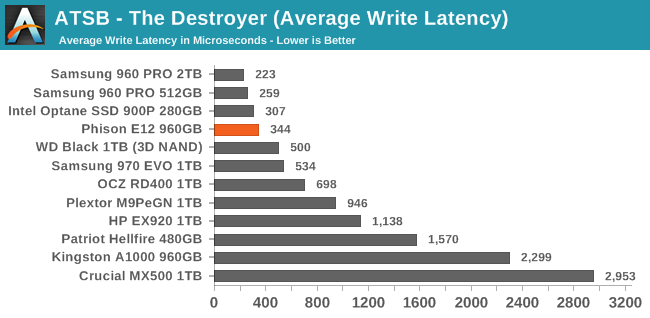
The average read latency from the Phison E12 is similar to most other high-end SSDs, but the average write latency is better than any other TLC-based SSD.
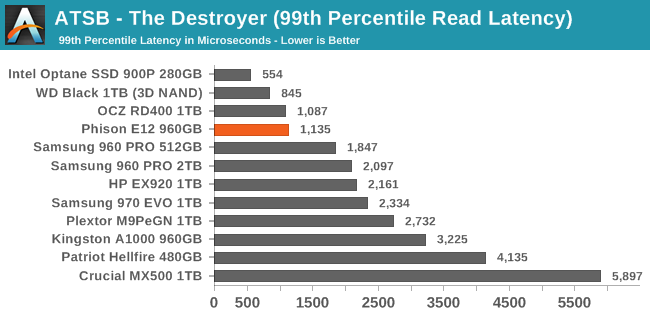
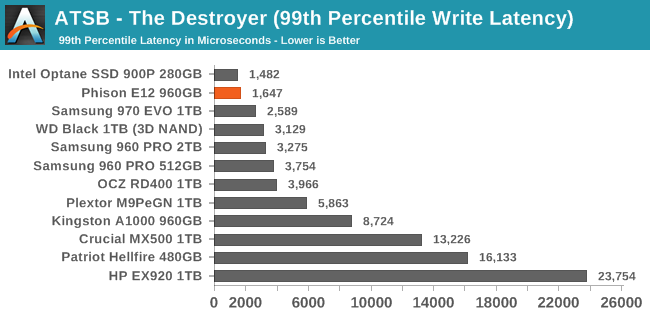
The Phison E12 turns in great scores for both 99th percentile read and write latency. The write latency particularly stands out, and it is clear that the E12 behaves well under pressure.
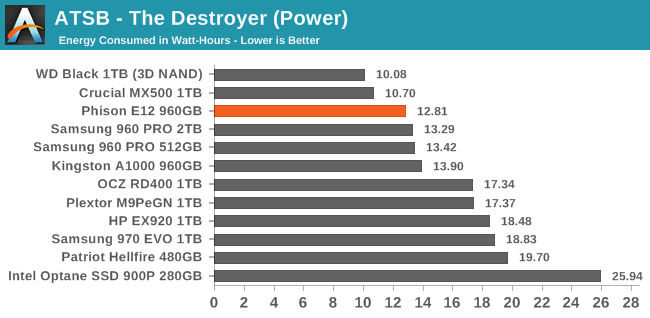
The Phison E12 uses far less energy on The Destroyer than the previous-generation E7-based Patriot Hellfire, and is a bit more efficient than the slower but lower-power E8-based Kingston A1000. The WD Black still holds a significant lead in power efficiency over all the other NVMe drives, but the E12 is making some progress toward that goal.
Originally published at https://www.anandtech.com/show/13080/the-phison-e12-nvme-ssd-controller-preview (Wayback Machine).