
AMD Ryzen 5 2400G and Ryzen 3 2200G Integrated Graphics Frequency Scaling
Ryzen 3 2200G Integrated Graphics Gaming Performance
As mentioned in the introduction, we overclocked both APUs from 1100 MHz to 1600 MHz in 50 MHz increments. With our gaming tests, we’re primarily concerned with the most common options associated with gaming including resolution; while the Ryzen APUs are marketed for 720p gaming, and while resolutions such as 2160p and 1440p are out of reach purely for performance reasons, we have opted to use moderate settings at 1080p for our testing. As also stated, frequencies between 1400 MHz and 1500 MHz have been omitted due to instability issues relating to a potential issue which we have reached out to AMD for; we will update when AMD respond to us regarding this.
Civilization 6
First up in our APU gaming tests is Civilization 6. Originally penned by Sid Meier and his team, the Civilzation series of turn-based strategy games are a cult classic, and many an excuse for an all-nighter trying to get Gandhi to declare war on you due to an integer underflow.

Truth be told I never actually played the first version, but every edition from the second to the sixth, including the fourth as voiced by the late Leonard Nimoy, it a game that is easy to pick up, but hard to master.
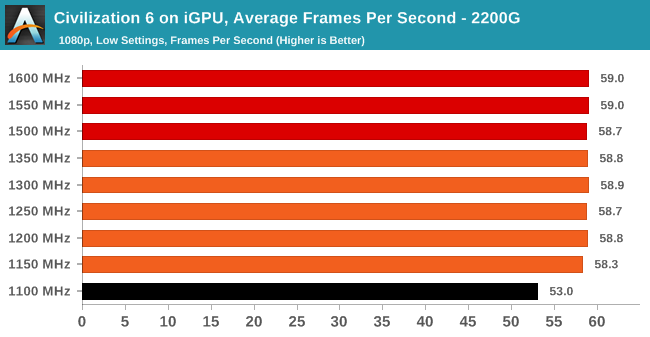
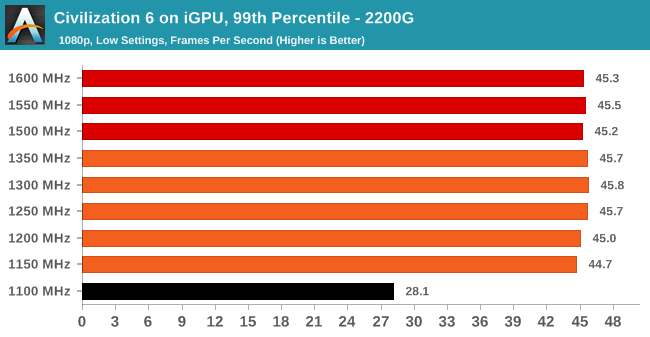
The 2200G experienced a jump of just over 11% from 1100 MHz to 1600 MHz in average frame rate performance. This signifies a modest increase, but like the 2400G did at 1250 MHz, the 99th frame time performance displayed seemed a little odd, although there was no major concerns.
Ashes of the Singularity (DX12)
Seen as the holy child of DX12, Ashes of the Singularity (AoTS, or just Ashes) has been the first title to actively go and explore as many of the DX12 features as it possibly can. Stardock, the developer behind the Nitrous engine which powers the game, has ensured that the real-time strategy title takes advantage of multiple cores and multiple graphics cards, in as many configurations as possible.

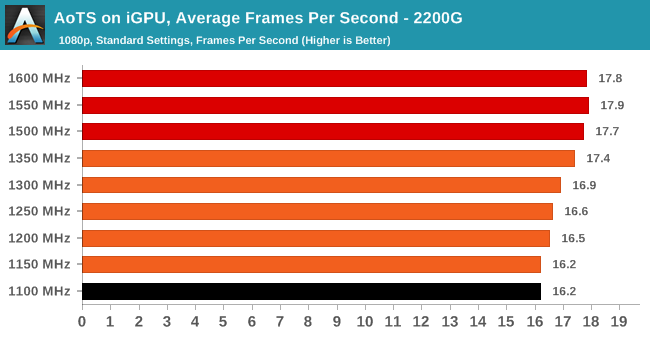
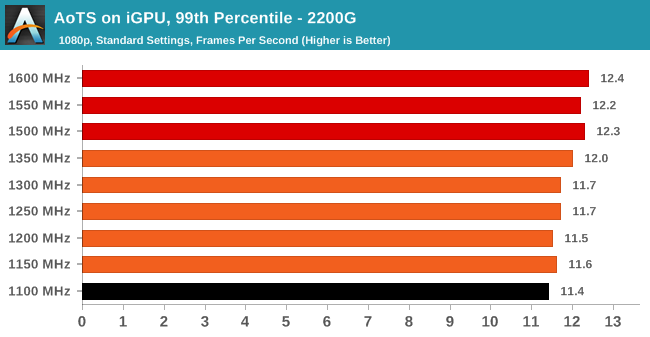
Ashes of the Singularity saw a persistent jump in average and 99th percentile frame rates with the 45% overclock from 1100 MHz to 1600 MHz yielding a 10% improvement in average frames on the 2200G; not mind blowing or game changing, but 10% is better than 0%.
Rise Of The Tomb Raider (DX12)
Rise of the Tomb Raider (RoTR), developed by Crystal Dynamics, and the sequel to the popular Tomb Raider which was loved for its automated benchmark mode. But don’t let that fool you: the benchmark mode in RoTR is very much different this time around. Visually, the previous Tomb Raider pushed realism to the limits with features such as TressFX, and the new RoTR goes one stage further when it comes to graphics fidelity.

This leads to an interesting set of requirements in hardware: some sections of the game are typically GPU limited, whereas others with a lot of long-range physics can be CPU limited, depending on how the driver can translate the DirectX 12 workload.
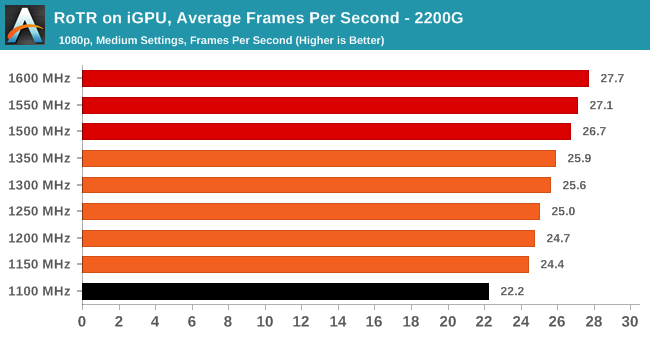
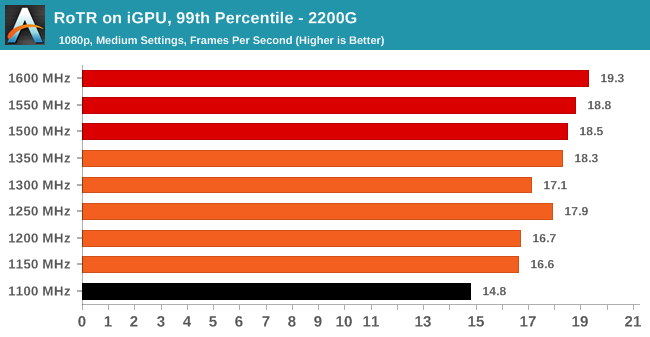
The Ryzen 3 2200G produced its biggest gains in Rise of the Tomb Raider with a massive increase of just under 25% in average frame rates and an even better 30% bump in 99th percentile frames.
Originally published at https://www.anandtech.com/show/13041/amd-ryzen-5-2400g-and-ryzen-3-2200g-integrated-graphics-frequency-scaling (Wayback Machine).