
The Kingston A1000 NVMe SSD Review: Phison E8 Revisited
AnandTech Storage Bench - The Destroyer
The Destroyer is an extremely long test replicating the access patterns of very IO-intensive desktop usage. A detailed breakdown can be found in this article. Like real-world usage, the drives do get the occasional break that allows for some background garbage collection and flushing caches, but those idle times are limited to 25ms so that it doesn't take all week to run the test. These AnandTech Storage Bench (ATSB) tests do not involve running the actual applications that generated the workloads, so the scores are relatively insensitive to changes in CPU performance and RAM from our new testbed, but the jump to a newer version of Windows and the newer storage drivers can have an impact.
We quantify performance on this test by reporting the drive's average data throughput, the average latency of the I/O operations, and the total energy used by the drive over the course of the test.
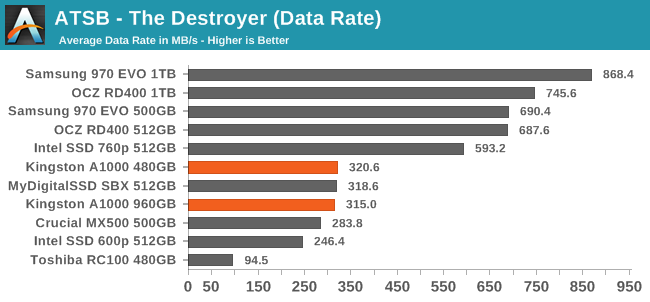
The average data rates from the Kingston A1000 on The Destroyer are only slightly above that of mainstream SATA SSDs. There's also essentially no performance difference between capacities, which isn't too surprising because even the 480GB model has plenty of NAND flash chips to keep all four channels of the controller busy. Performance differences from the MyDigitalSSD SBX are negligible.
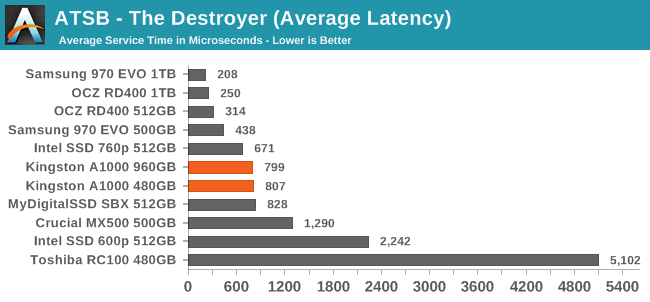
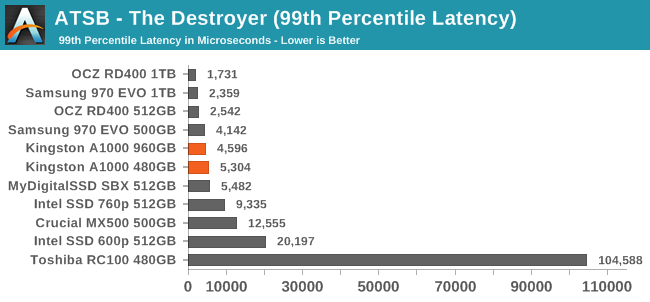
The average and 99th percentile latency scores from the Kingston A1000 are substantially lower than for SATA drives or other low-end NVMe drives like the Intel 600p and Toshiba RC100. The A1000 also has very slightly lower latency than the MyDigitalSSD SBX. Some of the more expensive PCIe x4 NVMe SSDs offer much better average latency, but for 99th percentile latency the A1000 is just a factor of two or three away from the best flash-based drives.
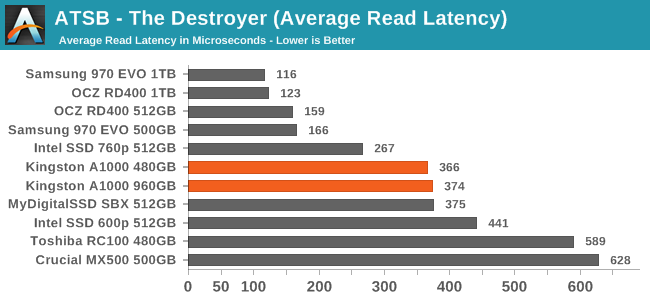
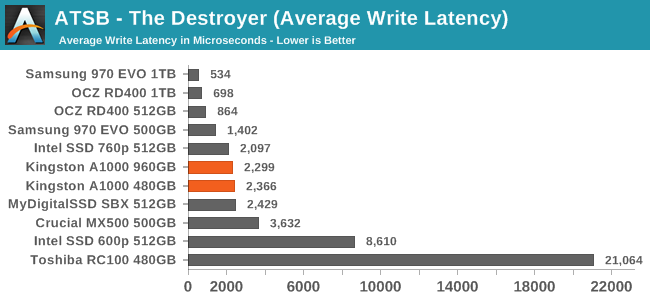
Average read latencies from the A1000 aren't as good as the best NVMe SSDs, but they're still just a fraction of a millisecond and clearly faster than typical SATA drives. Average write latency is much higher than the best NVMe drives but still reasonable for a low-end NVMe drive, with none of the severe write performance problems seen with the Intel 600p and Toshiba RC100.
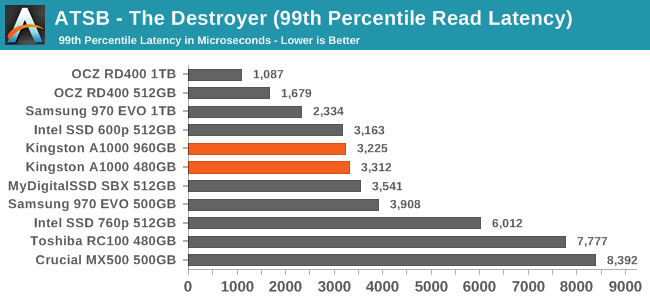
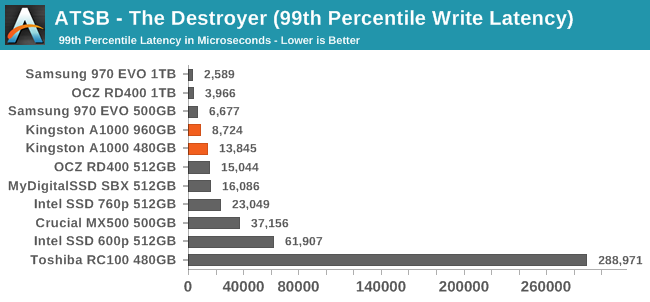
The 99th percentile read and write latencies from the Kingston A1000 are about as good as can be expected from a TLC-based drive; it even manages to slightly beat the Samsung 970 EVO for reads. The larger 960GB A1000 model has a substantially better 99th percentile write latency than the 480GB model.
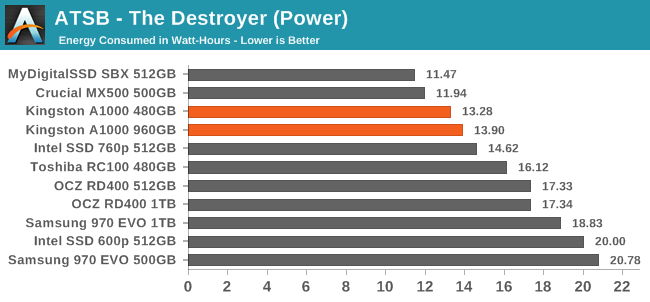
The larger 960GB Kingston A1000 uses a bit more energy over the course of The Destroyer than the 480GB model, and both use substantially more energy than the MyDigitalSSD SBX or the Crucial MX500. However, the A1000's power efficiency still compares favorably against the high-end PCIe x4 NVMe SSDs or the low-end NVMe SSDs that perform particularly badly on this long, intense test.
Originally published at https://www.anandtech.com/show/12991/the-kingston-a1000-nvme-ssd-review (Wayback Machine).