
ASRock DeskMini Z370 GTX1060 Review: A Compact Coffee Lake Gaming PC
Networking and Storage Performance
Networking and storage are two major aspects which influence our experience with any computing system. This section presents results from our evaluation of these aspects in the ASRock DeskMini Z370 GTX1060. On the storage side, one option would be repetition of our strenuous SSD review tests on the drive(s) in the PC. Fortunately, to avoid that overkill, PCMark 8 has a storage bench where certain common workloads such as loading games and document processing are replayed on the target drive. Results are presented in two forms, one being a benchmark number and the other, a bandwidth figure. We ran the PCMark 8 storage bench on selected PCs and the results are presented below.
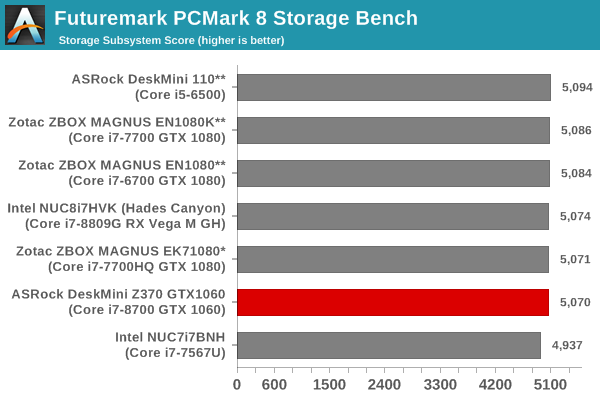
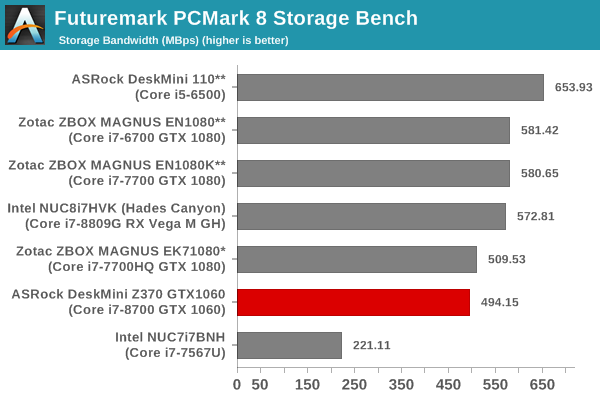
Almost all the systems scoring higher than the DeskMini Z370 have scores not impacted by the Spectre / Meltdown patches. Only the Hades Canyon NUC is better with the same patch status as the DeskMini Z370. This makes sense, given the responsiveness of the Optane stick in the NUC compared to the MLC NVMe SSD in the DeskMini Z370 GTX1060.
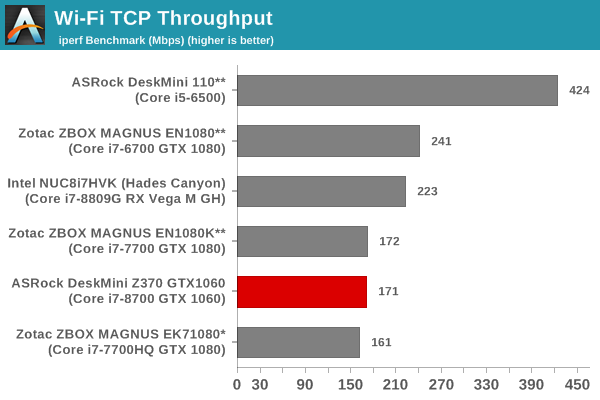
On the networking side, we restricted ourselves to the evaluation of the WLAN component. Our standard test router is the Netgear R7000 Nighthawk configured with both 2.4 GHz and 5 GHz networks. The router is placed approximately 20 ft. away, separated by a drywall (as in a typical US building). A wired client is connected to the R7000 and serves as one endpoint for iperf evaluation. The PC under test is made to connect to either the 5 GHz (preferred) or 2.4 GHz SSID and iperf tests are conducted for both TCP and UDP transfers. It is ensured that the PC under test is the only wireless client for the Netgear R7000. We evaluate total throughput for up to 32 simultaneous TCP connections using iperf and present the highest number in the graph below.
In the UDP case, we try to transfer data at the highest rate possible for which we get less than 1% packet loss.
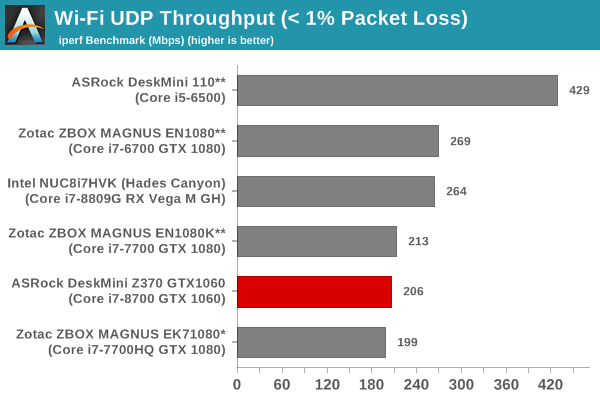
The 1x1 solution (AC3165) performs as expected, similar to the other 1x1 solutions in the Zotac PCs. Moving up the benchmark graphs requires a more capable WLAN module, a cost that ASRock understandably not want in this gaming-focused system. In any case, the WLAN module is easily replaceable, if the user needs better performance in this segment.
Originally published at https://www.anandtech.com/show/12934/asrock-deskmini-z370-gtx1060-review (Wayback Machine).