
The Toshiba RC100 SSD Review: Tiny Drive In A Big Market
Mixed Random Performance
Our test of mixed random reads and writes covers mixes varying from pure reads to pure writes at 10% increments. Each mix is tested for up to 1 minute or 32GB of data transferred. The test is conducted with a queue depth of 4, and is limited to a 64GB span of the drive. In between each mix, the drive is given idle time of up to one minute so that the overall duty cycle is 50%.
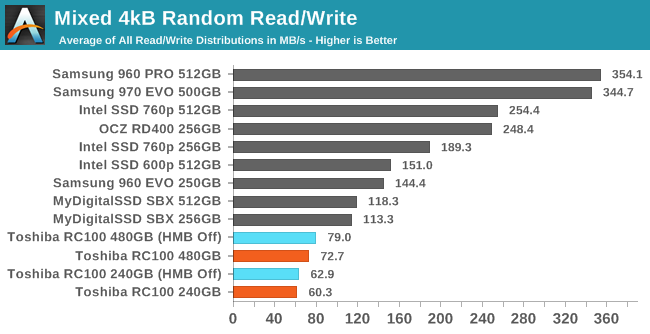
Mixed workloads are often the toughest for DRAMless SSDs, and with this mixed random I/O test covering 64GB of the drive, the Toshiba RC100's Host Memory Buffer is of little use. The RC100 is substantially slower than other NVMe drives on this test.
 |
|||||||||
| Power Efficiency in MB/s/W | Average Power in W | ||||||||
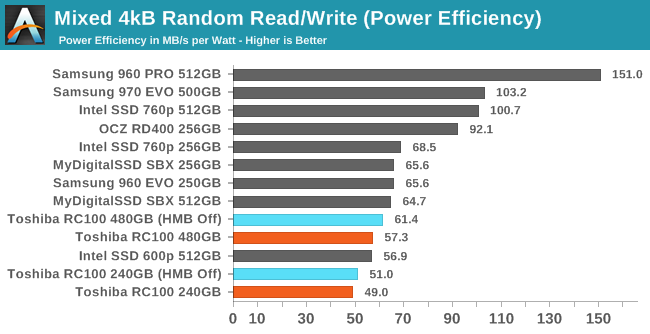
Power efficiency from the RC100 during the mixed random I/O test is also poor, but it's not a significant outlier compared from the competition. Total power consumption is half a Watt lower than any of the other NVMe drives.
 |
|||||||||
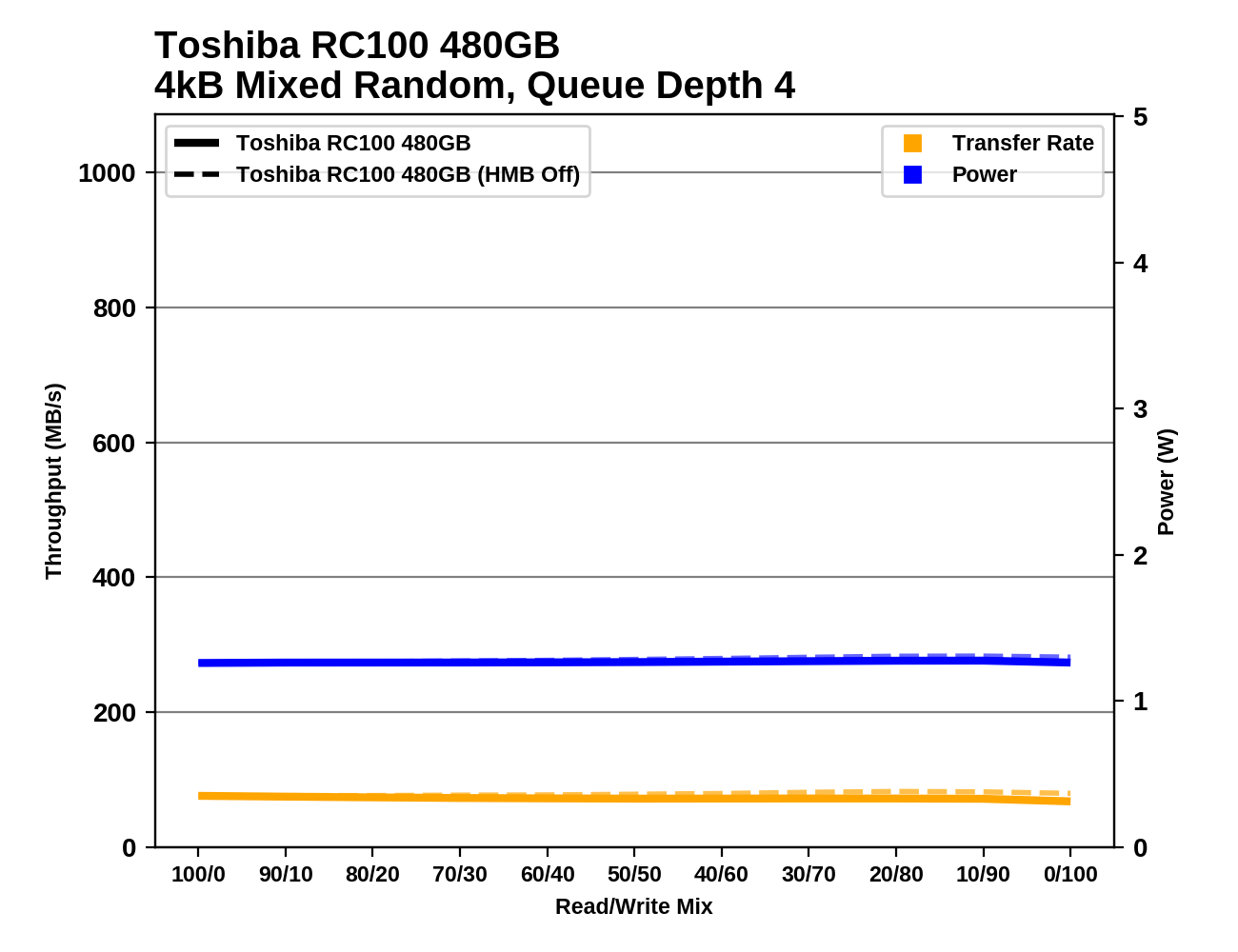
The performance and power consumption of the Toshiba RC100 are remarkably constant across the varying workload of this test. There's no sign of improved performance as the fraction of writes increases, which gives most SSDs the opportunity to perform more write combining.
Mixed Sequential Performance
Our test of mixed sequential reads and writes differs from the mixed random I/O test by performing 128kB sequential accesses rather than 4kB accesses at random locations, and the sequential test is conducted at queue depth 1. The range of mixes tested is the same, and the timing and limits on data transfers are also the same as above.
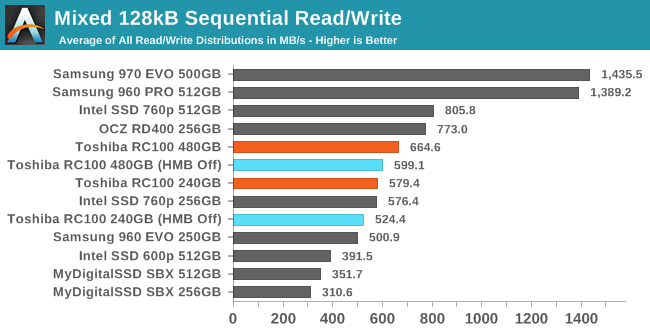
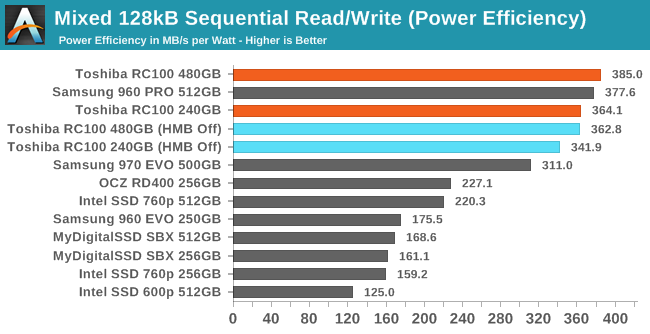
On the mixed sequential I/O test, the Toshiba RC100 is a decent performer with an average that exceeds what any SATA SSD is capable of. HMB is a bit of help here because the sequential access pattern is very cache-friendly even though the test spans a wider range of data than the cache can track.
 |
|||||||||
| Power Efficiency in MB/s/W | Average Power in W | ||||||||
The Toshiba RC100's power efficiency on the mixed sequential I/O test is great with or without HMB. The RC100 is clearly much slower than the high-end drives, but its power consumption is reduced proportionally.
 |
|||||||||
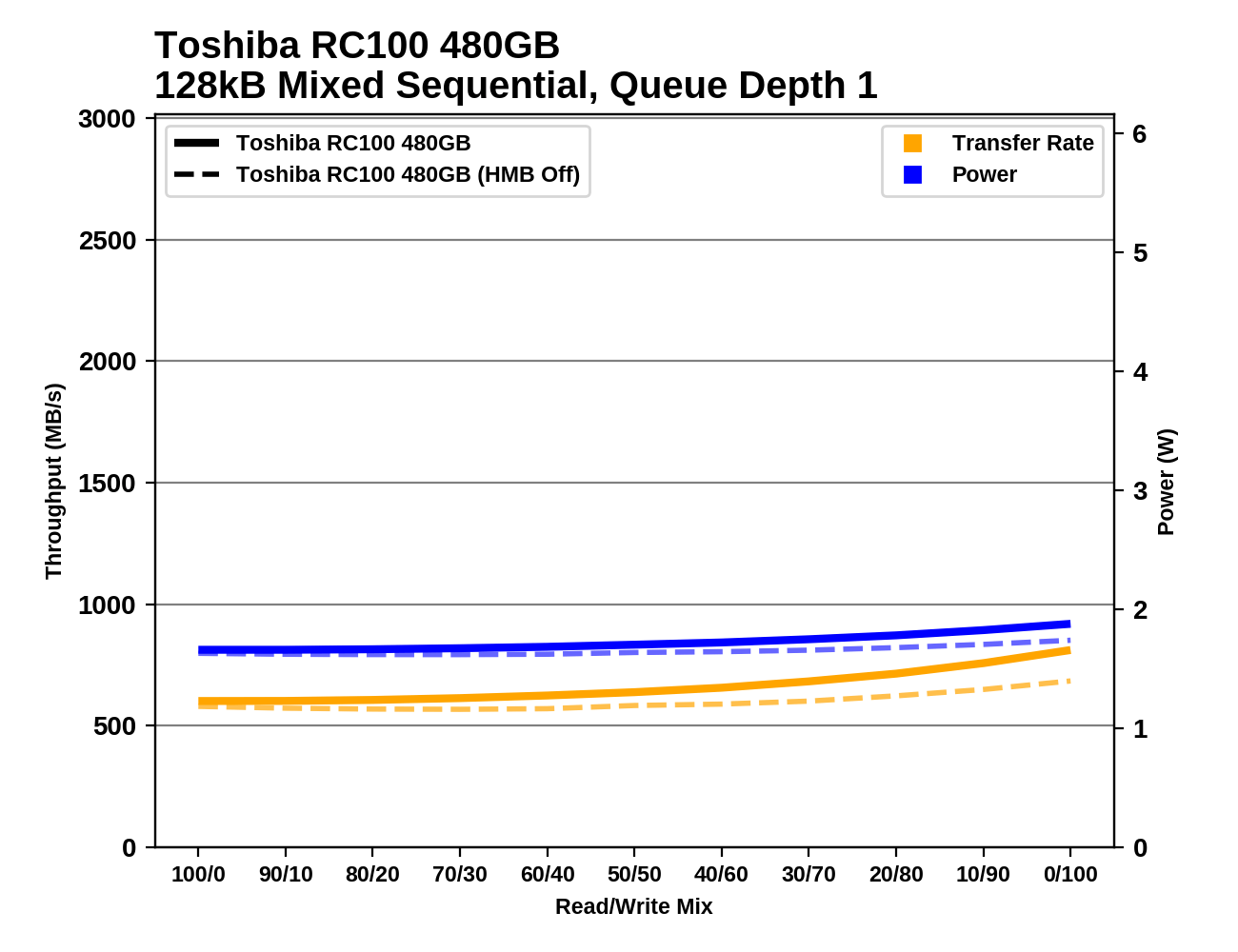
The performance and power consumption of the Toshiba RC100 are not quite as flat on the mixed sequential test as for the mixed random I/O test. The RC100 gets a bit faster as the workload shifts toward writes, and HMB becomes more beneficial with increasing write volume.
Originally published at https://www.anandtech.com/show/12819/the-toshiba-rc100-ssd-review (Wayback Machine).