
The Intel Optane Memory M10 (64GB) Review: Optane Caching Refreshed
AnandTech Storage Bench - Light
Our Light storage test has relatively more sequential accesses and lower queue depths than The Destroyer or the Heavy test, and it's by far the shortest test overall. It's based largely on applications that aren't highly dependent on storage performance, so this is a test more of application launch times and file load times. This test can be seen as the sum of all the little delays in daily usage, but with the idle times trimmed to 25ms it takes less than half an hour to run. Details of the Light test can be found here. As with the ATSB Heavy test, this test is run with the drive both freshly erased and empty, and after filling the drive with sequential writes.
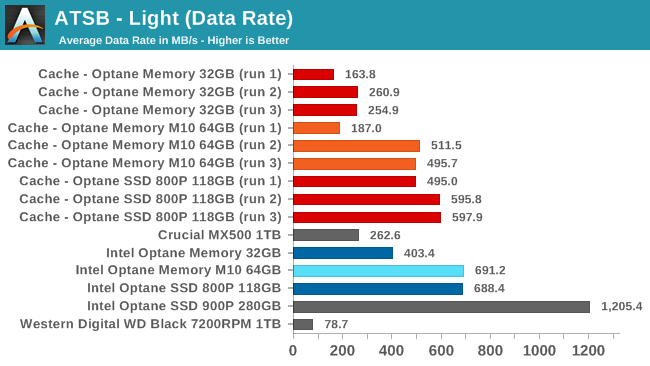
The data rates on the Light test show clear signs of a cold cache on the first run, with substantially improved performance for the second and third runs. The 32GB cache module is still a bit small for this test and it can only bring the data rates up to about the level of a SATA SSD, but the 64GB and 118GB modules allow for performance that almost matches low-end NVMe SSDs like the MyDigitalSSD SBX (and without the capacity limitations or steep performance drop when full).
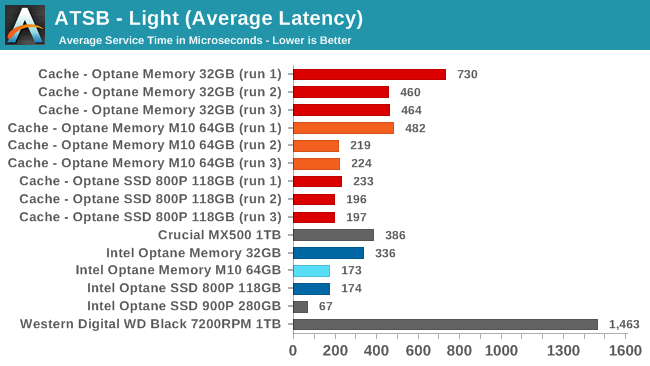
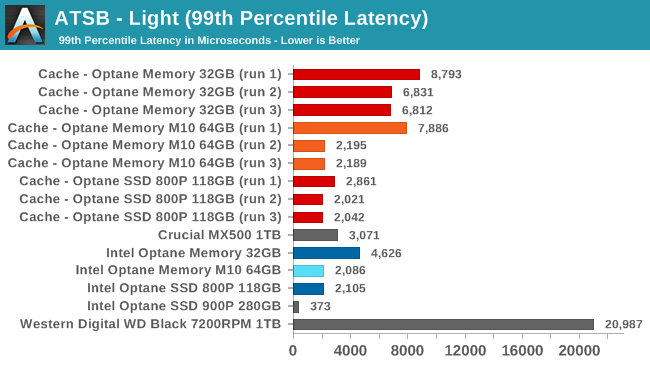
With a warmed-up cache, the Optane Memory M10 64GB and the larger Optane SSD 800P offer better average and 99th percentile latency than SATA SSDs. The 118GB cache beats the SATA drives even with a cold cache. The 32GB Optane Memory is well behind the SATA SSD even with a warm cache, especially for 99th percentile latency. But even so, all of these cache configurations easily beat running on just a hard drive.
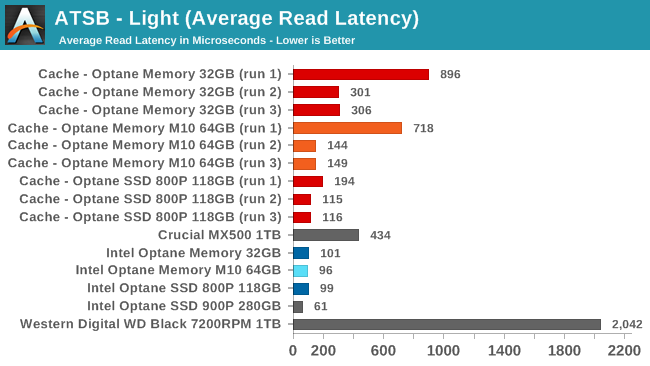
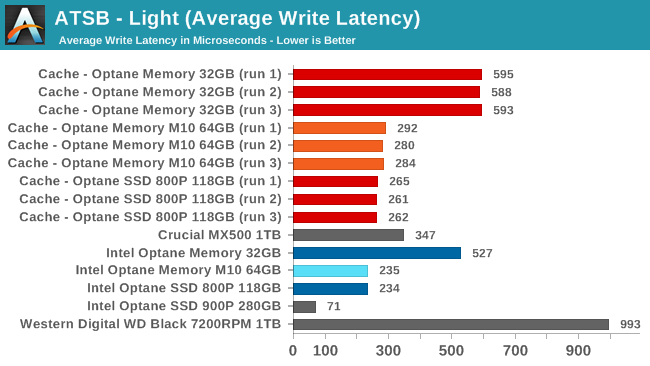
The effects of a cold vs. warm cache show up quite clearly on the average read latency chart, but naturally have minimal effect on the average write latencies. It is clear that the 32GB Optane Memory's overall latency fell behind that of the SATA SSD almost entirely because of poor write performance: with a warm cache, the read latency of the 32GB module is slower than that of its larger siblings but is still an improvement over the SATA SSD.
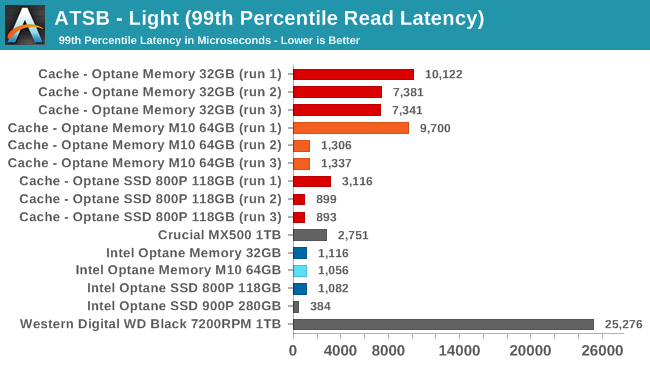
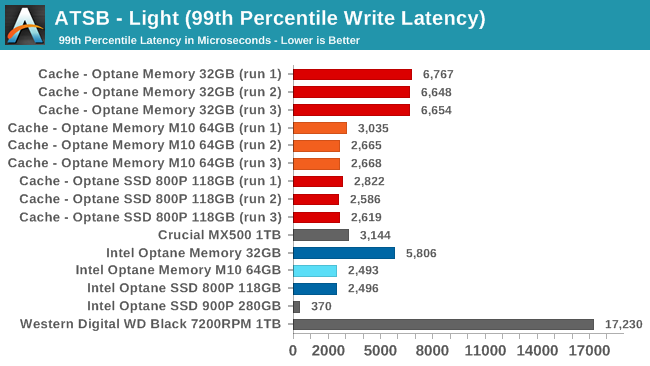
The 99th percentile read latency scores emphasize the impact of a cold cache more than the average latency, especially for the 64GB cache module. Even the 118GB cache lags behind the SATA SSD on the first run. The 99th percentile write latencies are larger in absolute terms than the average write latencies, but the relative differences are almost all the same except that the hard drive stands out even more.
Originally published at https://www.anandtech.com/show/12748/the-intel-optane-memory-m10-64gb-review-optane-caching-refreshed (Wayback Machine).