
Intel NUC8i7HVK (Hades Canyon) Gaming Performance - A Second Look
Futuremark VRMark
VRMark is Futuremark's virtual reality benchmark. Its workloads are termed as 'rooms', with each one being a piece of VR content designed to require a specific level of VR performance. The VRMark Professional Edition v1.2.1701 comes with three rooms. Each room can be run either in desktop or HMD mode, with varying minimum requirements for the same workload. The benchmark results include the average FPS achieved, and a score based on the FPS. A pass or fail indicator is also provided based on whether the average FPS exceeds the required FPS. In this section, we take a look at the performance of the Intel NUC8i7HVK (Hades Canyon) on a comparative basis across the three workloads in desktop mode.
VRMark Orange Room
The Orange Room is meant to test the effectiveness of a system for handling the requirements of the HTC Vive and the Oculus Rift. The recommended hardware for both VR HMDs should be able to easily achieve the desired target FPS (88.9 fps). However, in the desktop mode, the target performance is 109 fps without any frame drops. Systems benching with an average FPS lesser than that are deemed to have failed the VRMark Orange Room benchmark. The graphs below present the average FPS and score for the different systems being considered today.
| Futuremark VRMark - Orange Room | |||
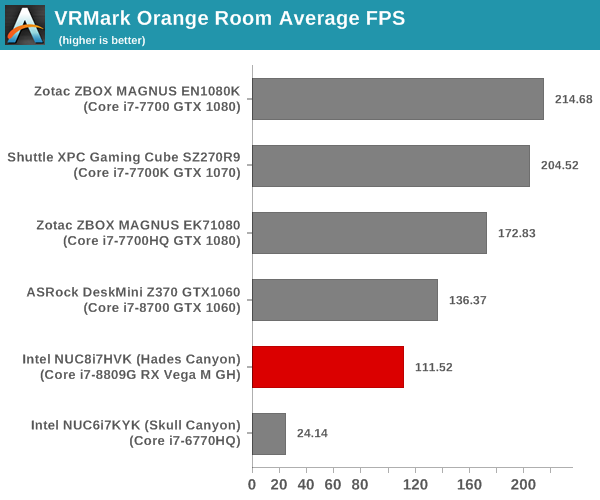
Other than the Skull Canyon NUC, all the other tested systems manage to pass the VRMark Orange Room test.
VRMark Cyan Room
The Cyan Room sits between the Orange and Blue rooms in complexity. It is a DirectX 12 benchmark. Similar to the Orange room, the target metrics are 88.9 fps on HMDs and 109 fps on the desktop monitor. The graphs below present the average FPS and score for the different systems being considered today.
| Futuremark VRMark - Cyan Room | |||
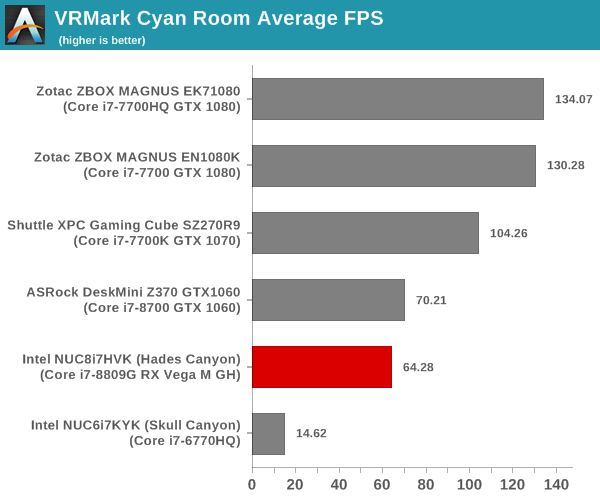
Systems equipped with the GTX 1080 manage to pass the Cyan Room test. The ASRock DeskMini Z370, the Hades Canyon NUC, and the Skull Canyon NUC all score comfortably below the required 109 fps threshold. The Shuttle XPC Cube SZ270R9 narrowly misses out.
VRMark Blue Room
The Blue Room is the most demanding of the three workloads. At the time of introduction of VRMark in October 2016, no publicly available system running as sold was able to pass the test. The performance of a system in this benchmark is an indicator of its VR-readiness for future generation of HMDs. Similar to the other workloads, the passing performance metrics are 88.9 fps on HMDs and 109 fps on desktop monitors. The complexity of the workload is due to the higher resolution (5012 x 2880) and additional geometry making it necessary to increase the number of Direct3D API calls. The graphs below present the average FPS and score for the different systems being considered today.
| Futuremark VRMark - Blue Room | |||
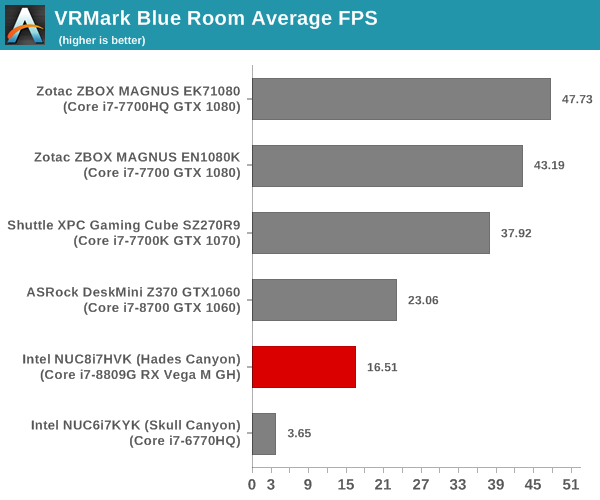
None of the tested systems come anywhere close to getting the required frame rate for passing the Blue Room test.
Originally published at https://www.anandtech.com/show/12736/intel-nuc8i7hvk-hades-canyon-gaming-performance-a-second-look (Wayback Machine).