
Assessing Cavium's ThunderX2: The Arm Server Dream Realized At Last
Java Performance: Huge Pages Investigated
Since experience tells us that it is quite rare for one CPU to beat another in a benchmark by a factor 3, we investigated the matter further. The most obvious candidate was Huge Pages, or as everybody besides the Linux community calls it: "Large Pages".
Every modern CPU caches the virtual-to-physical memory mappings in their TLBs. The "normal" size of a page is 4 KB, so with 1536 entries, the Skylake core can only cache about 6 MB per core. Consequently, as DRAM capacity has grown the past 15 years from a few GB to hundreds of GBs, TLB misses have become more and more of a concern. A TLB miss is quite expensive – costing several memory accesses in total – as you need to read out several tables to finally find the physical address.
All modern CPU support larger pages. In the x86-64 (Intel & AMD) a 2 MB large page is the most popular option, while a 1 GB page is also available. Meanwhile a large page on the ThunderX2 is no less than 0.5 GB. Using large pages reduces the number of TLB misses (although the number of entries in the TLB is typically much lower for large pages), and also they reduce the number of memory accesses needed if a TLB miss occurs.
However, it took a while before Linux supported this feature in an easy to handle way. Memory fragmentation, conflicting and hard to configure settings, incompatibilities, and especially very confusing names caused a lot of trouble. In fact, many software vendors still advise server admins to disable large pages. So while it was quickly embraced for benchmarks, the software community as a whole is still hesitant.
To that end, let's see what happens if we enable Transparent Huge Pages and keep the best settings we discussed on the previous page.
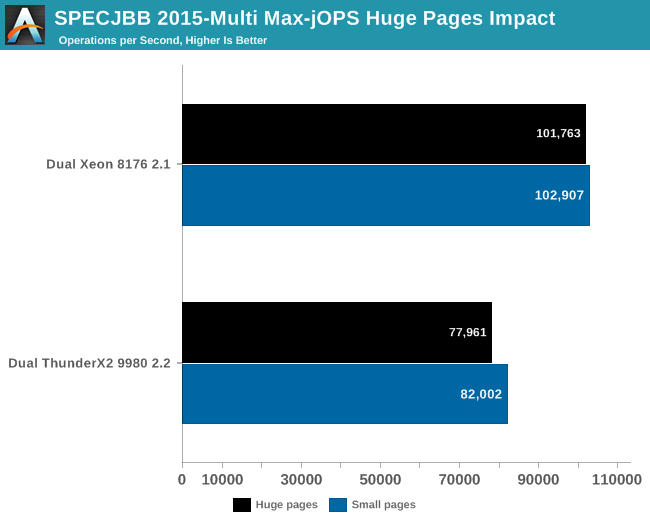
Overall, for Max-jOPs the performance impact is nothing spectaculair; in fact it's a slight regression. The Xeon loses about 1% of its throughput, the ThunderX2 about 5%.
Moving on, let's check out the Critical-jOPS metric, where throughput is measured with a 99 percentile response time constraint.
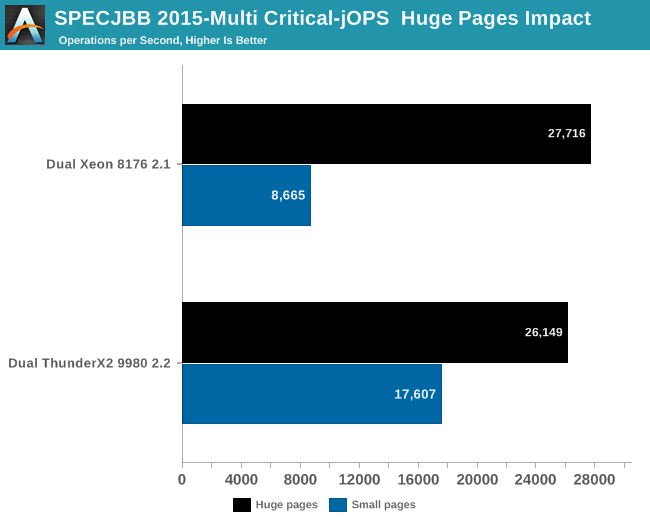
A massive difference! Instead of taking a massive beating, the Intel setup edges out the ThunderX2. Still, it must be said that performance with 4 KB pages seems to be a major weakness with Intel's architecture.
Originally published at https://www.anandtech.com/show/12694/assessing-cavium-thunderx2-arm-server-reality (Wayback Machine).