
The Mainstream Phoenix Rises: Samsung's 970 EVO (500GB & 1TB) SSDs Reviewed
AnandTech Storage Bench - The Destroyer
The Destroyer is an extremely long test replicating the access patterns of very IO-intensive desktop usage. A detailed breakdown can be found in this article. Like real-world usage, the drives do get the occasional break that allows for some background garbage collection and flushing caches, but those idle times are limited to 25ms so that it doesn't take all week to run the test. These AnandTech Storage Bench (ATSB) tests do not involve running the actual applications that generated the workloads, so the scores are relatively insensitive to changes in CPU performance and RAM from our new testbed, but the jump to a newer version of Windows and the newer storage drivers can have an impact.
We quantify performance on this test by reporting the drive's average data throughput, the average latency of the I/O operations, and the total energy used by the drive over the course of the test.
The Blue lines indicate the PM981, the OEM version of the 970 EVO.
The Orange lines are the 970 EVO.
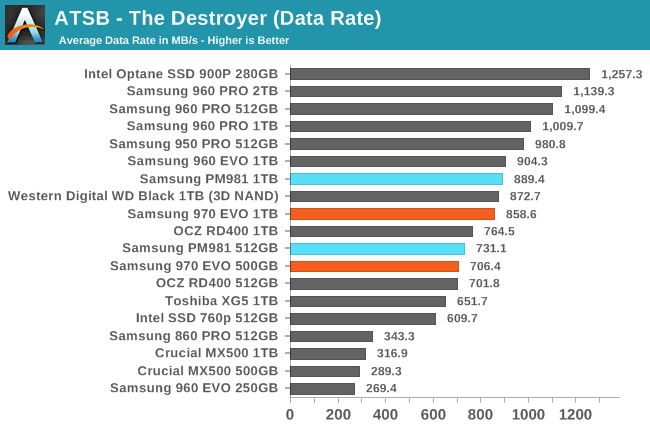
The average data rates from the Samsung 970 EVO on The Destroyer are a slight step backwards from the Samsung PM981 OEM drive and from the 960 EVO. All of the TLC-based drives are still performing below even Samsung's older MLC-based NVMe drives, and of course the Intel Optane SSD. This year's Western Digital WD Black offers about the same performance as the 970 EVO.
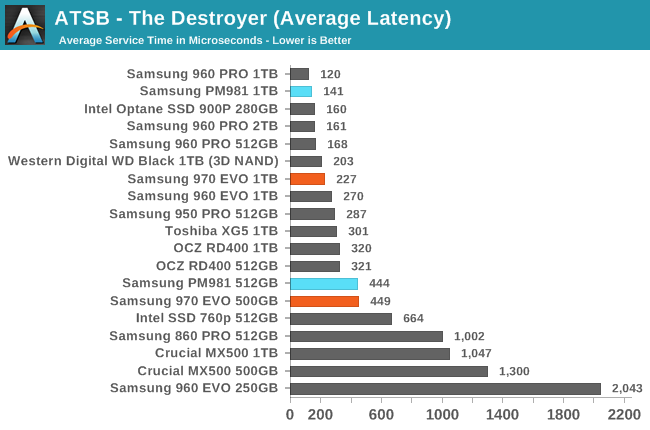
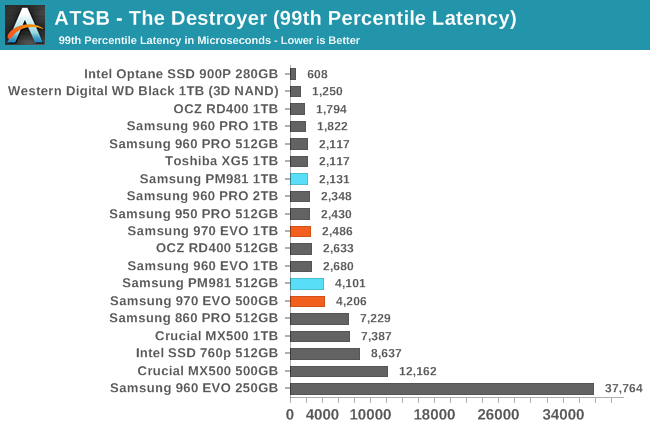
Average and 99th percentile latencies for the 970 EVO are again very slightly worse than the PM981, but on these metrics the 960 EVO doesn't beat its replacement. The WD Black has notably better 99th percentile latency than the other flash-based SSDs.
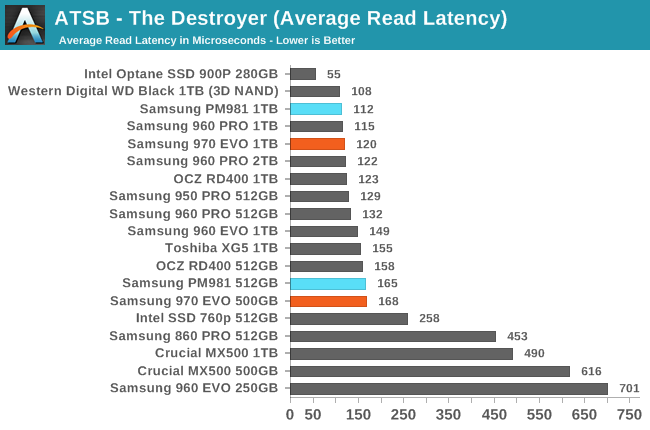
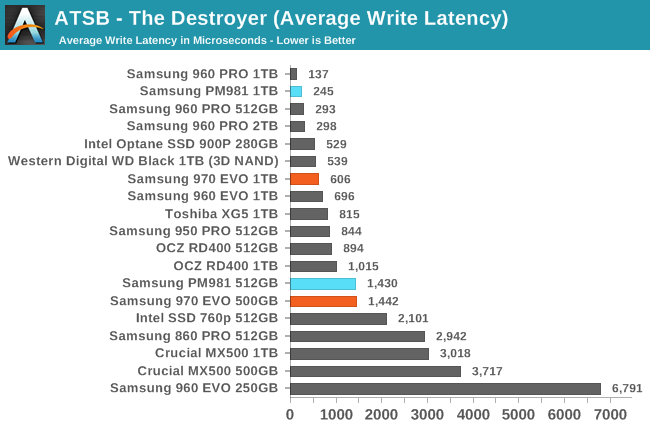
There is a clear range of average read latency scores that make up the high-end NVMe market segment. The 970 EVO doesn't stand out from the other drives in that category. For average write latency, scores vary a lot more, and the 970 EVO outperforms its predecessor slightly but fails to match the very good score the PM981 obtained.
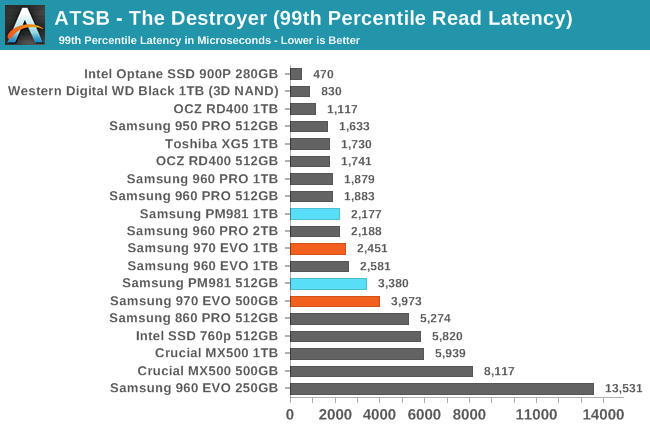
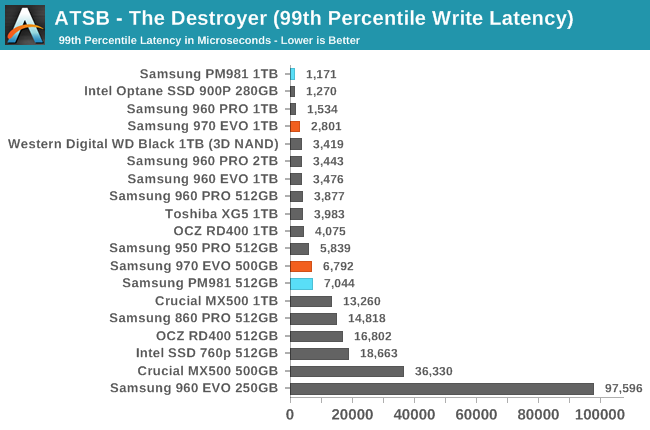
The 99th percentile read and write latency scores from the 970 EVO don't break new ground and mostly fail to match the PM981, though the differences aren't large enough to be a serious concern. The WD Black's notable QoS advantage is on the read side, where it is the only flash-based SSD to almost always keep read latency below 1ms.
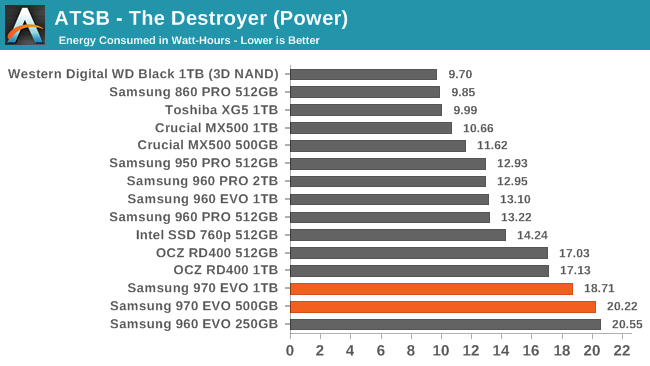
We didn't have the opportunity to measure power usage of the Samsung PM981 on The Destroyer, so this is our first look at the power draw of the Samsung Phoenix controller on this test. The situation isn't good. The 970 EVO uses twice the energy as the WD Black to does despite both drives offering about the same level of performance on The Destroyer. The power efficiency of the 970 EVO seems to be a big step backwards from the previous generation and is not at all competitive.
Originally published at https://www.anandtech.com/show/12670/the-samsung-970-evo-ssd-review (Wayback Machine).