
AMD Opteron vs. Intel Xeon: Database Performance Shootout
- Posted in
- IT Computing
FSB Impact on Performance
We've alluded to FSB bandwidth being a fundamental limitation in Intel's
multiprocessor architecture, and now we're here to address the issue
a bit further.
A major downside to Intel's reliance on an external North Bridge is that
it becomes very expensive to implement multiple high speed FSB interfaces as
well as a difficult engineering problem to solve once you grow beyond 2-way configurations.
Unfortunately Intel's solution isn't a very elegant one; regardless
of whether you're running 1, 2 or 4 Xeon processors they all share the
same 64-bit FSB connection to the North Bridge.
The following diagram should help illustrate the bottleneck:
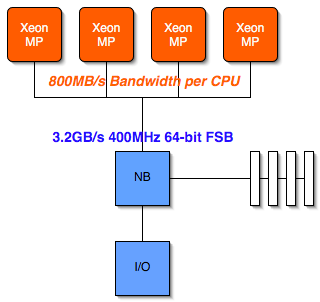
In the case of a 4-way Xeon MP system with a 400MHz FSB, each processor can be offered a maximum of 800MB/s of bandwidth to the North Bridge. If you try running a single processor Pentium 4 3.0GHz with a 400MHz FSB you'll note a significant performance decrease and that's while still giving the processor a full 3.2GB/s of FSB bandwidth; now if you cut that down to 800MB/s the performance of the processor would suffer tremendously.
It is because of this limitation that Intel must rely on larger on-die L3 caches to hide the FSB bottleneck; the more information that can be stored locally in the Xeon's on-die cache, the less frequently the Xeon must request for data to be sent over the heavily trafficked FSB.
What's even worse about this shared FSB is that the problem grows larger as you increase the number of CPUs and their clock speed. A 2-way Xeon system won't experience the negative effects of this FSB bottleneck as much as a 4-way Xeon MP; and a 4-way Xeon MP running at 3GHz will be hurting even more than a 4-way 2.0GHz Xeon MP. It's not a nice situation to be in, but there's nothing you can do to skirt the issue, which is where AMD's solution begins to appear to be much more appealing:
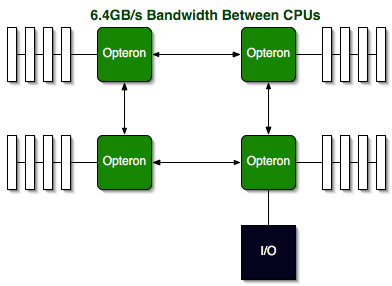
First remember that each Opteron has its own on-die North Bridge and memory controller, so there are no external chipsets to deal with. Each Opteron CPU features three point-to-point Hyper Transport links, delivering 3.2GB/s of bandwidth in each direction (6.4GB/s full duplex). The advantage is clear: as you scale the number of CPUs in an Opteron server there are no FSB bottlenecks to worry about. Scalability on the Opteron is king, which is the result of designing the platform first and foremost for enterprise level server applications.
Intel may be able to add 64-bit extensions to their Xeon MPs, but the performance bottlenecks that exist today will continue to plague the Xeon line until there's a fundamental architecture change.
Originally published at https://www.anandtech.com/show/1254 (Wayback Machine).