
The Plextor M8V SATA SSD Review: Toshiba 3D TLC In a Mainstream Drive
Power Management
Real-world client storage workloads leave SSDs idle most of the time, so the active power measurements presented earlier in this review only account for a small part of what determines a drive's suitability for battery-powered use. Especially under light use, the power efficiency of a SSD is determined mostly be how well it can save power when idle.
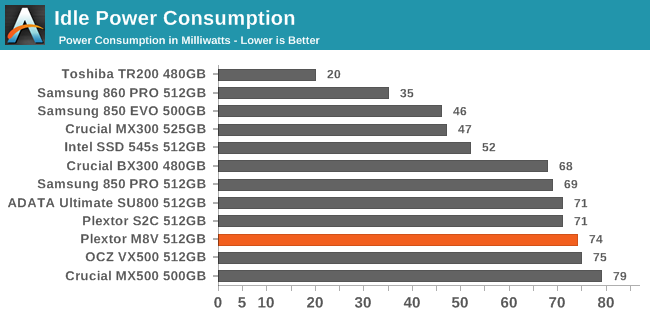
SATA SSDs are tested with SATA link power management disabled to measure their active idle power draw, and with it enabled for the deeper idle power consumption score and the idle wake-up latency test. Our testbed, like any ordinary desktop system, cannot trigger the deepest DevSleep idle state supported by many drives.
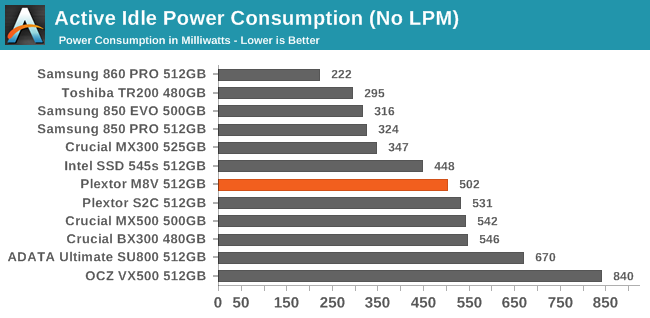
The half watt active idle power consumption of the Plextor M8V is not great, but is a fairly typical value. Most drives using the SM2258 controller draw a bit more power than the M8V.
When the SATA link power management is enabled, the M8V ends up drawing a few mW more than most of the other drives with the same controller, and is substantially more power hungry than the best SATA SSDs.
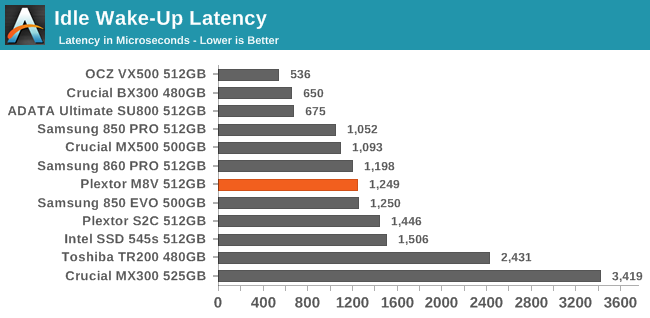
The Plextor M8V's idle wake-up latency of about 1.2ms is about average for SATA SSDs, and reasonable given the power savings achieved by the sleep state. Several other drives like the Crucial BX300 and ADATA sU800 have managed much faster wake-up times from the same SM2258 controller.
Originally published at https://www.anandtech.com/show/12485/the-plextor-m8v-sata-ssd-review (Wayback Machine).