
The Latest High-Capacity M.2: The Samsung 860 EVO 2TB SSD, Reviewed
Power Management
Real-world client storage workloads leave SSDs idle most of the time, so the active power measurements presented earlier in this review only account for a small part of what determines a drive's suitability for battery-powered use. Especially under light use, the power efficiency of a SSD is determined mostly be how well it can save power when idle.
SATA SSDs are tested with SATA link power management disabled to measure their active idle power draw, and with it enabled for the deeper idle power consumption score and the idle wake-up latency test. Our testbed, like any ordinary desktop system, cannot trigger the deepest DevSleep idle state.
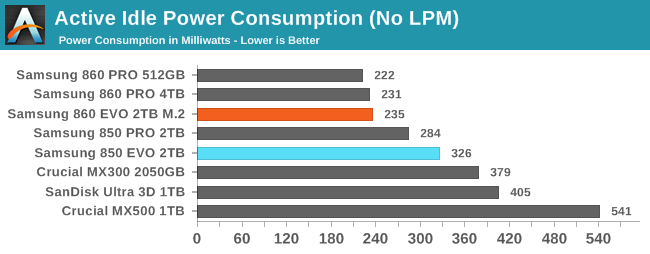
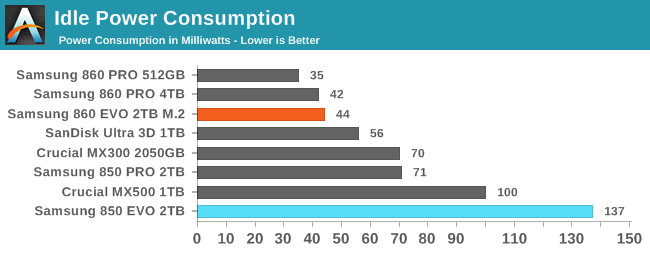
The idle power measurements for the 860 EVO are just a few milliwatts higher than for the 860 PRO, which can be attributed entirely to the M.2 to SATA converter board (it has a status LED). The 860 EVO benefits from all the same controller and DRAM power savings the 860 PRO brought. While there are some smaller SATA SSDs that have lower idle power numbers (eg. some DRAMless SSDs), among multi-TB drives Samsung has the lead.
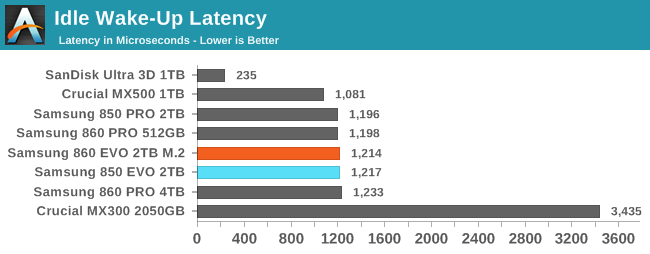
While Samsung's idle power usage has improved significantly with the 860 generation, the wake-up latency is unchanged. There's room for improvement here as many drives are able to wake up much faster from sleep states that are almost as deep as the Samsung 860 EVO's idle.
Originally published at https://www.anandtech.com/show/12408/the-samsung-860-evo-m2-2tb-ssd-review (Wayback Machine).