
Asus DigiMatrix - The Pizza Box Form Factor
- Posted in
- Systems
Construction - Under the Hood
Despite its small profile, Asus has decided to employ the DigiMatrix on a 533FSB Pentium 4 platform. This choice is more of one due to a lack of options. When it comes to MPEG encoding operations and tasks of the multimedia variety, Pentium 4 processors are more favorable over the Athlon XPs. An 800FSB Pentium 4 platform would no doubt increase the cost of the system because of the chipset, processor, and memory used. This is atop the increased thermal budget. So, it was perfectly natural to expect Asus to choose a 533FSB Pentium 4 platform base, no doubt based on a SiS chipset because of price reasons.|
|
|


The CPU socket is in the upper right hand corner of the motherboard. The heatsink can be removed via four screws that secure it to the motherboard and one to the backside of the system.
There is a riser card that is somewhat in the way of installing/uninstalling the CPU and memory, which can be unhinged via two screws that hold it in place to the back frame. The riser card itself is home to the radio module that seems to be manufactured by Nigata Semitsu, who also manufactures the radio module on the MSI Mega PCs.
|
|
|


The copper heatsink interfaces with the CPU with the help of some thermal adhesive, which seems to be of the epoxy variety.
|
|
|


Due to the design of the DigiMatrix, Asus had to build its motherboard to utilize notebook components, e.g. mini-PCI, instead of the full size PCI form factor.
There are two mini-PCI slots on the DigiMatrix motherboard, one on the top and one on the bottom. A TV tuner manufactured by Lifeview populates the mini-PCI slot on the top of the motherboard. This is definitely one of the smallest TV tuners that we have seen, but the question still remains to be that of quality. Manufacturing the smallest TV tuner isn't quite an accomplishment, unless it actually produces comparable quality to TV tuners of the PCI form factor.
|
|
|


The second mini-PCI slot is situated on the bottom side of the motherboard and is populated by Asus' 802.11b WiFi card. The card is powered by Ralink's RT2460P 802.11b chipset.
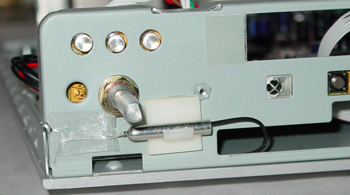
The WiFi antenna is fixed directly behind and below the volume dial, but it is inaccessible due to the front cover.
Originally published at https://www.anandtech.com/show/1237 (Wayback Machine).