
The Intel SSD 760p 512GB Review: Mainstream NVMe Done Right
AnandTech Storage Bench - Light
Our Light storage test has relatively more sequential accesses and lower queue depths than The Destroyer or the Heavy test, and it's by far the shortest test overall. It's based largely on applications that aren't highly dependent on storage performance, so this is a test more of application launch times and file load times. This test can be seen as the sum of all the little delays in daily usage, but with the idle times trimmed to 25ms it takes less than half an hour to run. Details of the Light test can be found here. As with the ATSB Heavy test, this test is run with the drive both freshly erased and empty, and after filling the drive with sequential writes.
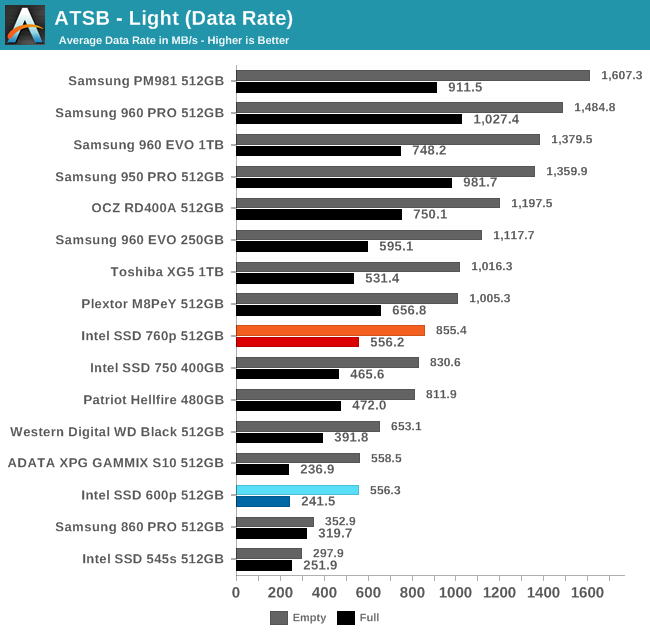
The Light test reveals bigger performance differences for full and empty drive states than the Heavy test, but the 760p doesn't suffer as much as most drives. The average data rates from the 760p are slightly higher than from the Intel SSD 750, and much higher than the 600p or the SATA drives. On the other hand, the TLC-based Samsung PM981 is almost twice as fast.
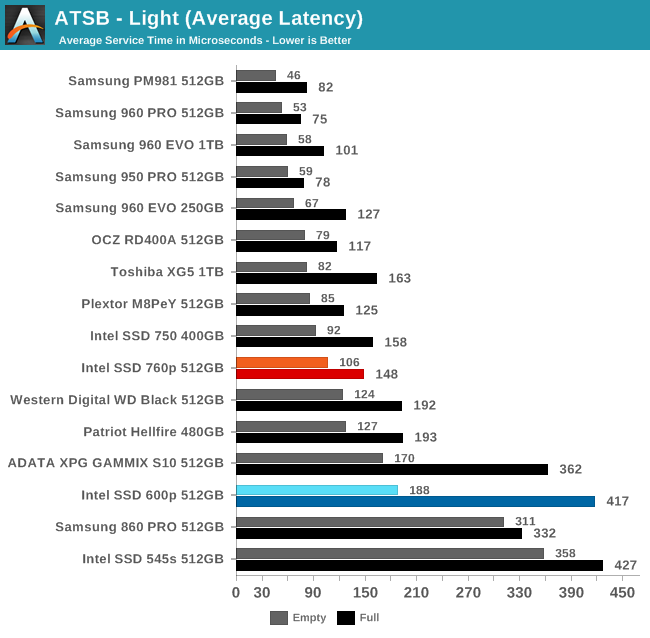
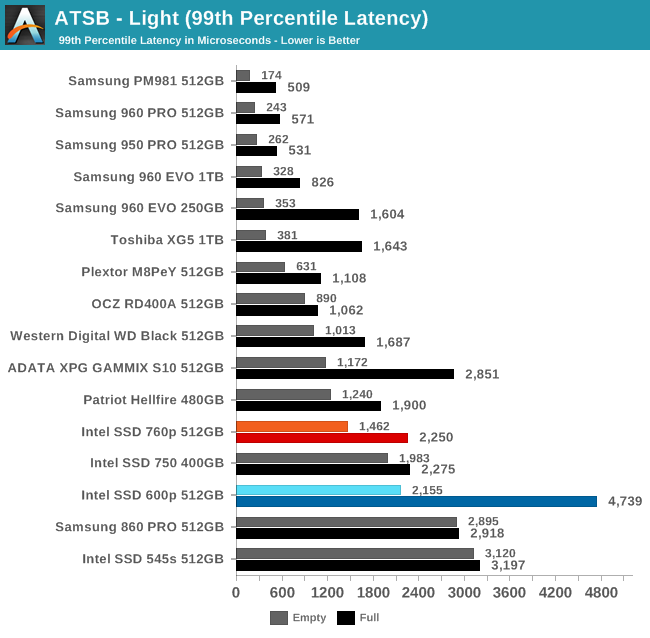
The average latency scores of the Intel SSD 760p are twice those of the fastest NVMe SSDs, but this isn't enough to amount to a noticeable difference on a light workload. The 99th percentile latencies are much higher than those of Samsung's NVMe drives, but are still faster than SATA SSDs.
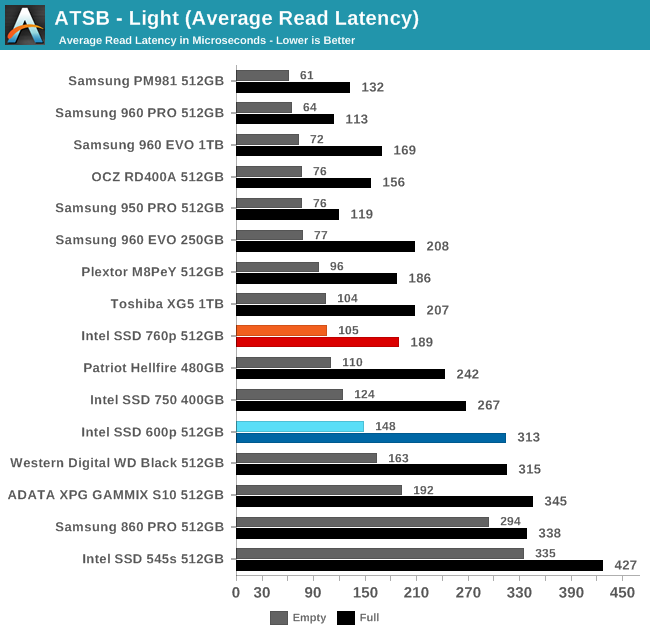
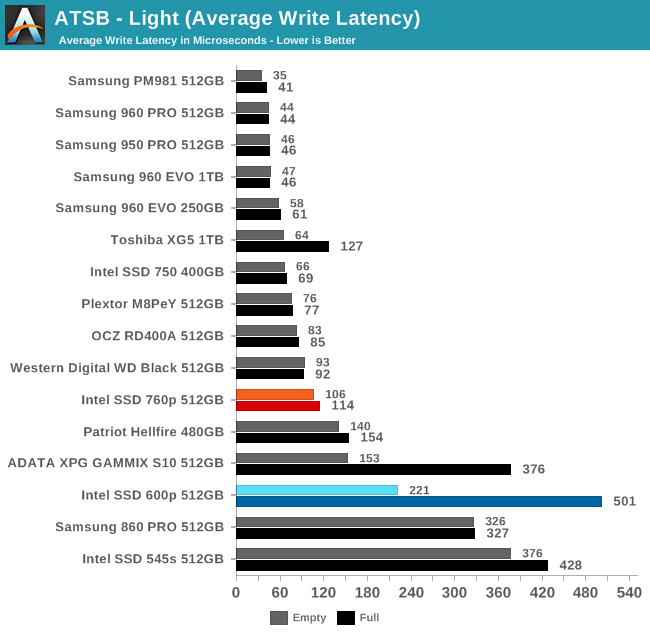
The average read latencies from the Intel 760p fall into the middle of the range for NVMe SSDs, but the average write latencies are clearly on the high side of normal.
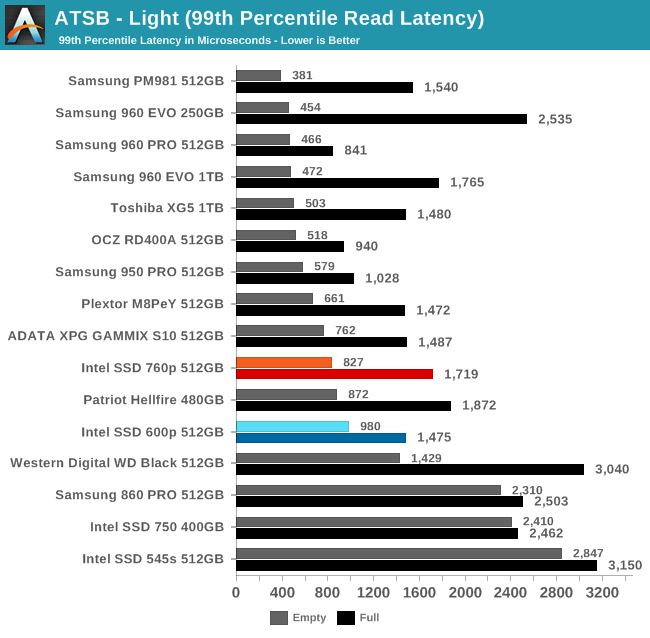
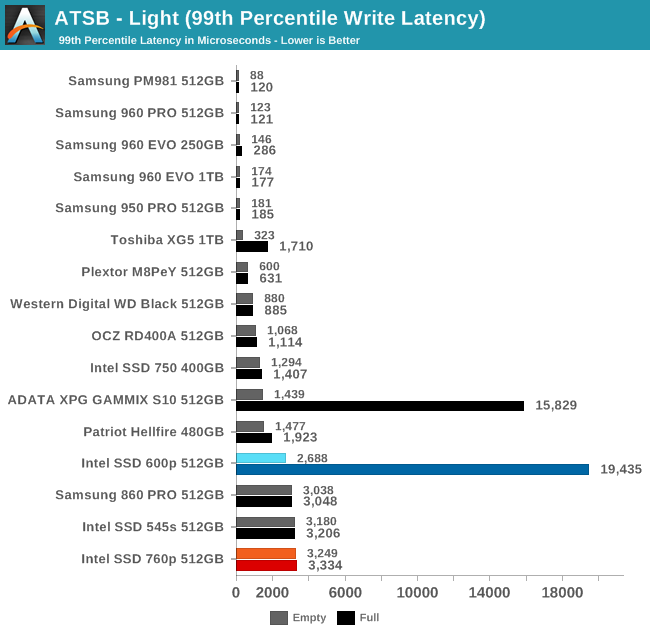
The 99th percentile read latencies of the 760p on the Light test are acceptable for a low-end NVMe SSD, but the full-drive score is actually slightly worse than the Intel 600p. On the write side, the 99th percentile latency is actually very slightly worse than good SATA SSDs, but the 760p doesn't get noticeably worse when full.
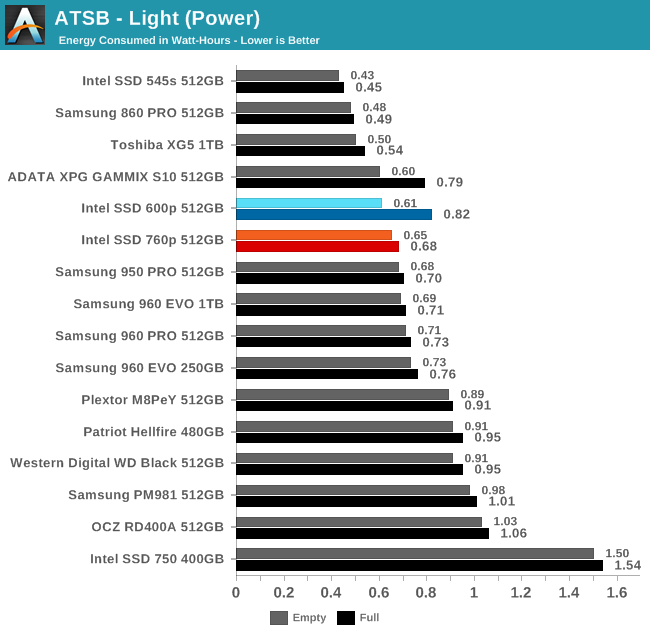
The two SM2260-based NVMe SSDs join the Toshiba XG5 this time as the most efficient NVMe SSDs ahead of the Intel 760p, but the SM2260-based 600p and GAMMIX S10 fall behind when the test is run on a full drive. The Samsung drives mostly use slightly more power than the 760p, but the PM981 ends up near the bottom of the chart.
Originally published at https://www.anandtech.com/show/12349/the-intel-ssd-760p-512gb-review (Wayback Machine).