
The Samsung 860 PRO (512GB And 4TB) SSD Review: Replacing A Legend
Random Read Performance
Our first test of random read performance uses very short bursts of operations issued one at a time with no queuing. The drives are given enough idle time between bursts to yield an overall duty cycle of 20%, so thermal throttling is impossible. Each burst consists of a total of 32MB of 4kB random reads, from a 16GB span of the disk. The total data read is 1GB.
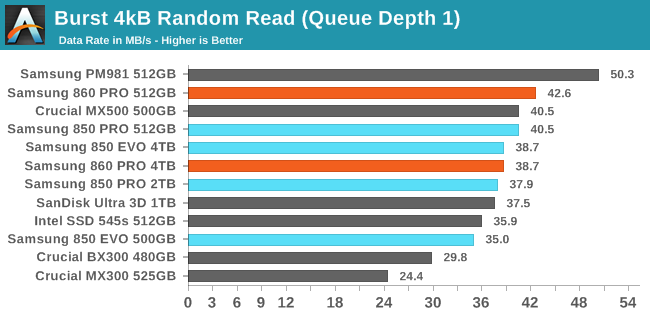
The 512GB Samsung 860 PRO has the fastest burst random read speed among these SATA SSDs, about 5% faster than the 850 PRO. The 4TB model is the same speed as the 4TB 850 EVO.
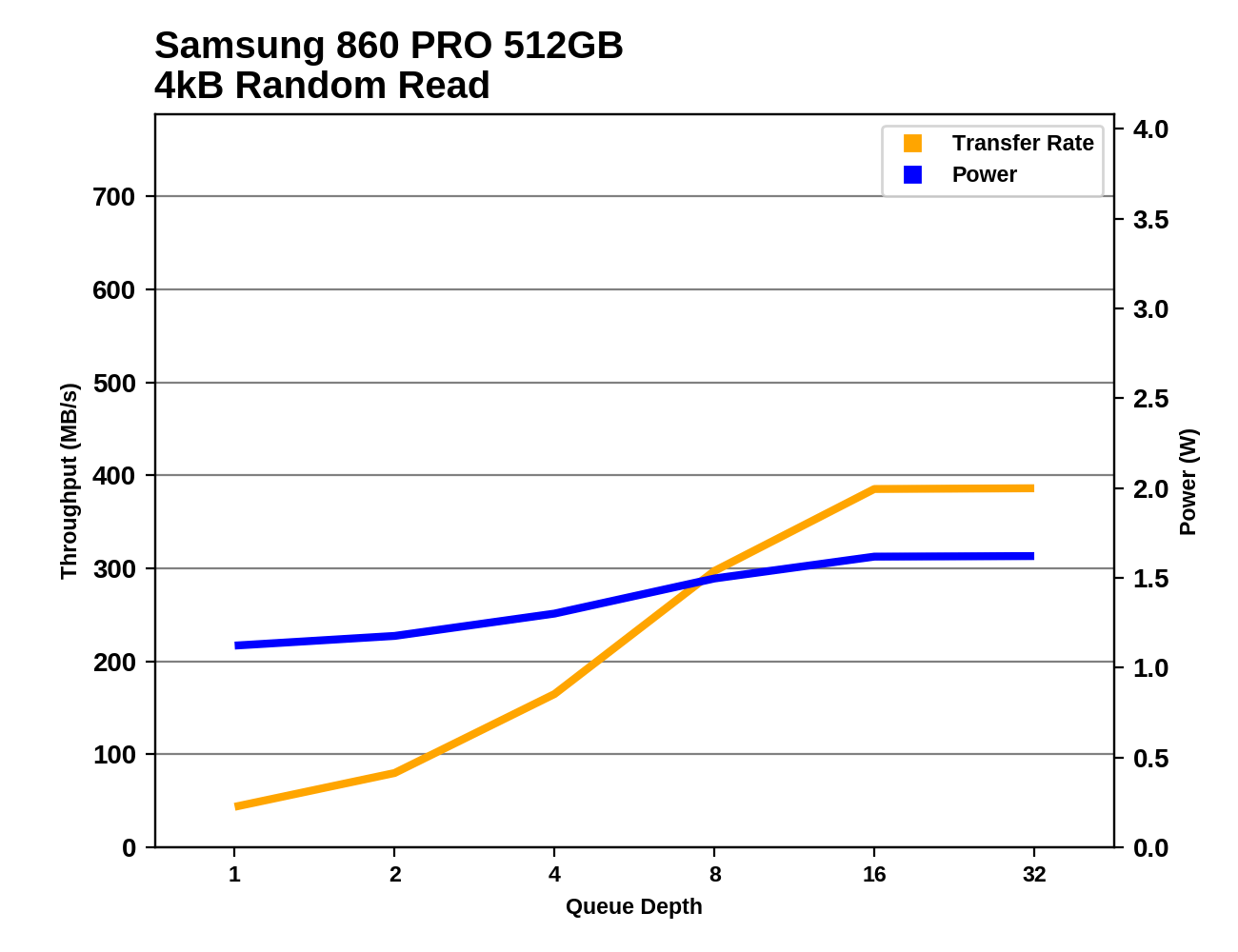
Our sustained random read performance is similar to the random read test from our 2015 test suite: queue depths from 1 to 32 are tested, and the average performance and power efficiency across QD1, QD2 and QD4 are reported as the primary scores. Each queue depth is tested for one minute or 32GB of data transferred, whichever is shorter. After each queue depth is tested, the drive is given up to one minute to cool off so that the higher queue depths are unlikely to be affected by accumulated heat build-up. The individual read operations are again 4kB, and cover a 64GB span of the drive.
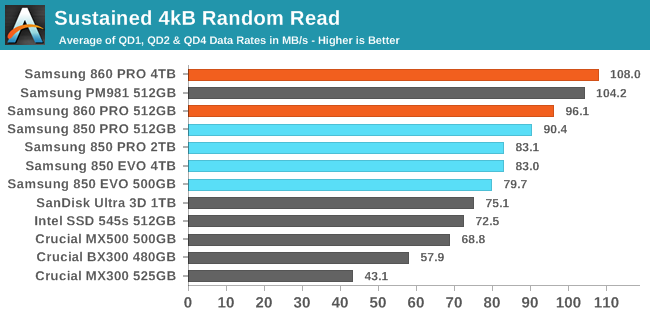
On the longer random read test involving some higher queue depths, the Samsung 860 PROs take a clear lead, and the 4TB model even outperforms the PM981 NVMe SSD.
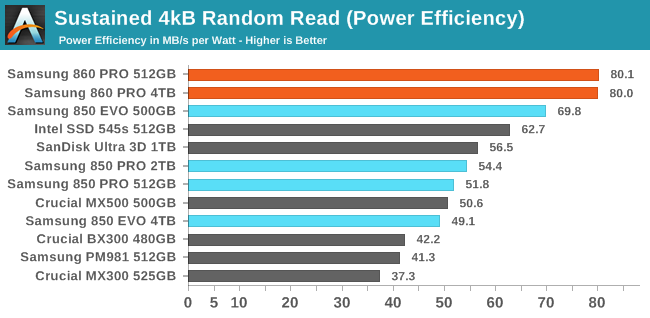
The two Samsung 860 PROs offer the same power efficiency, which is a huge step up from the 850 PRO's efficiency and significantly better than any of the competition.
 |
|||||||||
Most of the Samsung drives hit the same limit of almost 400 MB/s around QD16. The two latest Crucial SSDs only just reach reach that level of performance at QD32, while the Intel 545s and Crucial MX300 never scale up that far. The PM981 NVMe drive scales far beyond any of the SATA drives, but at the cost of very poor power efficiency, especially at lower queue depths.
Random Write Performance
Our test of random write burst performance is structured similarly to the random read burst test, but each burst is only 4MB and the total test length is 128MB. The 4kB random write operations are distributed over a 16GB span of the drive, and the operations are issued one at a time with no queuing.
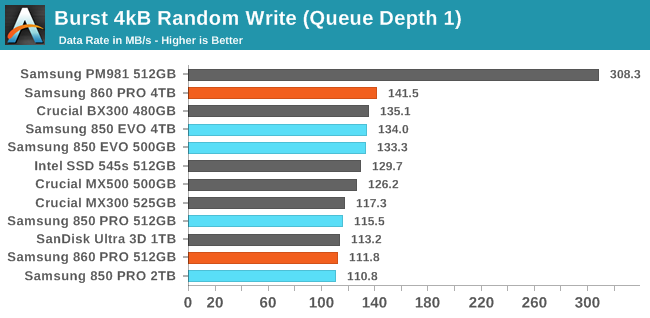
The 4TB 860 PRO has the fastest burst random write speed, while the 512GB model scores slightly worse than the 512GB 850 PRO.
As with the sustained random read test, our sustained 4kB random write test runs for up to one minute or 32GB per queue depth, covering a 64GB span of the drive and giving the drive up to 1 minute of idle time between queue depths to allow for write caches to be flushed and for the drive to cool down.
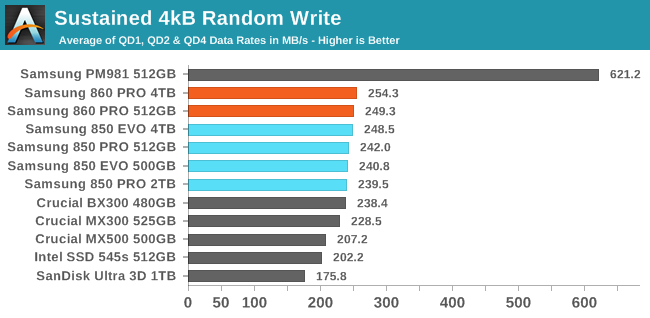
The sustained random write performance of the Samsung 860 PRO is a very slight improvement over their previous drives. Most of the competition is significantly slower on this test, but the Crucial BX300 is pretty close.
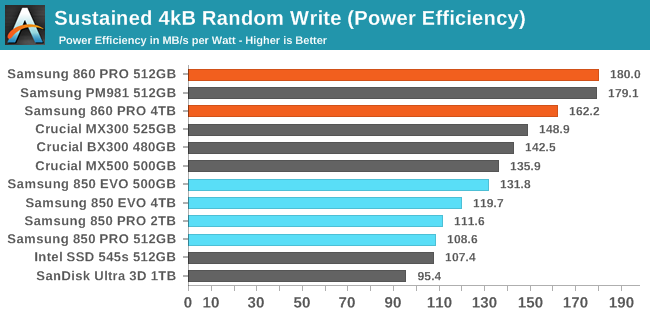
The Samsung 860 PROs are again the two most efficient SATA SSDs, and the 512GB model manages to match the efficiency of the much faster but more power hungry PM981.
 |
|||||||||
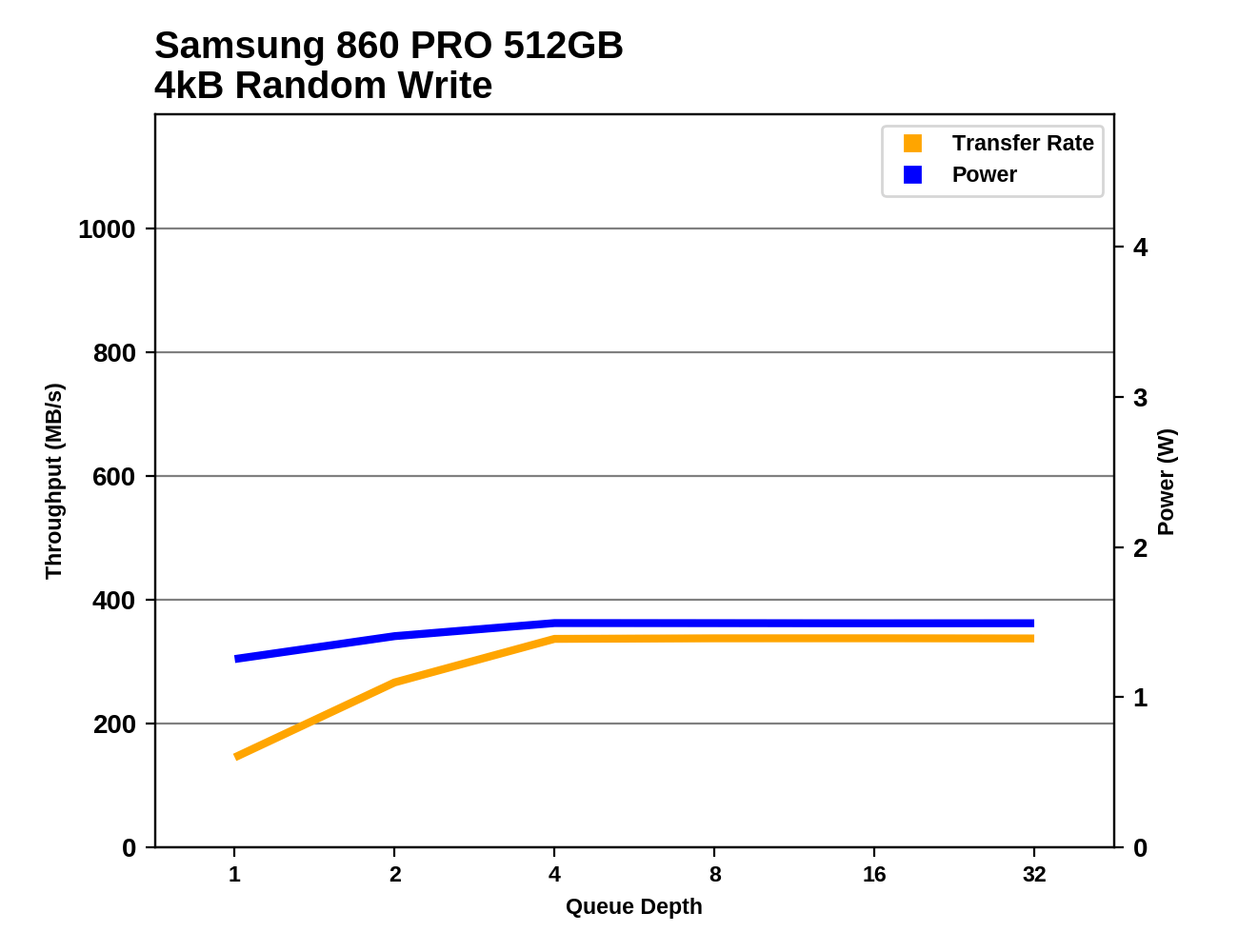
The 860 PRO reaches full random write speed at QD4 and is steady through the rest of the test. The Crucial MX500 and Intel 545s are much slower to get up to speed, and the SanDisk Ultra 3D plateaus at a mere 200MB/s after QD2.
Originally published at https://www.anandtech.com/show/12348/the-samsung-860-pro-512gb-and-4tb-ssd-review (Wayback Machine).