
The ASUS Prime X299-Deluxe Motherboard Review: Onboard OLED and WiGig
Conclusion
At the time of this writing, the ASUS Prime X299-Deluxe will ring up the register to the tune of $480. We mentioned earlier this price point puts the board at the high-end of the spectrum. In fact, the only board that costs more is ASUS' own ROG Rampage VI Extreme, currently selling for over $550. Almost anyone searching for a motherboard close to the $500 range will likely not purchase a quad-core Kaby Lake-X, but will navigate directly to a higher core count Skylake-X CPU. With a jump to more cores comes more PCIe lanes, which opens up the options on the platform for more PCIe devices and storage.

The Prime Deluxe comes close to being maxed with all the features it has placed on the board. It has a U.2 port, the fastest integrated Wi-Fi (WiGig), and four USB 3.1 (10 Gbps) ports on the back panel, all of which put this board heads above most boards in each category. Outside of the WiGig capabilities, it also comes with dual Intel Gigabit NICs, the I219-V and I211-AT - both proven performers. At this price, it was clear that ASUS had the option of a multi-gigabit wired connection, or the WiGig connection.
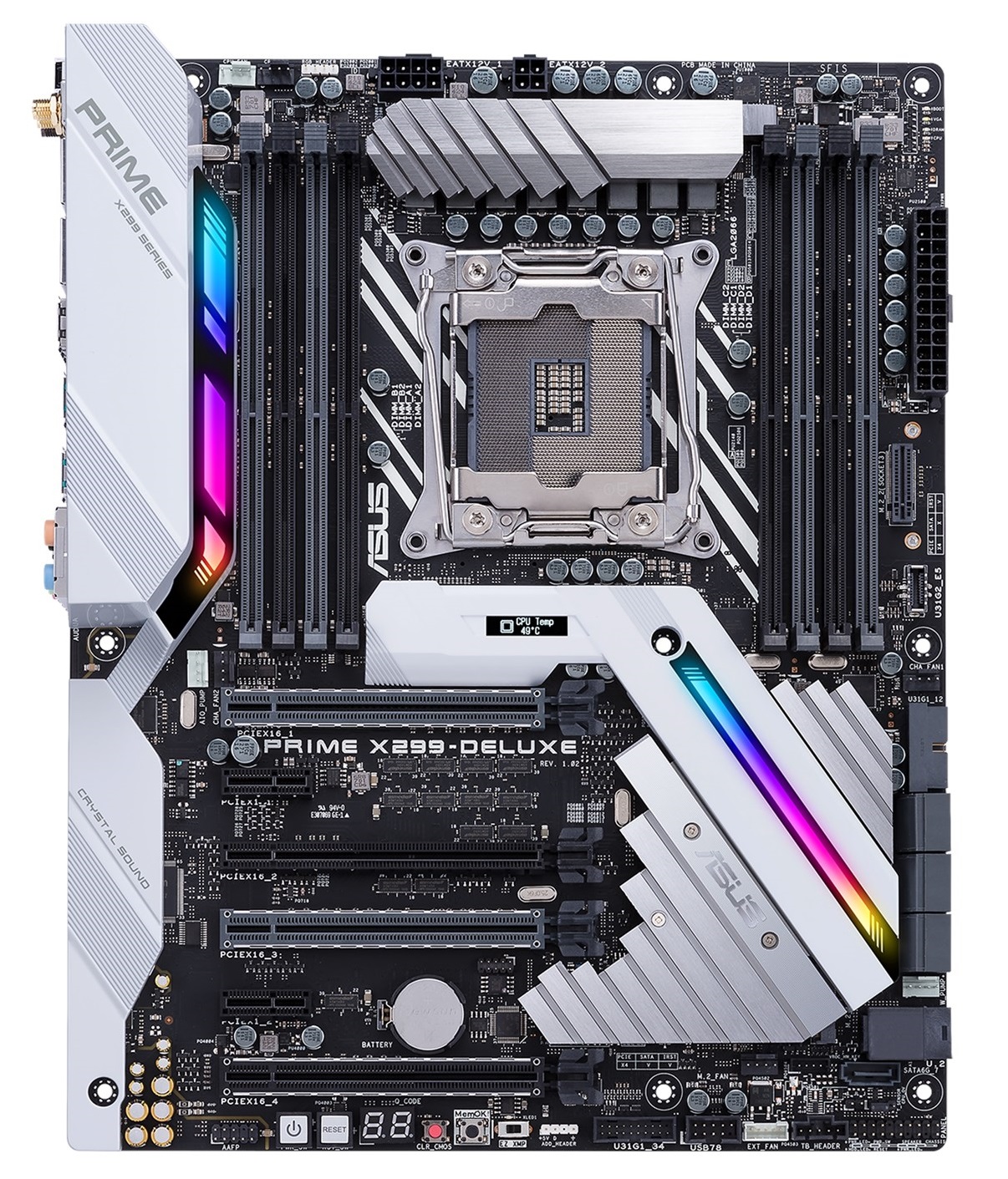
The overall build quality felt good. Though the Prime X299-Deluxe does not have a large heatsink, it did just fine throughout our testing, as well as in the extended testing with the power delivery thermal sensor peaking at 71C when the CPU was set to 4.5 GHz. To aid in cooling, the power delivery also included a backplate on the rear of the motherboard.
Performance on this board was relatively seemless. In most CPU tests, the results were right in the middle of the pack, showing the i7-7900X we use boosted to 3.6 GHz on all cores and appearing to use Intel defaults on boost. For system testing, the motherboard was also similar to others for POST time and DPC Latency. When overclocking with the new CPU, we were able to reach 4.6 GHz, which was 100 MHz above the older ES CPU, but 100 MHz lower than what was achieved on a Gigabyte board. The auto-overclocking tools were also a bit too aggressive for our cooling, and resulted in temperatures which breached our 90C threshold.
The ASUS Prime X299-Deluxe has a number of high-end features that befits the price: it uses the high-end ASUS modified Realtek codec, has more USB 3.1 (10 Gbps) Type-A and Type-C ports on the back panel than most other boards, supports up to 3-way SLI and Crossfire, has a U.2 port and two M.2 ports, and also comes with an onboard OLED display for system information or customization. The RGB LEDs are quite tastefully integrated hidden under the back panel shroud and the PCH heatsink. If more is needed there are two RGB headers on the board (one addressable) which can all be controlled by the Aura Software.

The Prime X299-Deluxe is certainly a solid motherboard, capable of supporting a high-end system, however the one critical element that is hard to ignore is the price. Some users might see the OLED screen as a gimmick that causes added cost, or that the WiGig is too esoteric a feature, or that a bundled Thunderbolt 3 card just removes PCIe slots from a multi-PCIe card setup. Ultimately it is a motherboard that relies a lot on having the infrastructure in place to make the most of some of the features.
But, if, as an enthusiast, a user is already riding the wave of high-speed wireless connectivity and storage, then the Prime X299-Deluxe is a premium motherboard for an appropriate premium PC build.
Other AnandTech X299 Motherboard Reviews:
Prices checked Feb 16th
- The Intel Skylake-X Review: Core i9-7980XE and Core i9-7960X Tested
- The Intel Skylake-X Review: Core i9-7900X, i7-7820X and i7-7800X Tested
- The Intel Kaby Lake-X Review: Core i7-7740X and i5-7640X Tested
- Intel Announces Basin Falls: The New High-End Desktop Platform and X299 Chipset
- ($480) The ASUS Prime X299-Deluxe Review (this review)
- ($400) The GIGABYTE X299 Gaming 7 Pro Review [link]
- ($390) The ASRock X299E-ITX/ac Review [link]
- ($390) The ASRock X299 Professional Gaming i9 Review [link]
- ($370) The ASUS Strix X299-XE Gaming Review [link]
- ($308) The MSI X299 Gaming Pro Carbon Review [link]
- ($340) The ASUS X299 TUF Mark 1 Review [link]
- ($330) The EVGA X299 FTW-K Review [link]
- ($290) The EVGA X299 Micro Review [link]
- ($290) The ASRock X299 Taichi Review [link]
- ($260) The MSI X299 Tomahawk Arctic Review [link]
- ($232) The MSI X299 SLI Plus Review [link]
Originally published at https://www.anandtech.com/show/12194/the-asus-prime-x299-deluxe-motherboard-review (Wayback Machine).