
The Intel Optane SSD 900p 480GB Review: Diving Deeper Into 3D XPoint
Sequential Read Performance
Our first test of sequential read performance uses short bursts of 128MB, issued as 128kB operations with no queuing. The test averages performance across eight bursts for a total of 1GB of data transferred from a drive containing 16GB of data. Between each burst the drive is given enough idle time to keep the overall duty cycle at 20%.
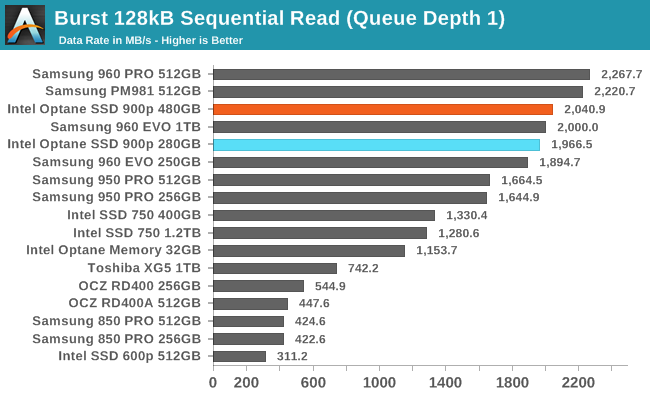
Despite having incredibly low access latency, the Optane SSD 900p doesn't beat the fastest flash-based SSDs in our burst sequential read test. The fastest flash SSDs make up for their slower initial response time through a combination of higher channel counts, prefetching and most likely larger native block sizes. The Optane SSD 900p still has a great score here, but it fails to stand out from the much cheaper flash-based drives.
Our test of sustained sequential reads uses queue depths from 1 to 32, with the performance and power scores computed as the average of QD1, QD2 and QD4. Each queue depth is tested for up to one minute or 32GB transferred, from a drive containing 64GB of data.
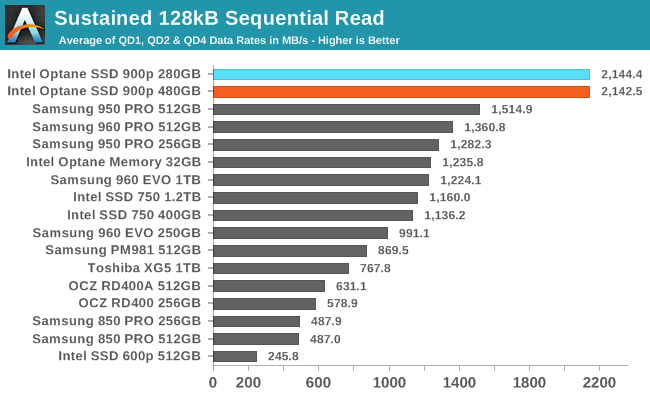
With the test of higher queue depths and longer run times, the Optane SSDs are back on top with a substantial performance lead. Unlike the burst test, this test shows almost no performance difference between the two capacities of the Optane SSD 900p.
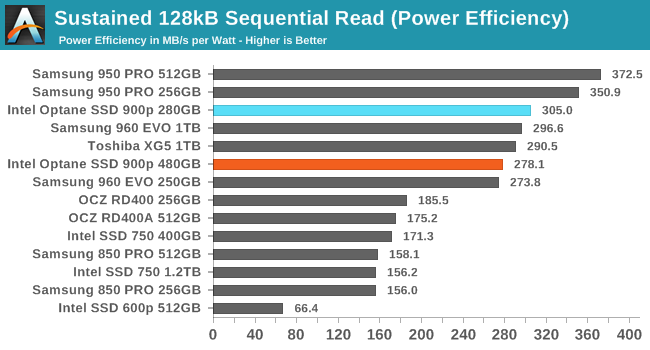
The performance lead of the Optane SSD 900p isn't enough to make up for its higher power consumption, so the 900p ends up in the second tier of drives for sequential read power efficiency, alongside Samsung's 960 generation and the Toshiba XG5.
 |
|||||||||
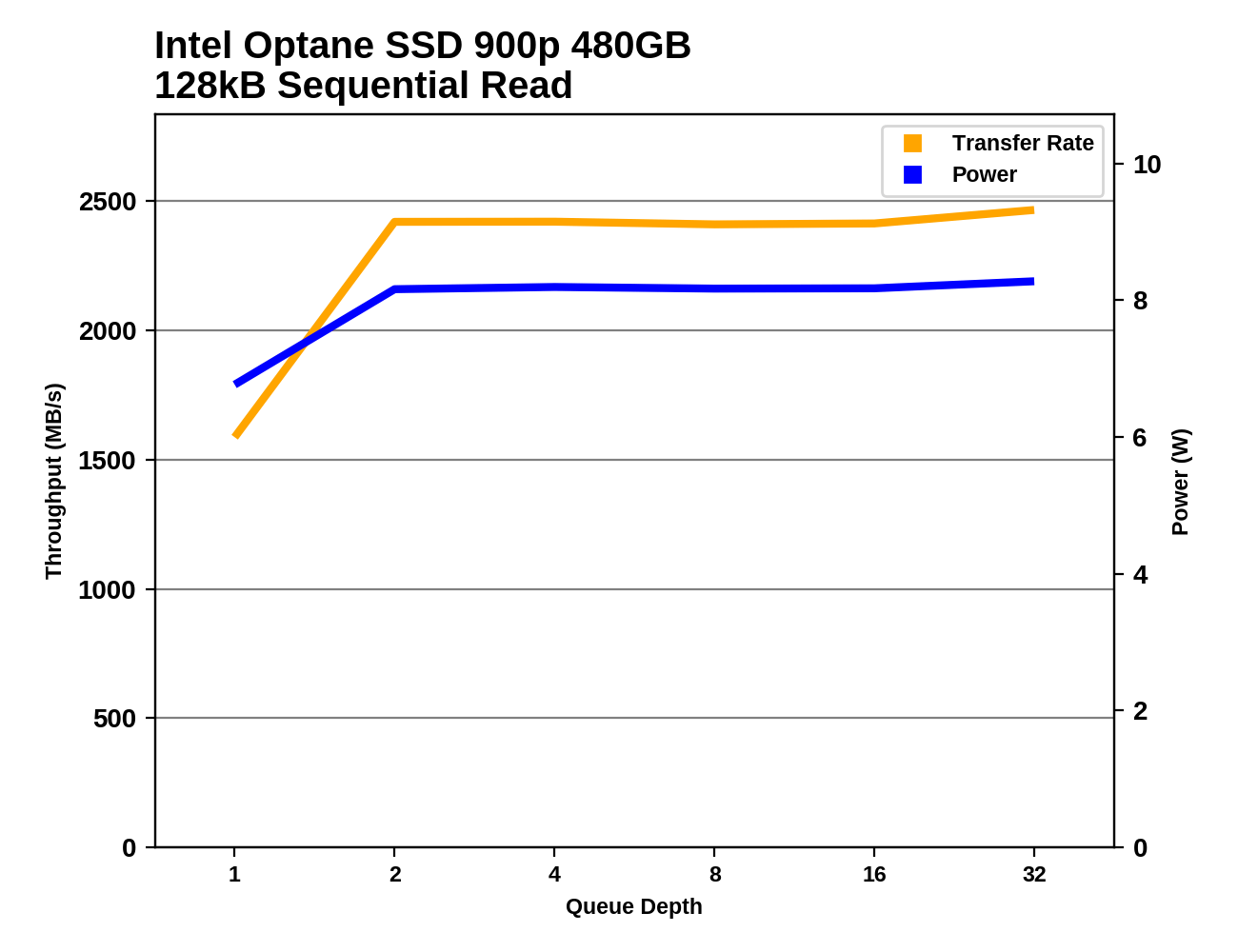
The 480GB Optane SSD 900p draws about 0.6–0.75W more than the 280GB model during the sequential read test, putting it just over 8W total when operating at full speed. Even the smaller 900p is still over 6W at QD1, while the flash-based SSDs are mostly in the 4-5W range. (The Intel SSD 750 breaks 9W at higher queue depths.)
Sequential Write Performance
Our test of sequential write burst performance is structured identically to the sequential read burst performance test save for the direction of the data transfer. Each burst writes 128MB as 128kB operations issued at QD1, for a total of 1GB of data written to a drive containing 16GB of data.
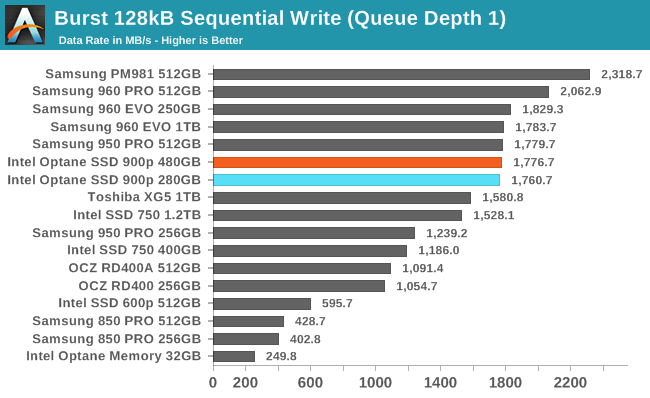
The burst sequential write performance of the Intel Optane SSD 900p is on par with some of Samsung's older NVMe SSDs, but is exceeded by the 960 generation and the PM981.
Our test of sustained sequential writes is structured identically to our sustained sequential read test, save for the direction of the data transfers. Queue depths range from 1 to 32 and each queue depth is tested for up to one minute or 32GB, followed by up to one minute of idle time for the drive to cool off and perform garbage collection. The test is confined to a 64GB span of the drive.
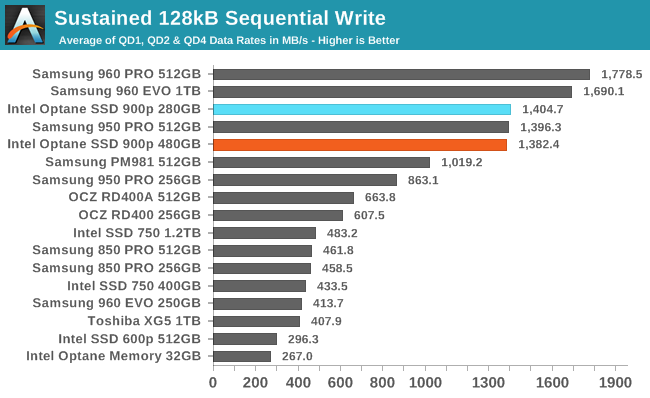
On the longer sequential write test, the Samsung PM981 falls out of first place and ends up substantially slower than the Optane SSD 900p, but the Samsung 960 PRO and EVO are still faster than the 900p.
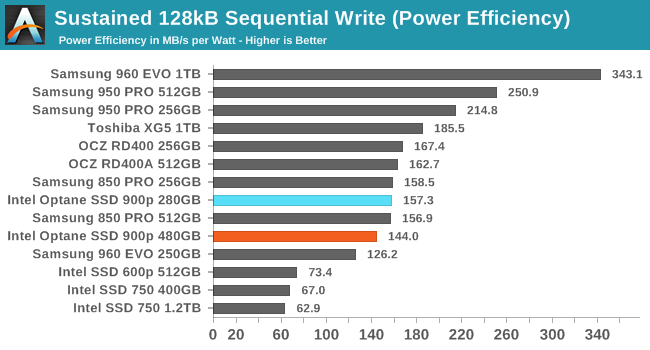
The power efficiency of the Optane SSD 900p during sequential writes is worse than most M.2 NVMe SSDs, though not as bad as the extremely power-hungry Intel SSD 750.
 |
|||||||||
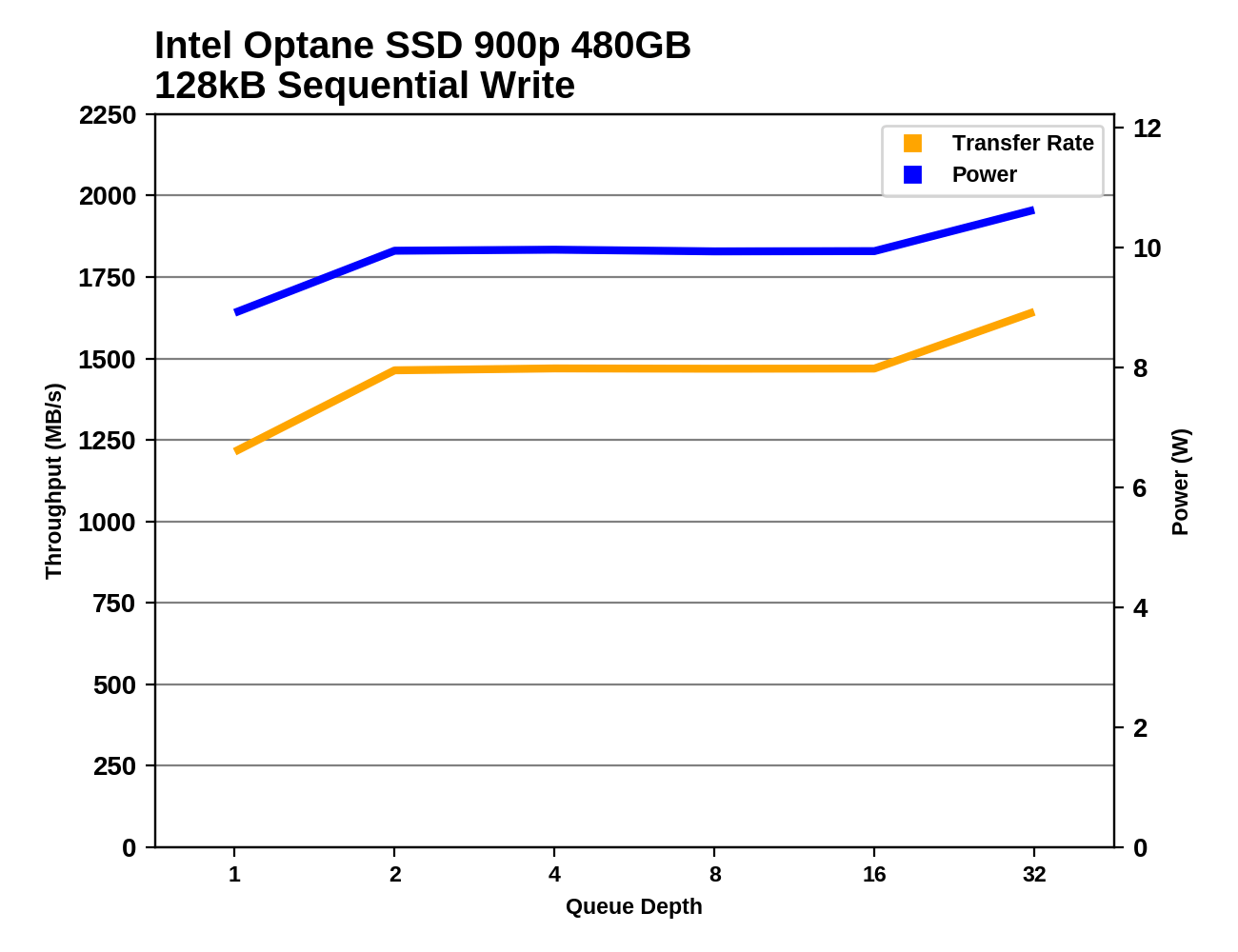
The two capacities of the Optane SSD 900p offer essentially identical sequential write performance. As with sequential reads, the difference in power consumption between the two capacities is about 0.75W, but the writes require about than 2W more than the reads.
Originally published at https://www.anandtech.com/show/12136/the-intel-optane-ssd-900p-480gb-review (Wayback Machine).