
NVIDIA GeForce FX Personal Cinema Roundup - Asus, Chaintech, eVGA, and MSI
- Posted in
- GPUs
NVIDIA NVRemote — A Page from the ATI Playbook
The NVIDIA's first remote was the most noteworthy feature of Personal Cinema. This remote communicates with the green base with infrared transmissions. The choice of this protocol allows for a cheaper solution on the remote side. Unfortunately, it means that line of sight must be achieved for it to function. Line of sight is acceptable for home theater equipment since the receiver is always in front of the device (e.g. TV, receiver, DVD player). However, the infrared nature of the remote prevents you from hiding the breakout box behind the computer or the TV. Additionally, there is no way to interact with the electronic programming guide or control the mouse pointer.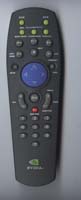
The new remote for the Personal Cinema is appropriately called NVRemote, which NVIDIA takes a page from ATI's playbook. ATI's Remote Wonder is a wireless remote manufactured by X10, which allows users to be in a completely separate room while maintaining control of the PC. The range on the remote is roughly 30 to 50 feet depending on the walls in the house.
The Remote Wonder is considerably larger than the first Personal Cinema remote and it's about the size of most home theater receiver remotes, but without all of the buttons. The buttons all have good tactile feel and are comfortable to use. We previously cited that the remote could really use a button to automatically click OK/Cancel or Yes/No when dialog boxes pop up, instead of having to navigate to the proper button and hit the left mouse button on the remote. The new software support provide this ability with the OK button, which functions as an Enter macro, and the left and right buttons to select the correct button on the dialog box pop ups. Additionally with EazyLook, ATI provides the ability to interact with the EPG on a limited basis, one channel at a time. This makes it a bit hard to schedule recordings one or two days later because it requires you to scroll horizontally from the current TV show to the desired channel and the desired time. We would like to see EazyLook implement an EPG interface similar to that on the Windows XP Media Center Edition because it would prove to be easier to schedule recordings.

Click to enlarge.
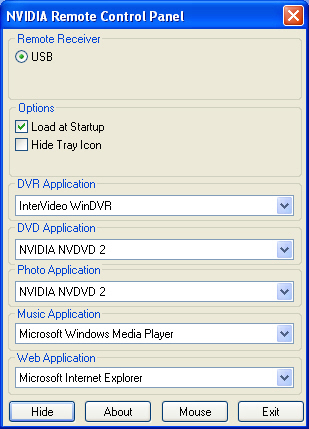
The NVRemote is basically the same as the ATI Remote Wonder (also manufactured by X10), with a few predefined abilities that the Remote Wonder doesn't have. However, there are no programmable buttons available for the NVRemote. The Remote Wonder offers the ability to emulate functions, such as shutting down the PC and any shortcut keys. The NVRemote only offers very limited changes to its use, such as changing the photo application to the “My Photos” folder. Settings, such as cursor acceleration and speed, can be set with the NVRemote, but the movement of the cursor is noticeably jerky, similar to a monitor on a very low refresh rate.
The buttons on the NVRemote seem to lack some of the natural feel that the Remote Wonder has. This is mainly in regard to the left and right buttons, which are slim and curved near the lower edge of the directional mouse pad. Ergonomically speaking, these buttons will be pressed by your thumb, and due to that, the number, closed caption, and snap shot buttons are too small. They are elliptical and their small size takes some time to get use to, particularly if you have become accustomed to using the Remote Wonder.

Click to enlarge.
The base of the NVRemote seems overlarge considering the technology powering both; the NVIDIA and ATI solution are basically the same. We prefer the base for the Remote Wonder because of its smaller profile, which is a point that we would like to see NVIDIA to improve upon.
Originally published at https://www.anandtech.com/show/1212 (Wayback Machine).