
Socket 940 Roundup: Motherboards for the Athlon64 FX
- Posted in
- Motherboards
A Closer Look at nForce3 150 Pro and VIA K8T800
We took a close look at the single-channel nForce3 150 and K8T800 in our launch review of Athlon64 Motherboards. The biggest distinction of the Socket 940 FX compared to the Socket 754 Athlon64 is the support of Dual-Channel memory. However, the memory controller for Athlon64 processors is on the processor itself, which makes the differences between chipsets for 940 and 754 fairly minimal — much less than would be seen with a chipset-based memory controller.
nVidia's nForce3 PRO is the only Athlon64/Athlon64 FX/Opteron chipset in a single-chip package. Both VIA K8T800 and SiS755 use the more familiar Northbridge/Southbridge arrangement. Key Features for nForce3 PRO are:
- Single-Chip Solution — Revolutionary single-chip solution designed for the AMD Opteron CPU enables higher-quality, full-featured motherboards and delivers maximum performance with the lowest latency. The single-chip design also means less power consumption and less heat dissipation.
- Dual-Channel DDR400 Memory — Full support for Dual-Channel DDR Registered ECC memory, and the Athlon64 version also supports non-ECC memory.
- 64-Bit Architecture — NVIDIA nForce3 Pro provides advanced processing capabilities and system innovations for the new 64-bit AMD processor architecture.
nVidia will soon introduce the nForce3 250 and 250 PRO chipsets, which they say will fully implement the 800 HT bus at full 16-bit speed, and will include support for SATA and SATA RAID. The nF3 150 is dated in terms of features, and nVidia promises that this will be corrected in the 250 incarnation.
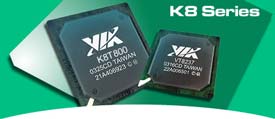
One of the most interesting features of the Athlon64/Athlon64 FX/Opteron is AMD's decision to include the memory controller on the CPU. For a chipset maker, the move of the memory controller to the CPU itself means that the chipset design is much simplified. In fact, about half of the requirements of the supporting chipset are eliminated, which allows a much simpler design. VIA chose to use a traditional North Bridge/South Bridge design instead of a single chip solution. However, VIA also added many features to the chipset like SATA RAID.
Key Features of VIA K8T800
- Supports full range of AMD Opteron/Athlon64/FX processors
- Hyper8 Technology enables 16-bit/1.6GHz HyperTransport processor-to-chipset link
- Support for AGP 8X/4X
- V-Link 533 MB/sec high bandwidth North/South Bridge interconnect
- Support for VIA Vinyl 5.1 & Vinyl Gold 7.1 Multichannel Audio Suite
- Serial ATA support for up to 4 devices
- Integrated V-RAID with RAID 0, RAID 1
- Parallel ATA133/100/66 support for up to 4 devices
- Support for up to 8 USB 2.0/USB 1.1 ports, UHCI compliant
- Support for VIA Gigabit Ethernet controller & Integrated 10/100 Fast Ethernet
- Integrated MC'97 Modem
The VIA K8T800 is a very contemporary chipset when combined with the VT8237 Southbridge. By offering SATA, SATA RAID, 8 USB 2.0, and ATA133, the feature set of the K8T800, unlike the nF3-150, is comparable to any of the best Intel boards on the market. While manufacturers have added supplementary chips to nF3-150 boards to make their boards competitive, the K8T800/VT8237 provides most of these same features with the chipset. Although the upcoming 250 chipset will bring features back into balance, for now, the VIA K8 solution has a much better feature mix than nVidia.
In the Athlon64 roundup we found no performance difference between nVidia and VIA on the single-channel A64 motherboards. However, nVidia boards did overclock further, apparently because of their ability to fix the PCI/AGP bus in BIOS. The Athlon64 chips are locked, or at the very least, “top-locked”. This means that you cannot presently exceed the stated multiplier of Athlon64 chips. However, there are utilities and even BIOS options on some boards that allow lower multipliers to be selected. All of this means that the ability to run a “locked” PCI/AGP — or Asynchronous bus — allows for better performance on motherboards designed for the Athlon64.
It is important to understand that the Athlon64 FX is quite different, since AMD, from the beginning, has emphasized that this “Enthusiast” processor is unlocked. With the ability to select both higher and lower multipliers on the FX, the choice to fix AGP/PCI is much less important. Many also do not understand that, despite what you have read, the Opteron 1xx and Athlon64 FX do differ in one very important way. The Athlon64 FX is unlocked and multipliers can be adjusted; the Opteron 1xx is multiplier locked and ratios can not be adjusted. This is a very important distinction if you plan to overclock your processor to achieve higher performance levels.
Originally published at https://www.anandtech.com/show/1210 (Wayback Machine).