
The Intel Optane SSD 900P 280GB Review
BAPCo SYSmark 2014 SE
BAPCo's SYSmark 2014 SE is an application-based benchmark that uses real-world applications to replay usage patterns of business users in the areas of office productivity, media creation and data/financial analysis. In addition, it also addresses the responsiveness aspect which deals with user experience as related to application and file launches, multi-tasking etc. Scores are calibrated against a reference system that is defined to score 1000 in each of the scenarios. A score of, say, 2000, would imply that the system under test is twice as fast as the reference system.
SYSmark scores are based on total application response time as seen by the user, including not only storage latency but time spent by the processor. This means there's a limit to how much a storage improvement could possibly increase scores, because the SSD is only in use for a small fraction of the total test duration. This is a significant difference from our ATSB tests where only the storage portion of the workload is replicated and disk idle times are cut short to a maximum of 25ms.
| AnandTech SYSmark SSD Testbed | |
| CPU | Intel Core i5-7400 |
| Motherboard | ASUS B250-PLUS |
| Chipset | Intel B250 |
| Memory | 2x 8GB Kingston DDR4-2400 CL17 |
| Case | In Win C583 |
| Power Supply | Cooler Master G550M |
| OS | Windows 10 64-bit, version 1703 |
Our SSD testing with SYSmark uses a different test system than the rest of our SSD tests. This machine is set up to measure total system power consumption rather than just the drive's power.
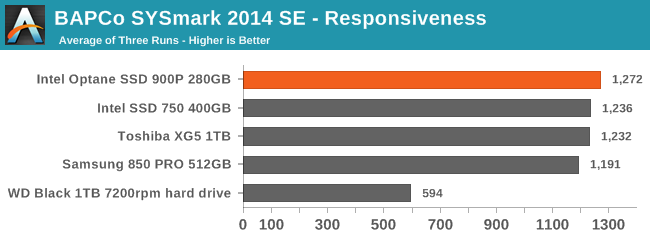
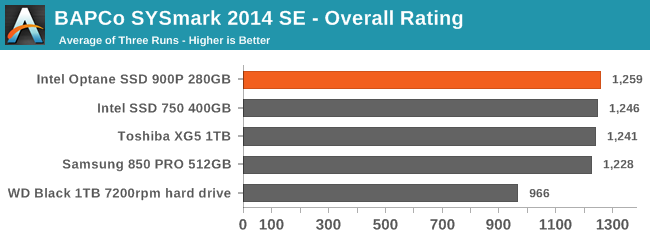
SYSmark 2014 SE doesn't come close to stressing the storage system enough to show meaningful distinctions between high-end NVMe SSDs. The Responsiveness sub-test is the most sensitive to storage performance, and only shows a few percent difference between most SSDs. The overall test barely registers a difference at all. But with my primary power meter broken, SYSmark does provide a rough assessment of how power hungry the Intel Optane SSD 900P is:
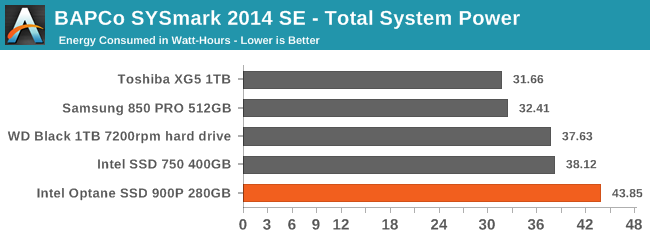
The SYSmark energy usage scores measure total system power consumption, excluding the display. Our SYSmark test system idles at around 26 W and peaks at over 60 W measured at the wall during the benchmark run. SATA SSDs seldom exceed 5 W and idle at a fraction of a watt, and the SSDs spend most of the test idle.
Despite being the fastest drive in this bunch and thus the one with the shortest SYSmark run times, the Optane SSD 900P used far more energy over the course of the three SYSmark runs. With higher idle power than even the Intel SSD 750 and similar power draw under load, the Optane SSD 900P really needs its heatsink. Intel is a very long way off from being able to package this level of performance in a M.2 SSD.
Originally published at https://www.anandtech.com/show/11953/the-intel-optane-ssd-900p-review (Wayback Machine).