
Dell Latitude X300: A Traveler's Companion
- Posted in
- Laptops
Construction — Under the Hood
The performance of the X300 comes from the use of Intel's Centrino technology. Our system came configured with a 1.2GHz Pentium-M processor, the Intel 855GM chipset, 256MB DDR PC2100 memory, WiFi connectivity, and a 40.0GB 5400RPM hard drive.The low voltage 1.2GHz Pentium-M that the X300 uses is a slower version of the Pentium-M family, as it has a smaller thermal footprint. Like the other ultraportable systems we have looked at, the CPU for the X300 is mounted directly on the system's motherboard. This is most likely in order to save space and quite frankly, doesn't bother us. Even if it were socketed, it would be hard to upgrade the CPU, because it is hard to get access and acquiring a single socketed Pentium-M would be extremely difficult. Note that the CPU makes contact with the heatsink with some thermal grease.

Click to enlarge.
The CPU and northbridge is cooled via an aluminum heatsink and fan. The heatsink surface connects to the CPU via a copper heat pipe. The fan that the unit employs is temperature controlled, and remained quiet throughout the duration of the testing on the whole.
|
|
|
| Click to enlarge. |
Click to enlarge. |


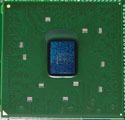
Mounted directly below the CPU is the system's 855GM northbridge. From our talks with IBM regarding the IBM X31, we learned that the 855GM (integrated graphics) has poorer content creation performance compared to discrete graphic processors, such as the Mobility Radeon. It seems that Dell has chosen to maximize the use of space over this type of performance margin.
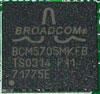
The system's ethernet controller is located on the top side of the motherboard. Our X300 came outfitted with the Broadcom BCM5705MKFB Gigabit ethernet controller. While the X300 doesn't support Gigabit ethernet, the addition of MediaBase supports Gigabit via the same chip. Dell told us that they used this chip so that the driver and the use of the MediaBase would be seamless. Additionally, Dell explains that the reason behind the lack of ethernet support on the system is due to space (specifically height) issues, which only allow the placement for a smaller transformer (one pair of the two pairs of pins on the transformer needed for Gigabit support).
The AC'97 audio codec is also on the bottom of the motherboard. For this, Dell turned to the SigmaTel C-Major STAC9750T.

As seen below, the motherboard of the X300 is fairly small and packed.

Click to enlarge.
Originally published at https://www.anandtech.com/show/1188 (Wayback Machine).