
The ADATA XPG SX950 480GB SSD Review: In Search of Premium
AnandTech Storage Bench - The Destroyer
The Destroyer is an extremely long test replicating the access patterns of very IO-intensive desktop usage. A detailed breakdown can be found in this article. Like real-world usage, the drives do get the occasional break that allows for some background garbage collection and flushing caches, but those idle times are limited to 25ms so that it doesn't take all week to run the test. These AnandTech Storage Bench (ATSB) tests do not involve running the actual applications that generated the workloads, so the scores are relatively insensitive to changes in CPU performance and RAM from our new testbed, but the jump to a newer version of Windows and the newer storage drivers can have an impact.
We quantify performance on this test by reporting the drive's average data throughput, the average latency of the I/O operations, and the total energy used by the drive over the course of the test.
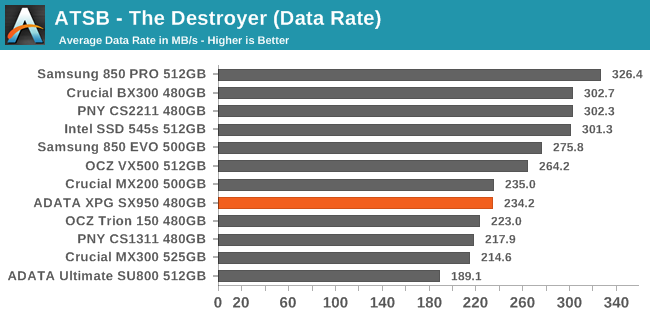
The ADATA XPG SX950 is the slowest MLC SSD in this group, going by its average data rate on The Destroyer, while the similarly-equipped Crucial BX300 is the second-fastest SATA drive in the half-TB capacity class.
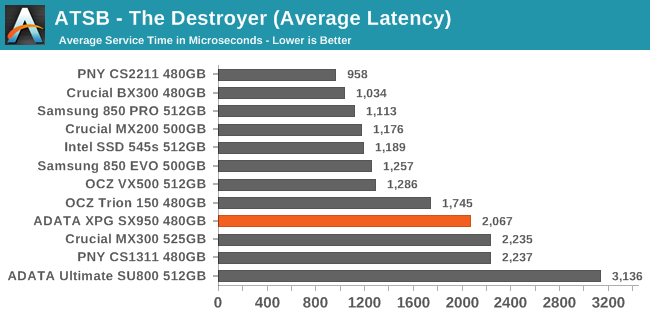
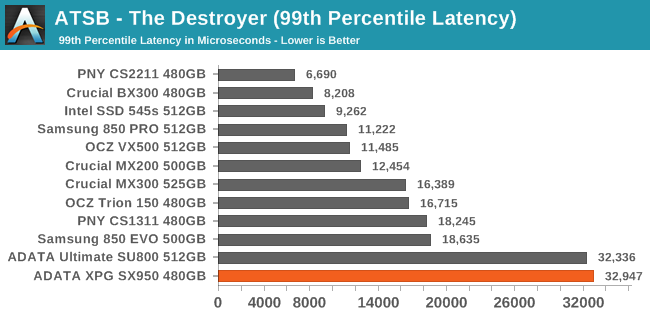
ADATA has a latency problem on The Destroyer. The SX950's average latency is much worse than any other MLC SSD, and the 99th percentile latency as bad as the TLC-based SU800, which was already an extreme outlier.
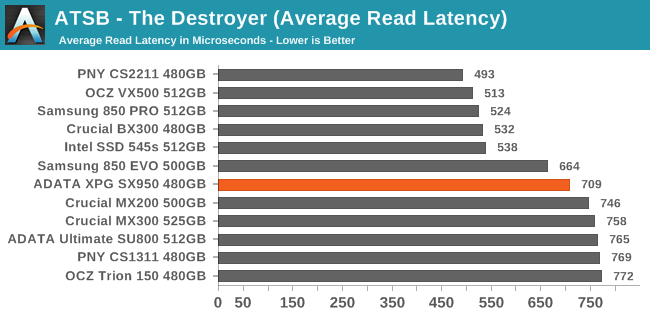
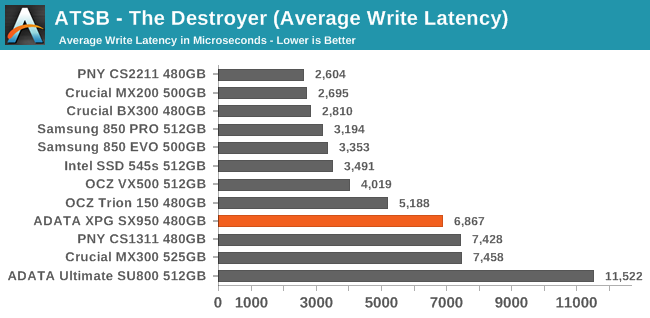
Splitting the average latency up by read and write operations, it's clear that the SX950's troubles are mostly on the write side, though the average read latency is also more typical of a TLC SSD than one with 3D MLC.
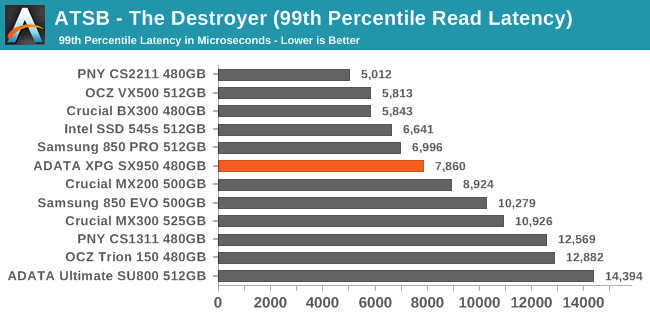
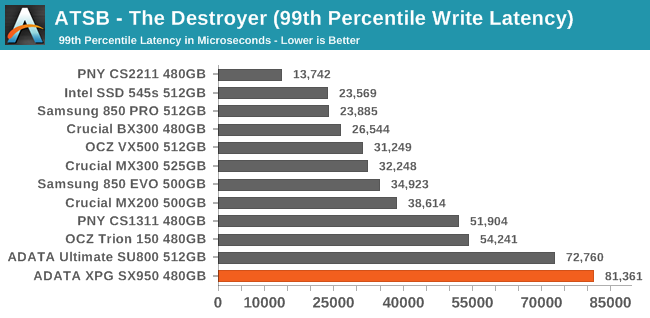
The 99th percentile read latency of the ADATA SX950 is not much worse than other 3D MLC SSDs, but the 99th percentile write latency on The Destroyer is unusually high at over 81ms. It appears that the SX950 is being quite aggressive with its SLC caching, leading to a serious backlog when it is finally forced to perform garbage collection. The BX300 avoids this by using relatively small fixed-size SLC caches.
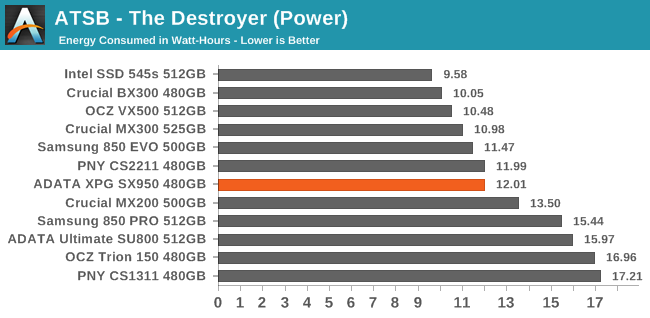
Given the mediocre data rate and poor QoS indicating a lot of background work, it's not too surprising to see that the SX950's energy usage on The Destroyer is substantially higher than the Crucial BX300 and most other 3D NAND SSDs. The SX950 does shave 25% off the energy usage of the TLC-based ADATA SU800, but Crucial still does much better with the same controller.
Originally published at https://www.anandtech.com/show/11879/the-adata-xpg-sx950-480gb-ssd-review (Wayback Machine).