
Memory Scaling on Ryzen 7 with Team Group's Night Hawk RGB
Test Bed Setup
As per our testing policy, we take a premium category motherboard suitable for the socket, and equip the system with a suitable amount of memory. With this test setup, we are using the BIOS to set the frequency using the provided straps on the GIGABYTE Aorus AX370-Gaming 5 motherboard.
| Test Setup | |||
| Processor | AMD Ryzen 7 1700, 65W, $300 MSRP, 8 Cores, 16 Threads 3.0 GHz Base, 3.7 GHz Turbo |
||
| Motherboard | GIGABYTE AX370-GAMING 5 | ||
| Cooling | Thermaltake Floe Riing RGB 360 | ||
| Power Supply | Thermaltake Toughpower Grand 1200 W Gold PSU | ||
| Memory | Team Group Night Hawk RGB DDR4-3000 16-18-18 2x8 GB 1.35 V |
||
| Video Card | ASUS GTX 980 STRIX 1178 MHz Base, 1279 MHz Boost) |
||
| Hard Drive | Crucial MX300 1 TB | ||
| Case | Open Test Bed | ||
| Operating System | Windows 10 Pro | ||
Many thanks to...
We must thank the following companies for kindly providing hardware for our multiple test beds.
Thank you to ASUS for providing us with GTX 980 Strix GPUs. At the time of release, the STRIX brand from ASUS was aimed at silent running, or to use the marketing term: '0dB Silent Gaming'. This enables the card to disable the fans when the GPU is dealing with low loads well within temperature specifications. These cards equip the GTX 980 silicon with ASUS' Direct CU II cooler and 10-phase digital VRMs, aimed at high-efficiency conversion. Along with the card, ASUS bundles GPU Tweak software for overclocking and streaming assistance.
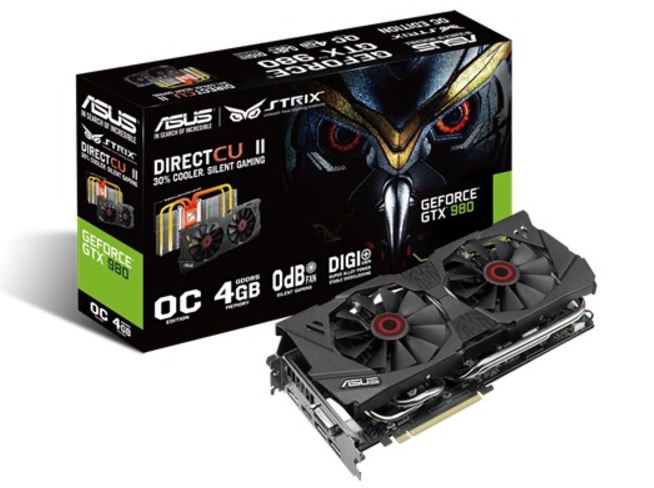
The GTX 980 uses NVIDIA's GM204 silicon die, built upon their Maxwell architecture. This die is 5.2 billion transistors for a die size of 298 mm2, built on TMSC's 28nm process. A GTX 980 uses the full GM204 core, with 2048 CUDA Cores and 64 ROPs with a 256-bit memory bus to GDDR5. The official power rating for the GTX 980 is 165W.
The ASUS GTX 980 Strix 4GB (or the full name of STRIX-GTX980-DC2OC-4GD5) runs a reasonable overclock over a reference GTX 980 card, with frequencies in the range of 1178-1279 MHz. The memory runs at stock, in this case, 7010 MHz. Video outputs include three DisplayPort connectors, one HDMI 2.0 connector, and a DVI-I.
Further Reading: AnandTech's NVIDIA GTX 980 Review
Thank you to Crucial for providing us with MX300 SSDs. Crucial stepped up to the plate as our benchmark list grows larger with newer benchmarks and titles, and the 1TB MX300 units are strong performers. Based on Marvell's 88SS1074 controller and using Micron's 384Gbit 32-layer 3D TLC NAND, these are 7mm high, 2.5-inch drives rated for 92K random read IOPS and 530/510 MB/s sequential read and write speeds.

The 1TB models we are using here support TCG Opal 2.0 and IEEE-1667 (eDrive) encryption and have a 360TB rated endurance with a three-year warranty.
Further Reading: AnandTech's Crucial MX300 (750 GB) Review
Originally published at https://www.anandtech.com/show/11857/memory-scaling-on-ryzen-7-with-team-groups-night-hawk-rgb (Wayback Machine).