
One Design, Two Products: The SanDisk Ultra 3D (1TB) and WD Blue 3D (1TB) SSD Reviews, with BiCS 3D NAND
AnandTech Storage Bench - Light
Our Light storage test has relatively more sequential accesses and lower queue depths than The Destroyer or the Heavy test, and it's by far the shortest test overall. It's based largely on applications that aren't highly dependent on storage performance, so this is a test more of application launch times and file load times. This test can be seen as the sum of all the little delays in daily usage, but with the idle times trimmed to 25ms it takes less than half an hour to run. Details of the Light test can be found here. As with the ATSB Heavy test, this test is run with the drive both freshly erased and empty, and after filling the drive with sequential writes.
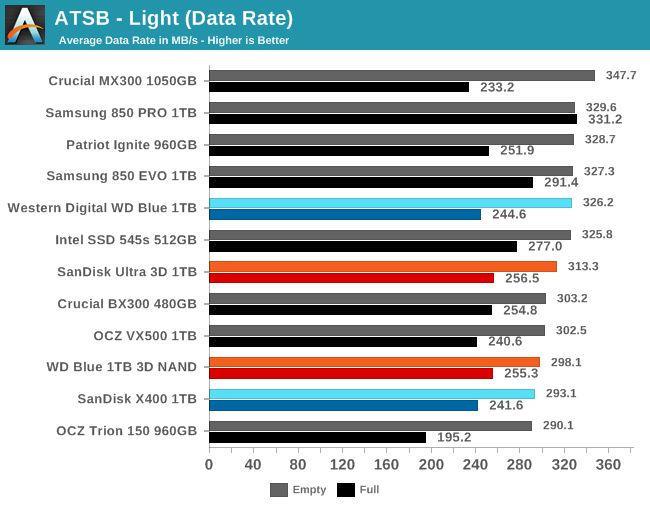
Orange is for the new drives, Blue is for the previous generation models
The new Western Digital 3D NAND SSDs don't show any improvement in average data rate on the Light test when the test is run on an empty drive, but performance when the drive is full is slightly better.
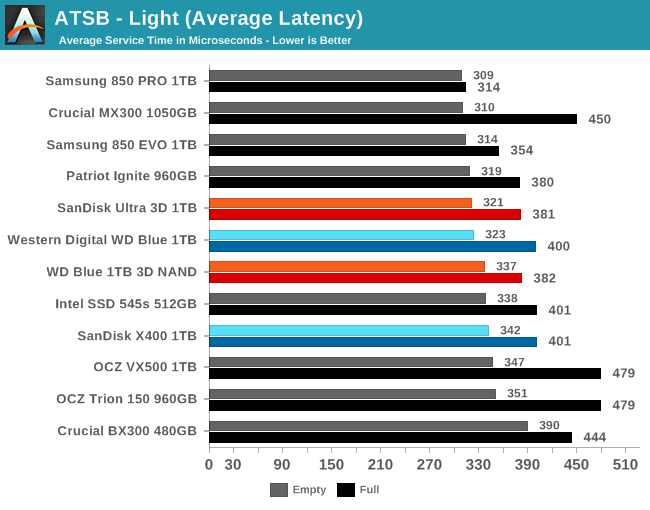
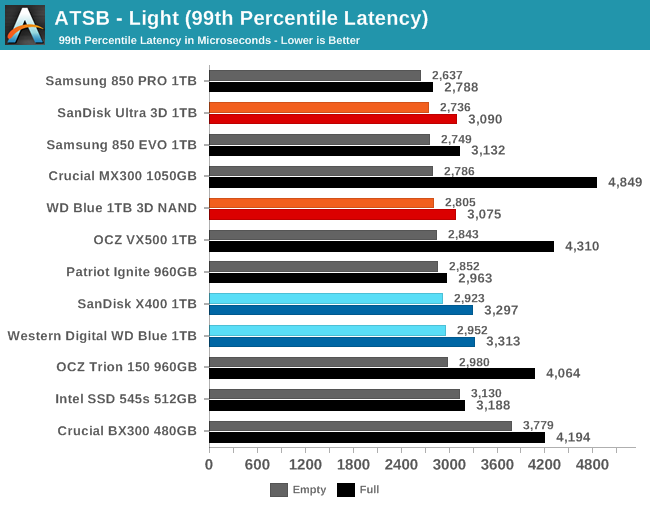
The average and 99th percentile latencies generally show no meaningful change for the new 3D NAND SSDs over their planar TLC predecessors; both new and old generations fall within the normal range of variation for most of their competitors. The full-drive latency scores for the new Western Digital 3D NAND SSDs are slightly improved and the difference between full and empty drive performance is relatively small.
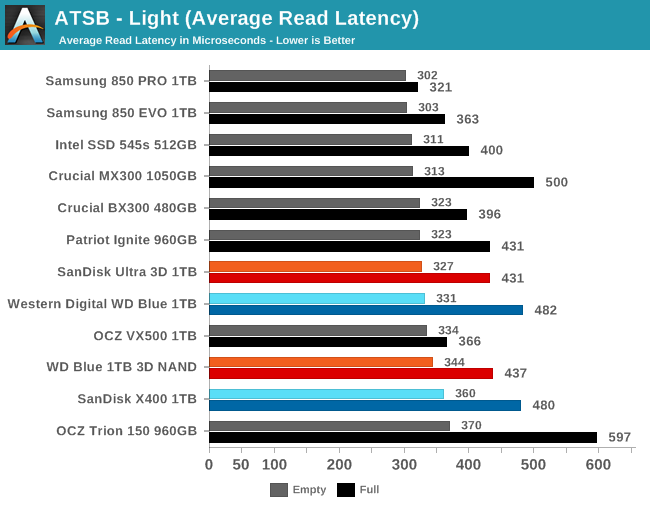
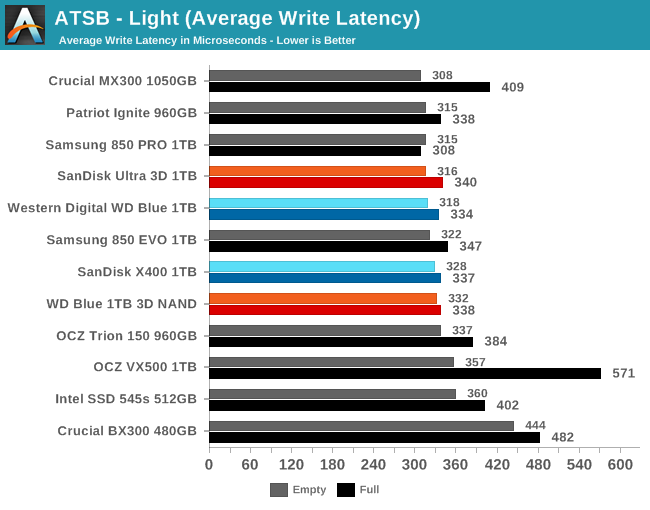
Splitting the average latency by reads and writes doesn't reveal anything interesting about the WD and SanDisk drives, though it does show that the drives with poor full-drive performance differ in how they are affected: the Crucial MX300 has significantly higher read and write latency, while the OCZ VX500 is mostly affected on the write side and the OCZ Trion 150 is mostly affected on the read side.
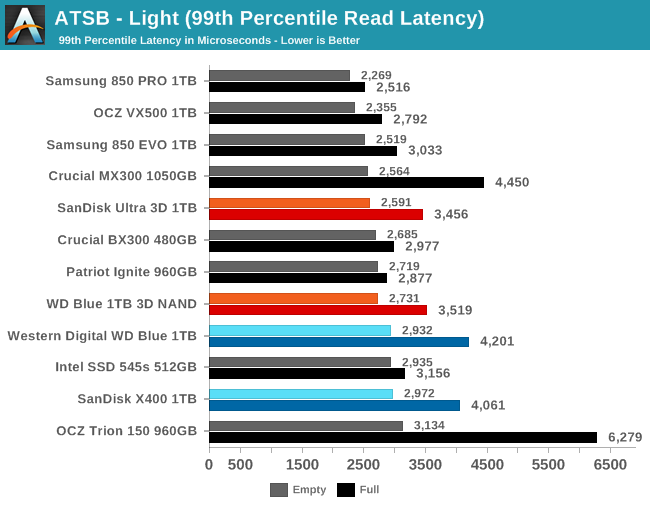
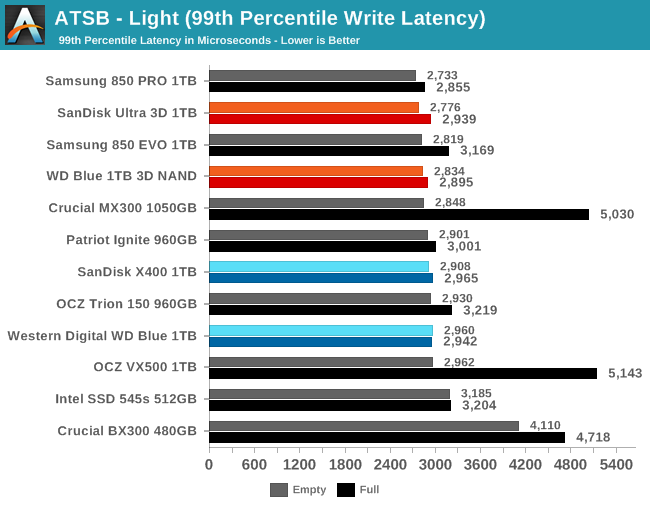
There's a small but clear improvement to 99th percentile read latency for the new WD/SanDisk drives, while the 99th percentile write latencies are quite similar for almost all of the drives in this bunch.
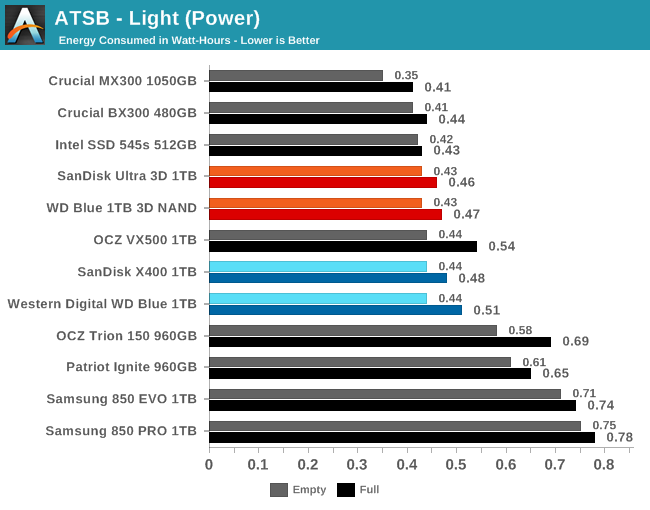
The energy usage differences between most of these SSDs are insignificant; only the Crucial MX300 stands out with clearly lower power consumption than the WD/SanDisk drives. The Samsung and Phison-based drives use more energy than most.
Originally published at https://www.anandtech.com/show/11792/the-sandisk-ultra-3d-1tb-and-western-digital-wd-blue-3d-nand-1tb-ssd-review (Wayback Machine).