
One Design, Two Products: The SanDisk Ultra 3D (1TB) and WD Blue 3D (1TB) SSD Reviews, with BiCS 3D NAND
AnandTech Storage Bench - The Destroyer
The Destroyer is an extremely long test replicating the access patterns of very IO-intensive desktop usage. A detailed breakdown can be found in this article. Like real-world usage, the drives do get the occasional break that allows for some background garbage collection and flushing caches, but those idle times are limited to 25ms so that it doesn't take all week to run the test. These AnandTech Storage Bench (ATSB) tests do not involve running the actual applications that generated the workloads, so the scores are relatively insensitive to changes in CPU performance and RAM from our new testbed, but the jump to a newer version of Windows and the newer storage drivers can have an impact.
We quantify performance on this test by reporting the drive's average data throughput, the average latency of the I/O operations, and the total energy used by the drive over the course of the test.
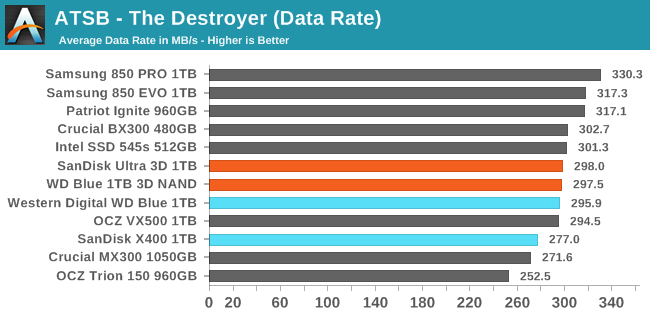
Orange is for the new drives, Blue is for the previous generation models
The new 3D NAND gives a minimal improvement in average data rate on The Destroyer for Western Digital's SSDs. SanDisk's 3D NAND is faster than Micron's first-generation 32L 3D TLC NAND as used in the Crucial MX300, but not quite as fast as the second-generation 64L 3D TLC in the Intel 545s. The Samsung 850 EVO remains the fastest SATA SSD with TLC on this test.
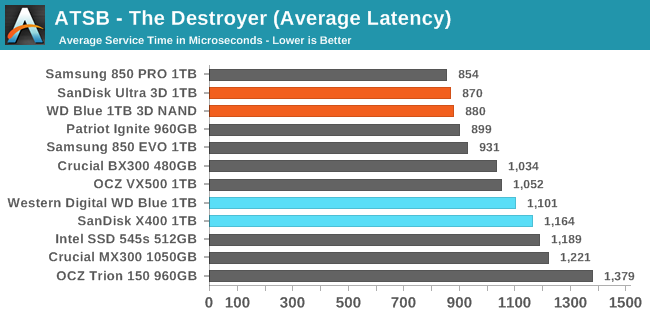
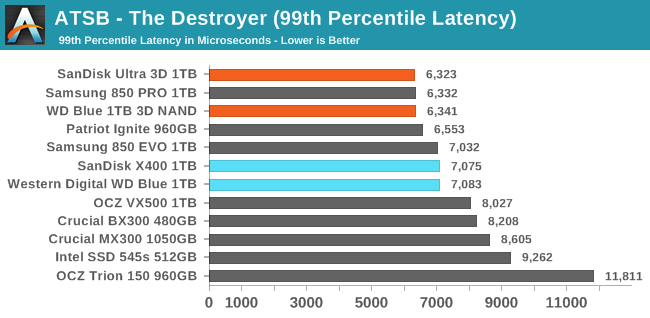
The new WD Blue and SanDisk Ultra 3D show substantial improvements in both average and 99th percentile latency, putting them on par with the Samsung 850 PRO and ahead of any other SATA TLC SSD.
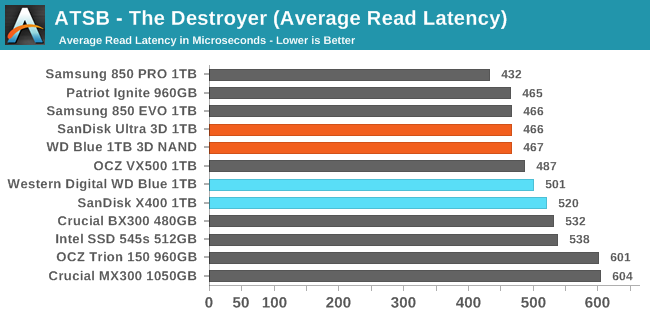
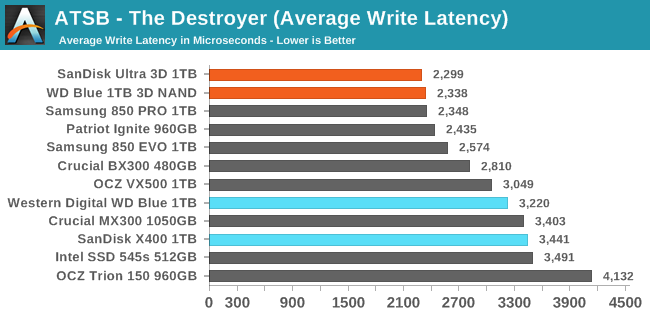
The average read and write latency on The Destroyer have both improved with SanDisk's 3D TLC compared to the planar 15nm TLC, with the more significant improvement being to write latency, where the new Western Digital SSDs are at the top of the chart.
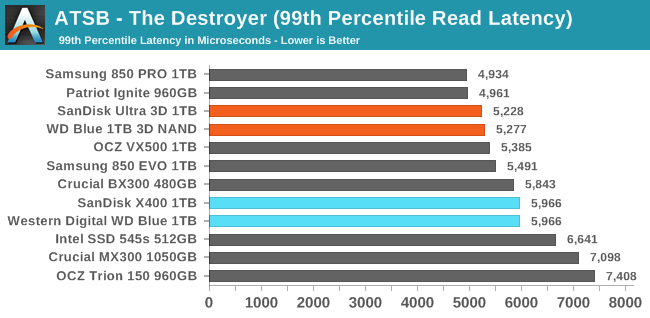
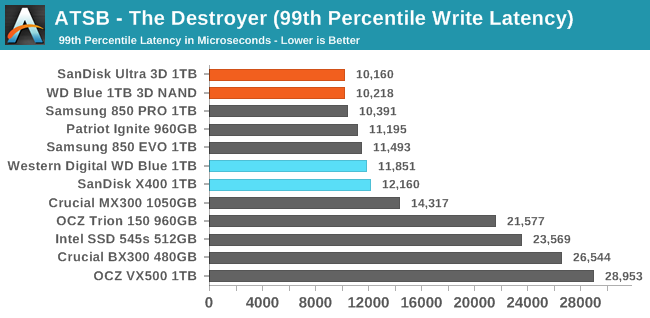
The 99th percentile latencies don't show quite as much improvement as the averages above, but there is still a clear improvement for both reads and writes that put the new WD and SanDisk drives ahead of anything else that uses TLC.
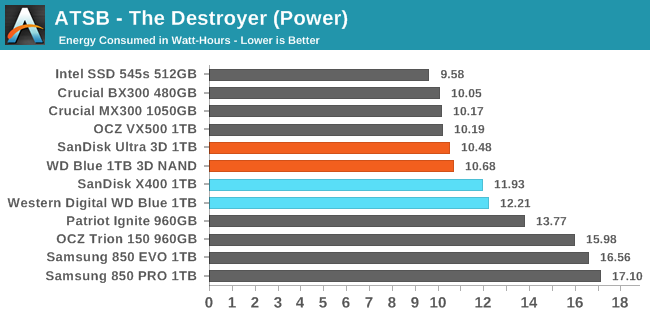
Energy efficiency is much improved with SanDisk's 3D TLC compared to their 15nm planar TLC. The Crucial MX300 uses a bit less energy despite being slower on The Destroyer, and the Intel 545s with its Silicon Motion controller still comes out on top. While Samsung's older 850 PRO and 850 EVO are still quite good in terms of performance, their energy usage now stands out as higher than the modern competition.
Originally published at https://www.anandtech.com/show/11792/the-sandisk-ultra-3d-1tb-and-western-digital-wd-blue-3d-nand-1tb-ssd-review (Wayback Machine).