
The HP S700 And S700 Pro SSD Review
AnandTech Storage Bench - Light
Our Light storage test has relatively more sequential accesses and lower queue depths than The Destroyer or the Heavy test, and it's by far the shortest test overall. It's based largely on applications that aren't highly dependent on storage performance, so this is a test more of application launch times and file load times. This test can be seen as the sum of all the little delays in daily usage, but with the idle times trimmed to 25ms it takes less than half an hour to run. Details of the Light test can be found here. As with the ATSB Heavy test, this test is run with the drive both freshly erased and empty, and after filling the drive with sequential writes.
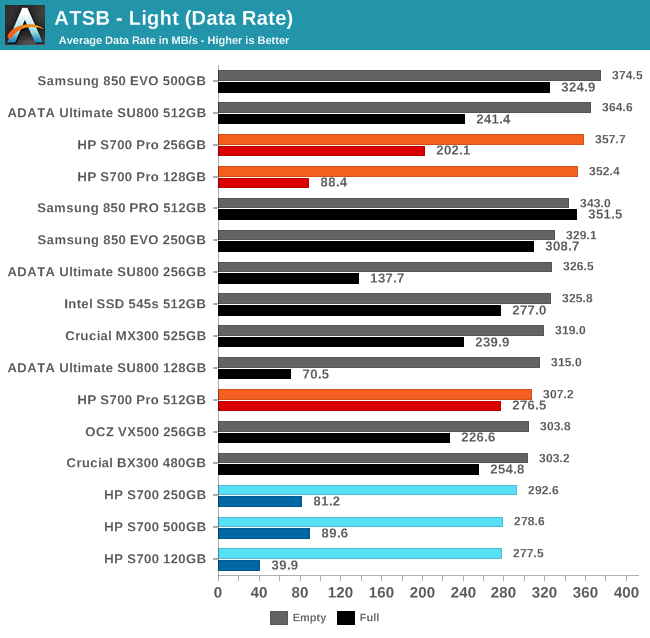
On our lightest ATSB test, the average data rate scores are not as widely variable and higher capacity doesn't always translate to a clearly higher score. The empty-drive performance of the HP S700 is slower than everything else regardless of capacity, but not by a huge margin. When the drives are full, the HP S700's performance drops precipitously, but the 512GB HP S700 Pro retains more performance than even Crucial's drives.
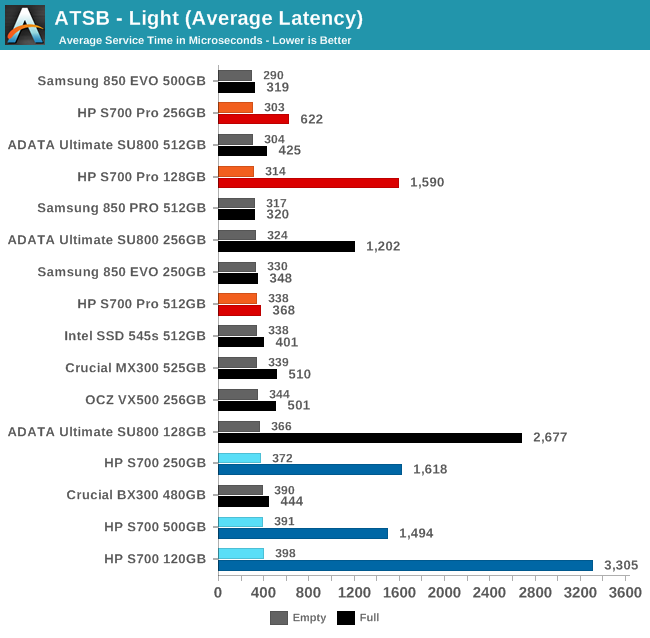
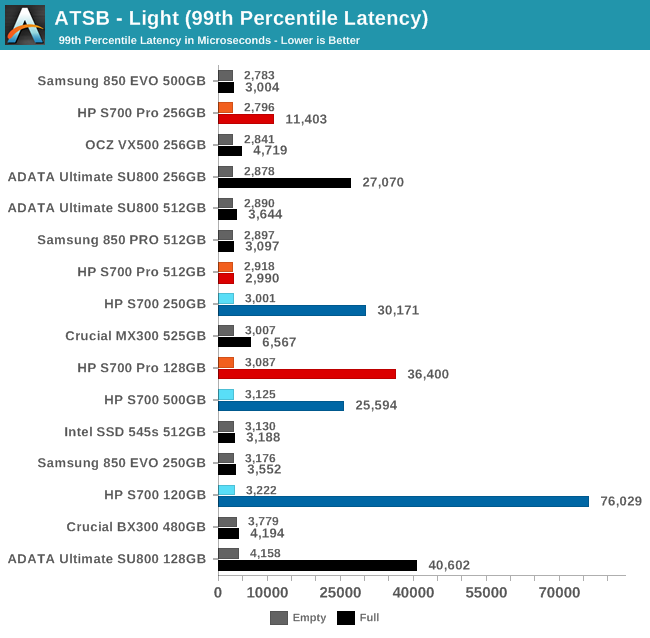
None of these drives has a problem with average latency when the Light test is run on an empty drive. The ADATA SU800, HP S700 and the smaller two capacities of the S700 Pro show much higher average latency when full, but on a test this light the worst scores are still in the low millisecond range. The 99th percentile latency scores paint a similar picture of all the drives being fine until they're full, and the 512GB S700 Pro handles being full quite well.
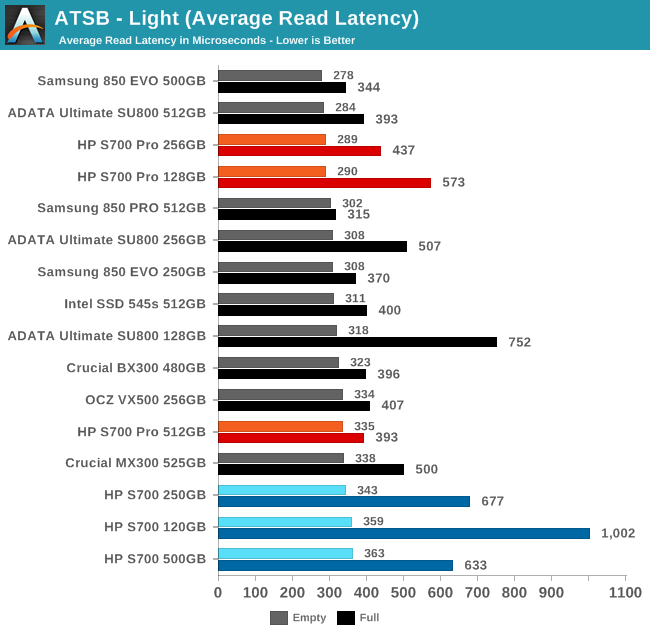
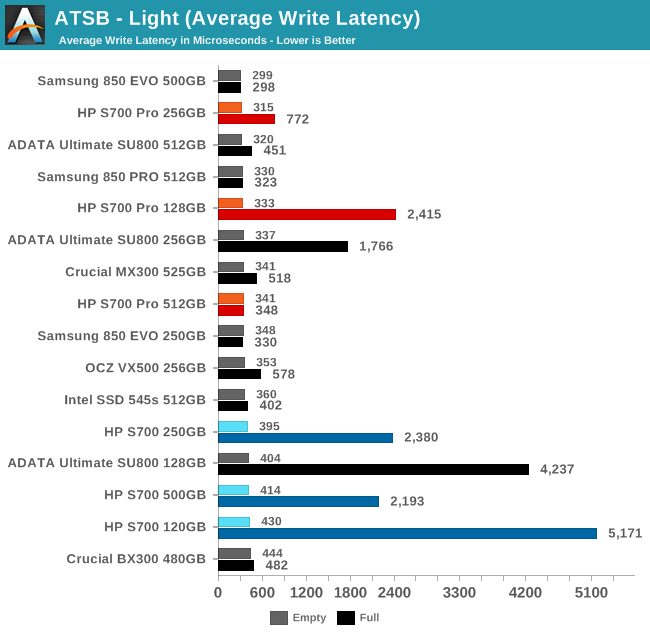
The 120GB S700 is the only drive in this bunch where average read latency exceeds 1ms when the test is run on a full drive. Average write latencies can climb to over 1ms for several drives, and the 120GB S700 breaks 5ms in the worst-case conditions for the Light test.
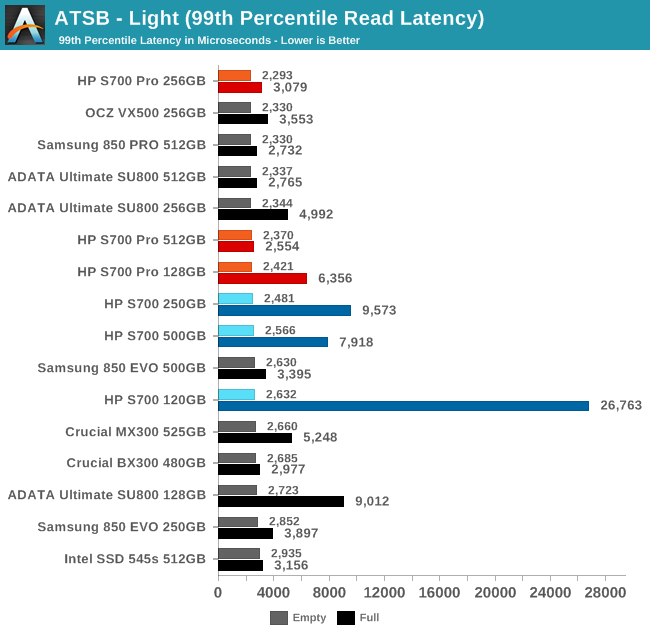
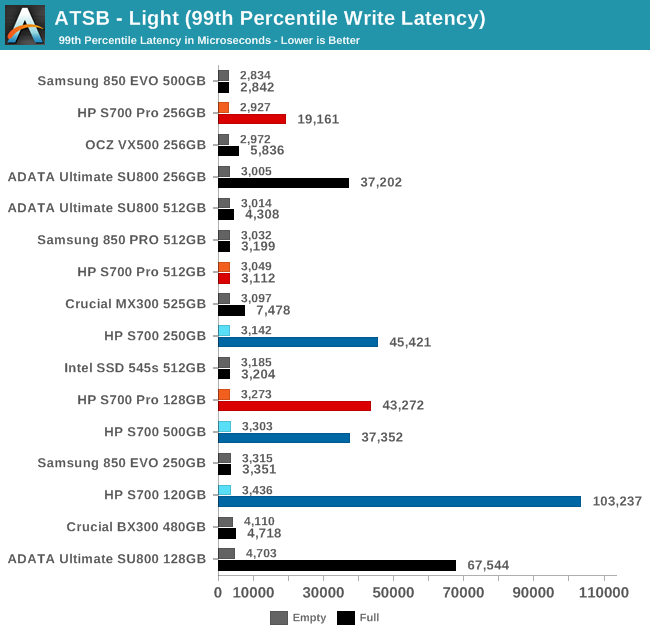
The 99th percentile read and write latencies are all in the low-millisecond range when the Light test is run on an empty drive. With the drives full, the worst case is again the 120GB S700, with thirty times higher 99th percentile write latency. But since this is still only 100ms, even this slowest drive doesn't produce noticeable pauses during ordinary use for light workloads.
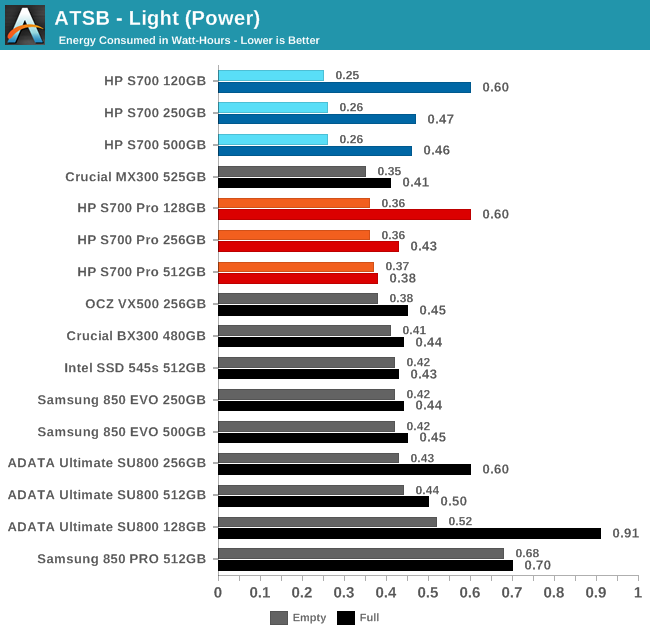
All three HP S700s top the energy efficiency charts, and the S700 Pros aren't far behind. Energy efficiency is worse when the test is run on a full drive, but the result is that the S700 Pro ends up at the top instead of the S700. Before TLC NAND took over the mainstream SSD market, Silicon Motion's controllers were known for great efficiency. HP's drives show off Silicon Motion's efficiency much better than the ADATA SU800 did.
Originally published at https://www.anandtech.com/show/11790/the-hp-s700-and-s700-pro-ssd-review (Wayback Machine).