
The Crucial BX300 (480GB) SSD Review: Back To MLC
Sequential Read Performance
Our first test of sequential read performance uses short bursts of 128MB, issued as 128kB operations with no queuing. The test averages performance across eight bursts for a total of 1GB of data transferred from a drive containing 16GB of data. Between each burst the drive is given enough idle time to keep the overall duty cycle at 20%.
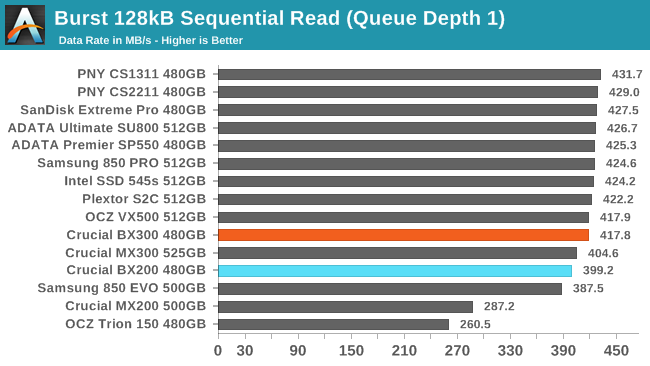
The sequential read burst speed of the Crucial BX300 is faster than any previous Crucial drive, but only just barely catches up to the rest of the market.
Our test of sustained sequential reads uses queue depths from 1 to 32, with the performance and power scores computed as the average of QD1, QD2 and QD4. Each queue depth is tested for up to one minute or 32GB transferred, from a drive containing 64GB of data.
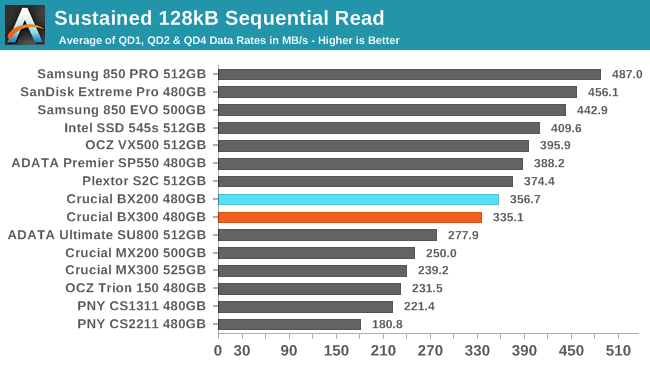
The sustained sequential read performance of the BX300 actually shows a regression from the BX200, though both drives fall in the middle of the pack and above Crucial's MX drives. The fastest SATA SSD (Samsung 850 PRO) is 45% faster than the BX300, and even the Intel 545s is 22% faster.
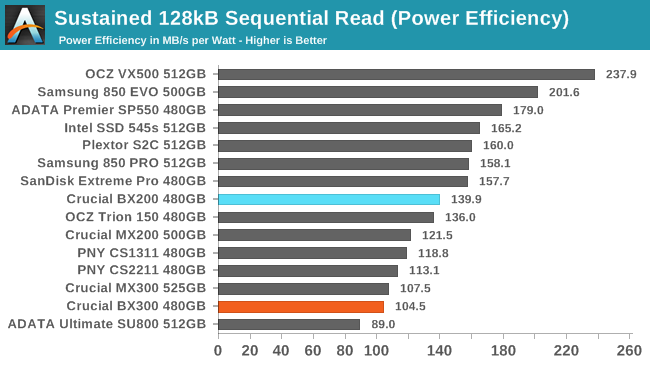
The power efficiency of the Crucial BX300 on the sequential read test is poor, and the other two drives that use Micron's 3D NAND (as TLC) join the BX300 at the bottom of the chart. The Intel 545s does well on this efficiency score, so Micron will probably be able to shore up this weakness in future products when they adopt their 64L 3D NAND.
 |
|||||||||
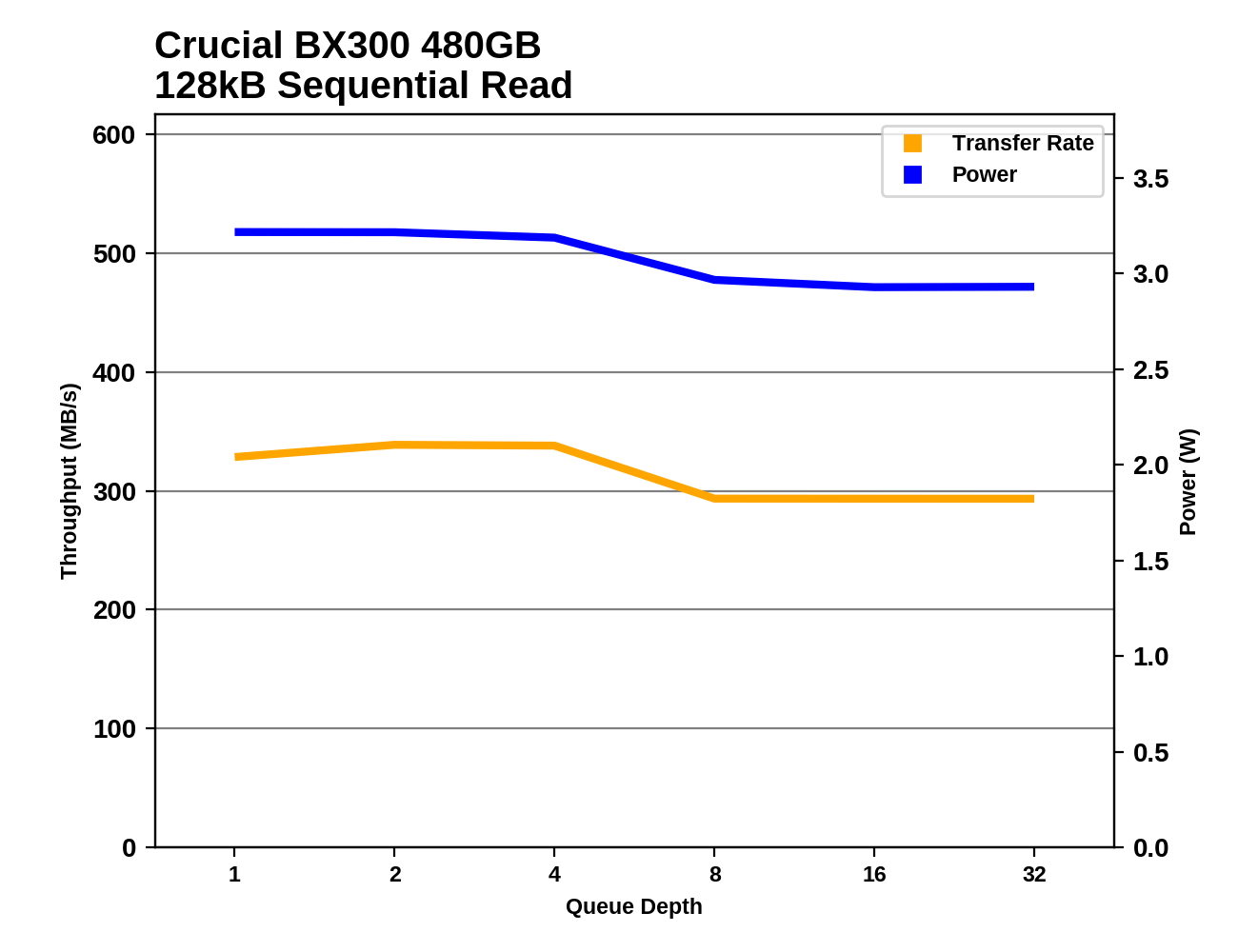
Samsung's SSDs are the best-behaved on this test, with performance saturating at QD2 and consistently staying there through the rest of the test. The MX300 is also quite consistent through this test, but with much lower performance overall.
Sequential Write Performance
Our test of sequential write burst performance is structured identically to the sequential read burst performance test save for the direction of the data transfer. Each burst writes 128MB as 128kB operations issued at QD1, for a total of 1GB of data written to a drive containing 16GB of data.
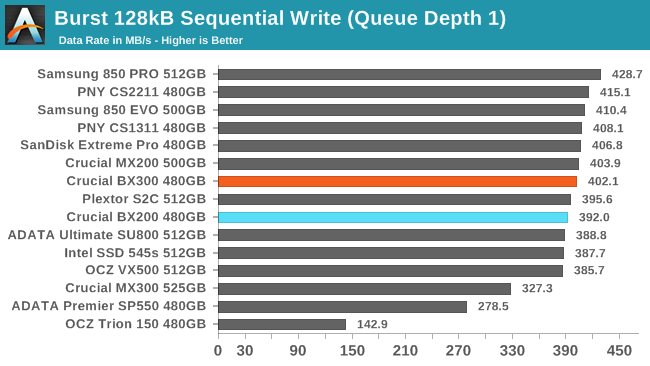
The burst sequential write speed of the BX300 is good, but not enough for it to stand out from the crowd or to beat the MX200. The MX300 stands out for being substantially slower than most SATA SSDs.
Our test of sustained sequential writes is structured identically to our sustained sequential read test, save for the direction of the data transfers. Queue depths range from 1 to 32 and each queue depth is tested for up to one minute or 32GB, followed by up to one minute of idle time for the drive to cool off and perform garbage collection. The test is confined to a 64GB span of the drive.
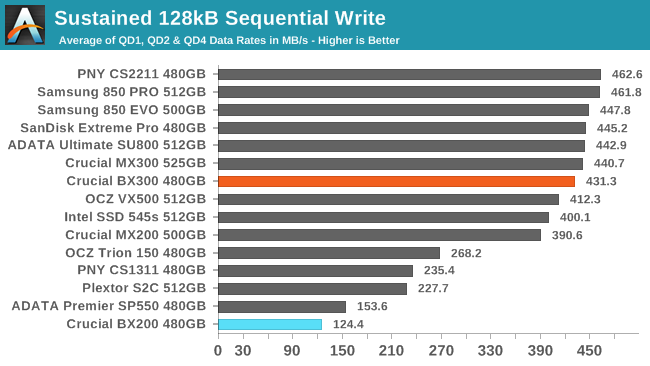
On the longer sequential write test, the BX300 stays in the top half of the chart and performs close to the top tier of drives, but is a bit slow given that it uses 3D MLC.
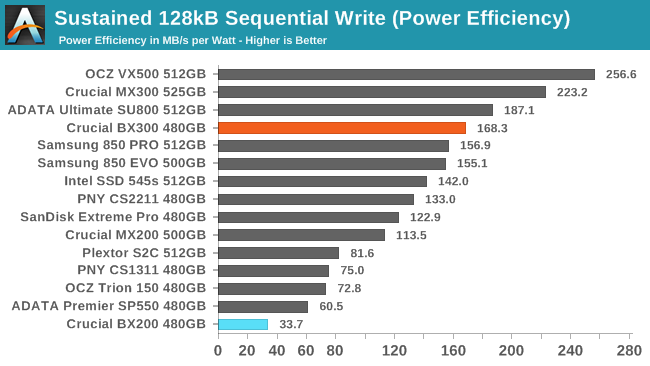
The power efficiency of the Crucial BX300 is a bit better than Samsung's SSDs, but the drives using Micron's 3D TLC are more efficient and Toshiba's OCZ VX500 is in the lead by a substantial margin.
 |
|||||||||
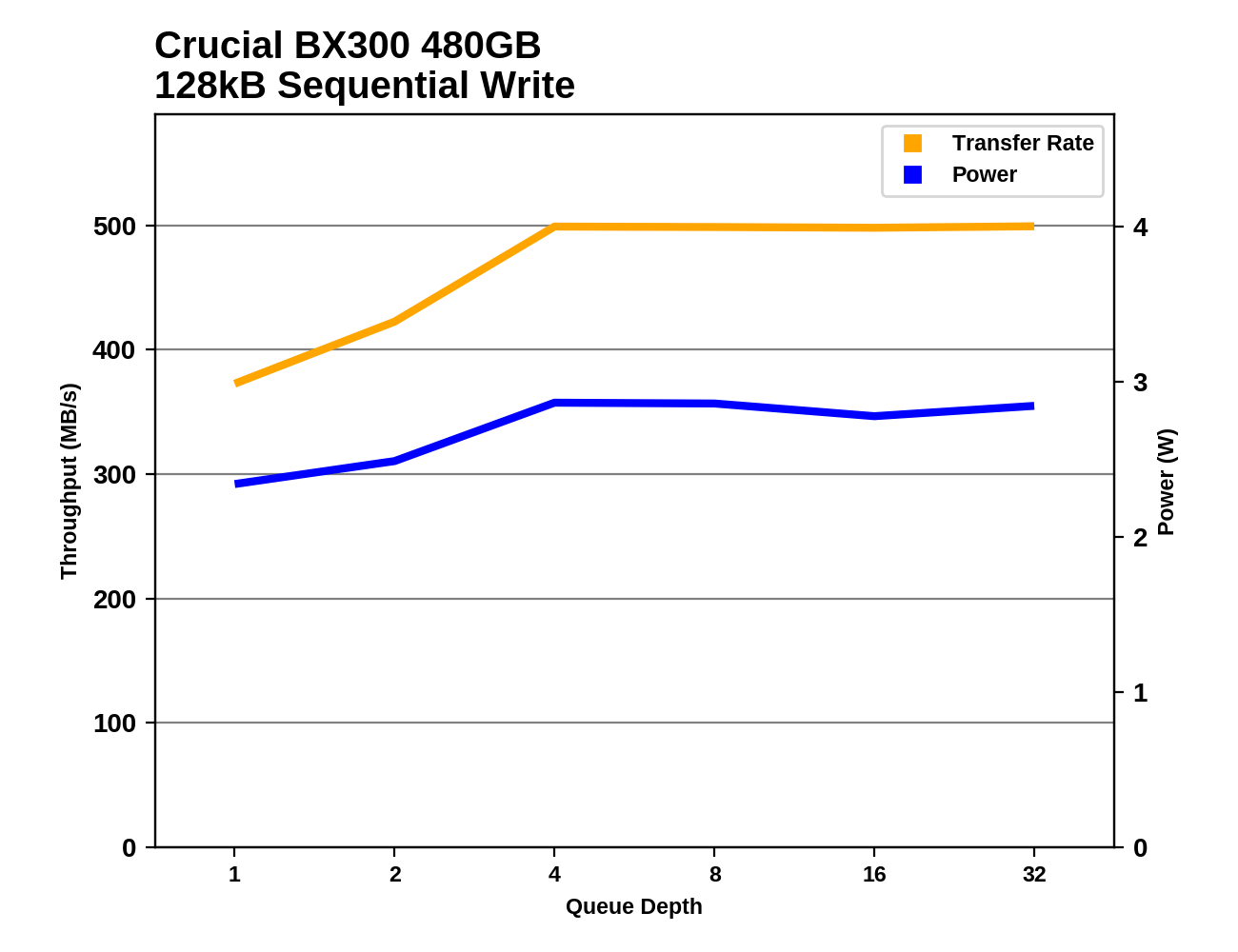
The Crucial BX300's sequential write speed saturates at QD4 and it performs steadily thereafter, but at QD2 it is much slower than its maximum and is outperformed by many SSDs.
Originally published at https://www.anandtech.com/show/11766/the-crucial-bx300-480gb-ssd-review-back-to-mlc (Wayback Machine).