
Biostar iDEQ 200T: Great Performance & Brilliant Design
- Posted in
- Systems
Biostar iDEQ 200T: BIOS and Overclocking
You buy a Small Form Factor system for the small size and quiet unobtrusive operation. However, as we demonstrated in our review of the Shuttle SB65G2, these systems are becoming capable of anything that the full-size systems can do.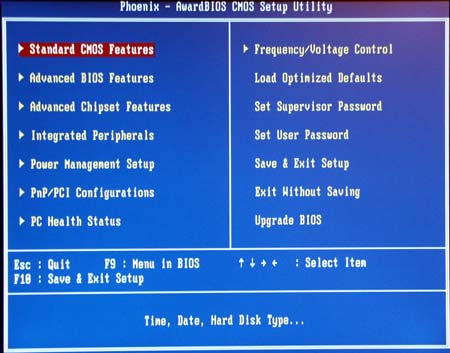
Biostar uses the familiar Phoenix-Award Bios in the iDEQ 200T system. Most will be very comfortable with the familiar menu/submenu arrangement.
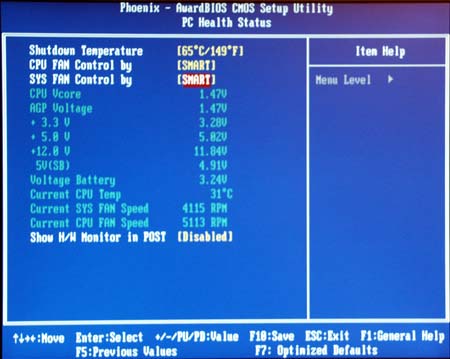
Most of the submenus and options are familiar, including a full PC Health submenu with Smart Fan adjustments and a complete readout of fan speeds, temperatures, and power levels.
You might not expect full control of memory timings on a SFF system, but the iDEQ 200T offers a full selection of memory timings to allow you to get the most performance from your memory. Memory Timing options are very good, as good as you will normally find in any 865 system.
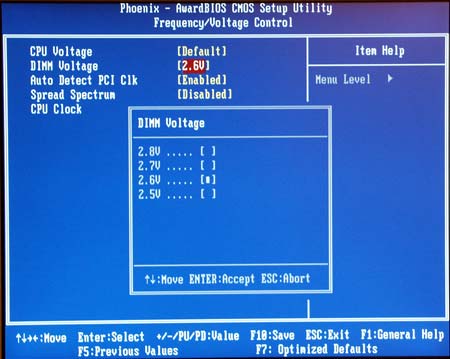
You also have a range of vDIMM adjustments from 2.5V to 2.8V.
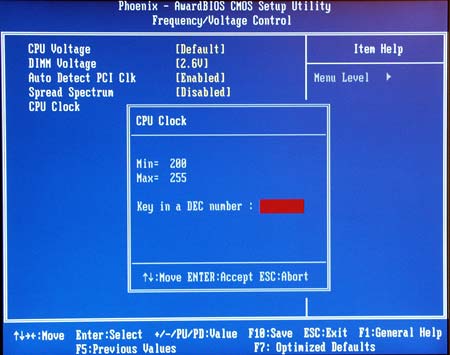
The Biostar does have the capabilities of overclocking, but the options are a bit more meager than what we normally see on top-line 865 boards. FSB frequency can be set from 200 to 255, and CPU voltage (vCore) is adjustable through a modest range from default to +8.1%. This means with a default voltage of 1.525V, you can select up to 1.65V (+8.1%). We have found that the 800FSB P4 processors do not respond normally to much more than about 1.6V, so this is probably a fine range for overclocking. The vDIMM to 2.8V is also fine. It appears that PCI/AGP lock is implemented with the BIOS option, “Auto Detect PCI Clock”. When this option is “Enabled”, we were able to achieve our highest overclocks with the Biostar system. The Biostar does not offer vAGP, or chipset voltage adjustments, but these are not as critical for good overclocking results. The Biostar should be a decent overclocker with these options, and will likely be limited in the top overclock by the 200-watt power supply.
FSB Overclocking Results
The last system that you normally think about overclocking would be a Small Form Factor. However, since our excellent overclocking results in our Shuttle SFF review seems to prove that you don’t have to give up anything in a SFF system, we decided to take a look at where we could go with the Biostar. The following setup was used on the iDEQ 200T for FSB overclocking:| Front Side Bus Overclocking Testbed | |
| Processor: | Intel 3.0 800FSB Pentium 4 |
| CPU Voltage: | 1.525V (default) |
| Cooling: | Biostar Cooling System |
| Memory: | 2 x 512MB Mushkin PC3500 Level II DS |
| Power Supply: | Enhance SFF 200W |
The highest stable FSB overclocking that we could achieve at default voltage was 228 (912FSB) while running an ATI Radeon 9800 PRO and an IDE hard drive. With the on-board Intel Extreme Graphics, highest stable overclock was slightly more limited at 225FSB. This translates into an astounding 3.4+ GHz speed in this little system with a 200-watt power supply. This 3.0 CPU is known to perform as high as 245 on other Intel motherboards, but keep in mind that our Intel testbed has a 470W power supply. The limitation is clearly the 200W power supply, as we would expect, but the fact that we could overclock to 225-228 on this loaded SFF box is an amazing performance on this Biostar iDEQ 200T.
At 3.42GHZ, we ran the machine overnight, stress-tested, ran benchmarks, and still could not get the system to fail or the automatic setup of the fan to kick into high speed. With a loaded Biostar iDEQ 200T — 1 GB of memory, 120GB hard drive, combo DVD/CD burner, and an ATI Radeon 9800 PRO — consider these excellent results the worst overclocking that you are likely to see on this machine. A card drawing less current or a slower CPU will make fewer demands on the system and should allow an even higher overclock. So would a slightly larger power supply.
Originally published at https://www.anandtech.com/show/1169 (Wayback Machine).