
The Toshiba XG5 (1TB) SSD Review
AnandTech Storage Bench - Heavy
Our Heavy storage benchmark is proportionally more write-heavy than The Destroyer, but much shorter overall. The total writes in the Heavy test aren't enough to fill the drive, so performance never drops down to steady state. This test is far more representative of a power user's day to day usage, and is heavily influenced by the drive's peak performance. The Heavy workload test details can be found here. This test is run twice, once on a freshly erased drive and once after filling the drive with sequential writes.
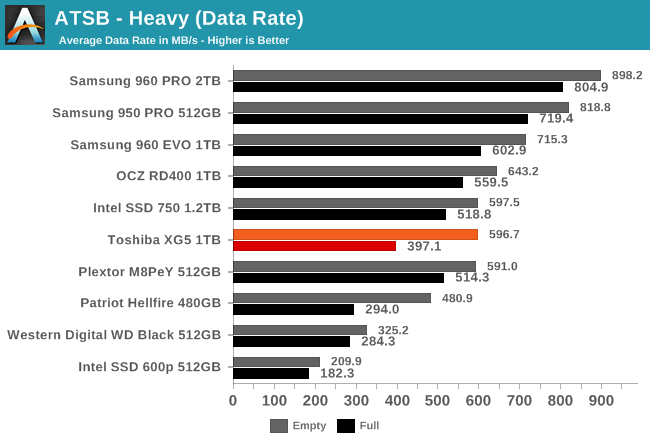
The Toshiba XG5's average data rate on the Heavy test is not quite competitive with the Samsung 960 EVO and also trails behind Toshiba's OCZ RD400, but it ties or beats several MLC SSDs and fares far better than the WD Black and Intel 600p. The XG5 does suffer a relatively large performance hit when the test is run on a full drive, but even in that case it is still substantially faster than the SSDs that it beats when the test is run on an empty drive.
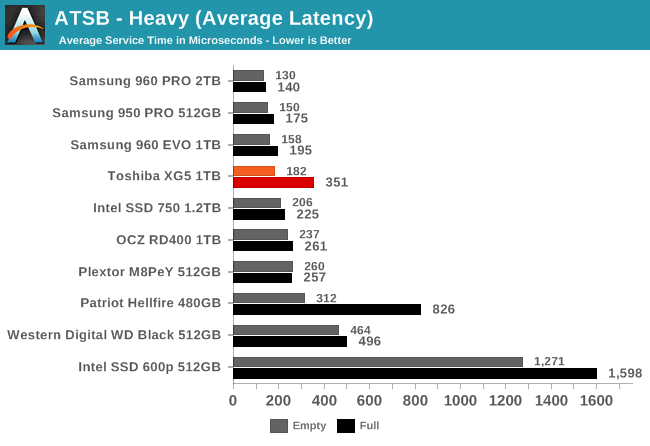
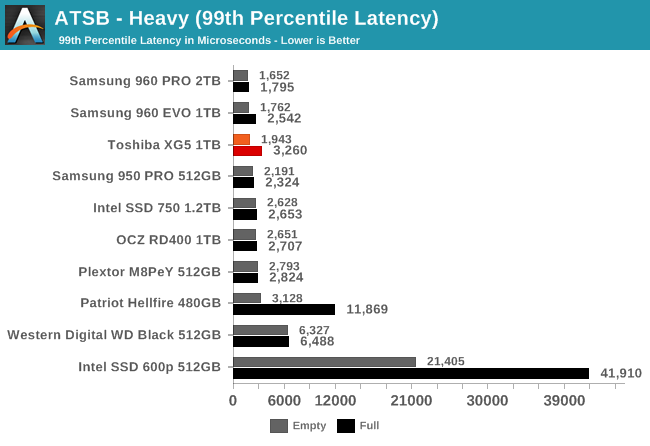
When the Heavy test is run on an empty drive, the XG5's average and 99th percentile latency are just shy of Samsung's NVMe SSDs and ahead of the Intel SSD 750. When the test is run on a full drive the latencies are increased significantly, but this still leaves the XG5 ahead of the slowest MLC-based NVMe SSDs.
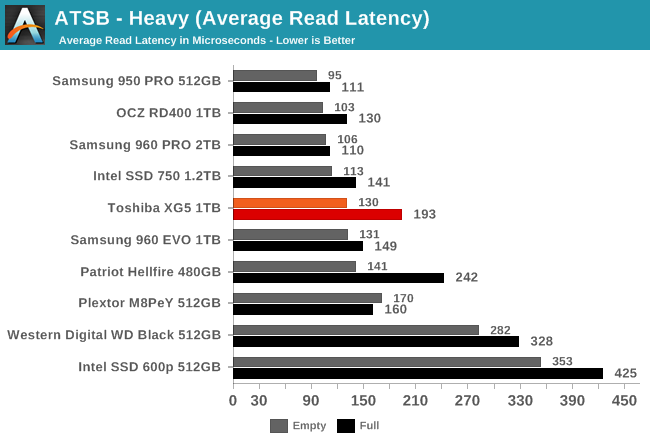
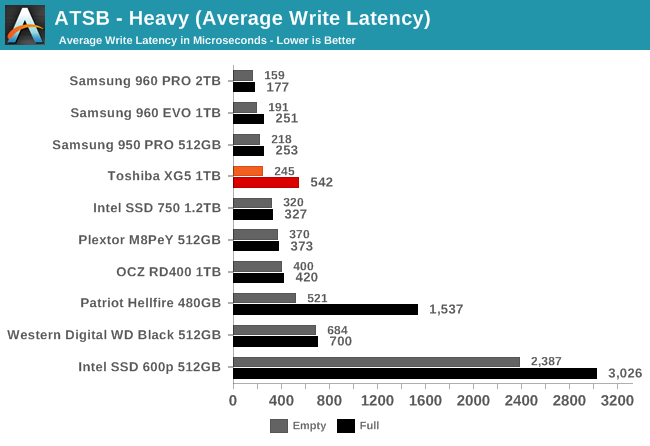
Separating the average read and write latencies shows that the XG5 performs well with both types of operation. The full-drive penalty affects writes more than reads, but the overall wider spread of write latencies means the XG5 still isn't close to the bottom of the charts for that test.
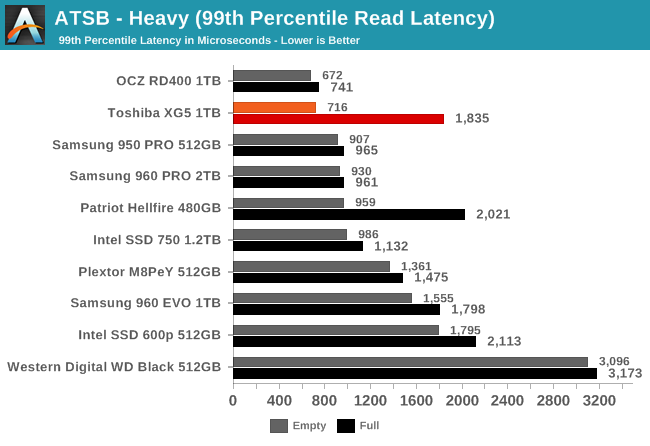
The 99th percentile read latencies show one of the XG5's greatest strengths with a clear advantage over Samsung's best SSD when the test is run on an empty drive, but the full-drive penalty is acute and pushes the 99th percentile latency 2.5 times higher. The Samsung 960 EVO performs poorly here with scores worse than most MLC NVMe SSDs and just ahead of the Intel 600p.
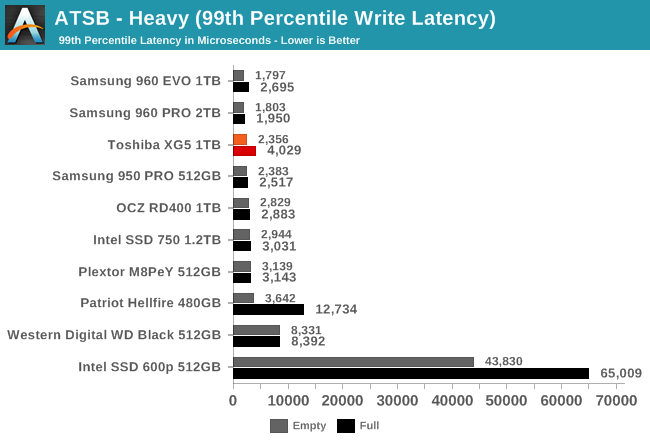
The 99th percentile write latencies paint a very different picture. Only a few drives have trouble keeping write latency under control, and the XG5 clearly isn't one of them, even when full.
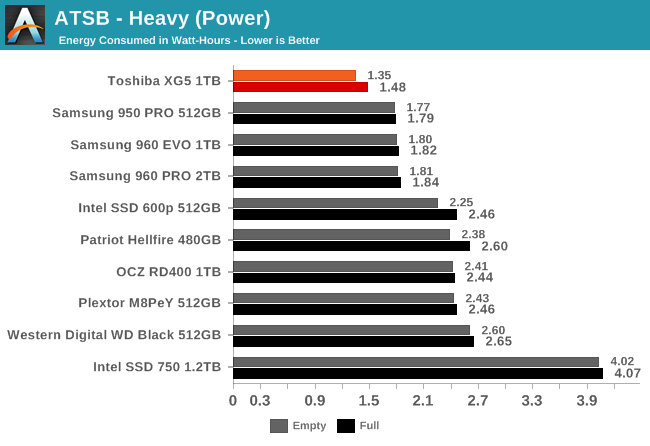
The Toshiba XG5's energy usage on the Heavy test is again much better than any previous PCIe SSD. There's a clear increase in energy consumption when the test is run on a full drive, but the effect is much smaller than the performance impact and is not enough to knock the XG5 out of first place.
For context, the energy usage of the XG5 is on par with the most efficient SATA SSDs based on planar TLC, but is not competitive with SATA SSDs using MLC or 3D NAND. Those SATA results are not shown here because they were recorded on our earlier 2015 testbed running Windows 8.1, but they should be quite similar to how those drives will perform on the new 2017 testbed.
Originally published at https://www.anandtech.com/show/11663/the-toshiba-xg5-1tb-ssd-review (Wayback Machine).