
The Corsair Neutron NX500 (400GB) PCIe SSD Review: Big Card, Big Pricetag
AnandTech Storage Bench - The Destroyer
The Destroyer is an extremely long test replicating the access patterns of very IO-intensive desktop usage. A detailed breakdown can be found in this article. Like real-world usage, the drives do get the occasional break that allows for some background garbage collection and flushing caches, but those idle times are limited to 25ms so that it doesn't take all week to run the test. These AnandTech Storage Bench (ATSB) tests do not involve running the actual applications that generated the workloads, so the scores are relatively insensitive to changes in CPU performance and RAM from our new testbed, but the jump to a newer version of Windows and the newer storage drivers can have an impact.
We quantify performance on this test by reporting the drive's average data throughput, the average latency of the I/O operations, and the total energy used by the drive over the course of the test.
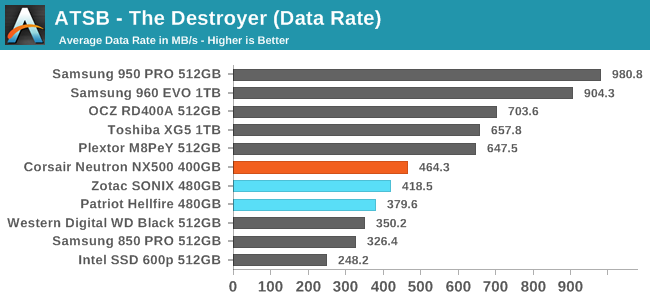
The NX500's average data rate on The Destroyer is clearly faster than the other Phison E7 drives, but still far slower than competing MLC NVMe SSDs. The Plextor M8Pe and OCZ RD400 offer much higher performance from the same 15nm MLC NAND.
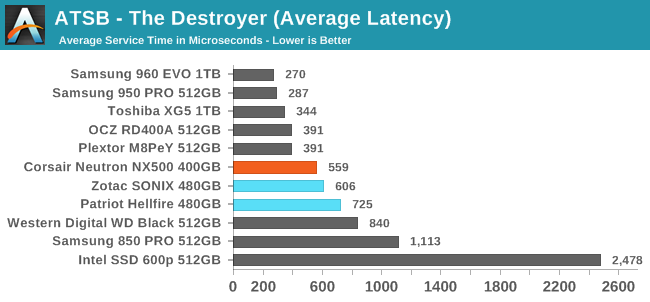
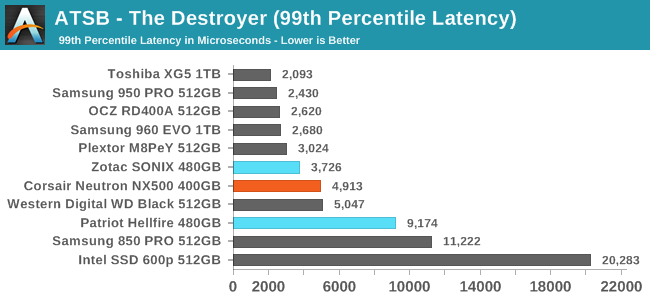
The NX500 offers the best average latency on The Destroyer among the Phison E7 drives. The 99th percentile latencies are quite different, with the Zotac SONIX outperforming the Corsair NX500, while the Patriot Hellfire is clearly having problems keeping latency under control.
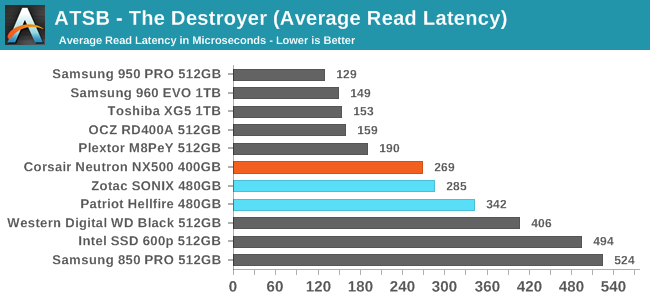
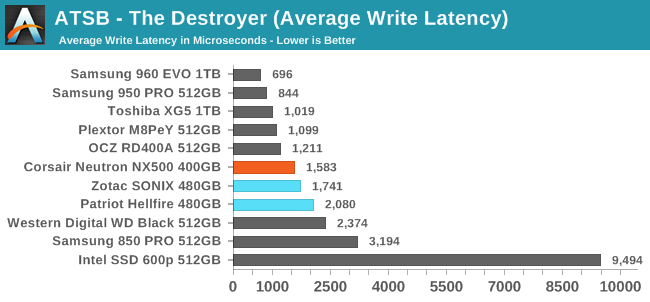
Splitting the average latency by reads and writes doesn't reveal any surprises among the Phison drives, but there are a few differences in the rankings of the other drives. The Intel 600p stands out as the only drive that has a real problem with write latency even in the average case.
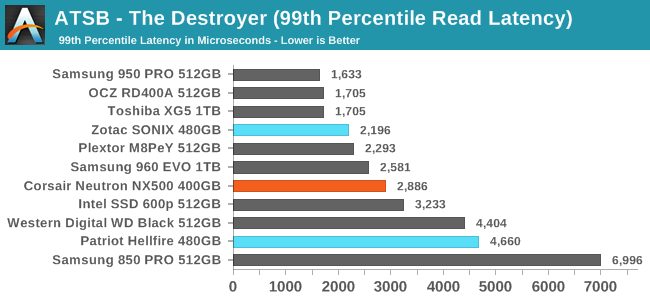
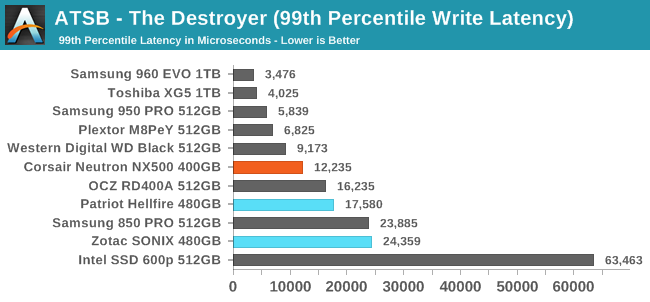
The 99th percentile latencies show interesting differences between the Phison drives in how they handle reads and writes. The Zotac SONIX has the best 99th percentile read latency among the Phison E7 drives and places pretty well among the overall field of competitors. The Corsair Neutron NX500 is substantially slower, while the Patriot Hellfire's 99th percentile read latency is worse than any other NVMe drive on this chart.
The 99th percentile write latencies are all rather slow on the Phison E7 drives, but the Corsair NX500 is the best of the three at keeping write latency low. This is to be expected given the greater spare area the NX500 has to work with, but the impact of that much extra overprovisioning on write QoS ought to be more significant.
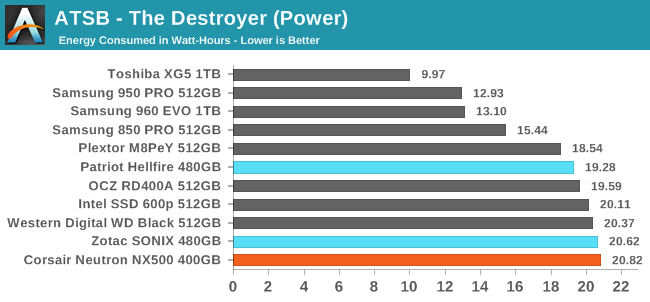
The Corsair Neutron NX500 and Zotac SONIX are at a bit of a disadvantage compared to the M.2 drives here since the NX500 and SONIX add-in cards draw power from the 12V supply and thus include more voltage regulation circuitry than the M.2 SSDs. The NX500 is further disadvantaged by having more DRAM to power. However, even the Patriot Hellfire M.2 can't come close to the 3D NAND SSDs from Samsung and Toshiba. Surprisingly, the most efficient planar NAND SSD in this bunch is the Plextor M8PeY, which was flashing its red LEDs during the entire test.
Originally published at https://www.anandtech.com/show/11602/the-corsair-neutron-nx500-400gb-ssd-review (Wayback Machine).