
The Intel SSD 545s (512GB) Review: 64-Layer 3D TLC NAND Hits Retail
AnandTech Storage Bench - Heavy
Our Heavy storage benchmark is proportionally more write-heavy than The Destroyer, but much shorter overall. The total writes in the Heavy test aren't enough to fill the drive, so performance never drops down to steady state. This test is far more representative of a power user's day to day usage, and is heavily influenced by the drive's peak performance. The Heavy workload test details can be found here. This test is run twice, once on a freshly erased drive and once after filling the drive with sequential writes.
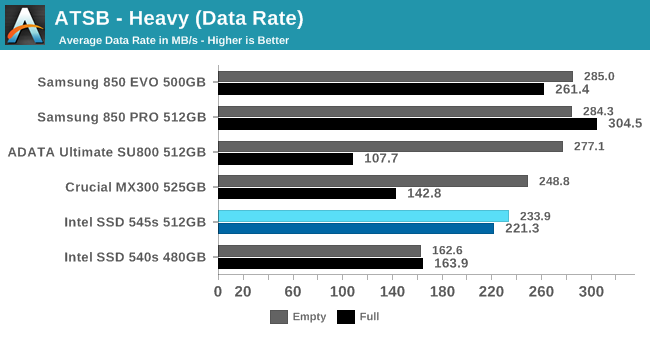
The Intel SSD 545s shows substantial improvement over the 540s in average data rates for the Heavy test. The 545s is not quite able to compete against Samsung as was the case for The Destroyer, but it comes much closer than its predecessor.
The 545s also fares far better when the test is run on a full drive than the drives that use the previous generation 32L 3D TLC (ADATA's SU800 and Crucial's MX300). Both of those drives beat the 545s when the test is run on an empty drive, but suffer a huge performance loss when the drive is full.
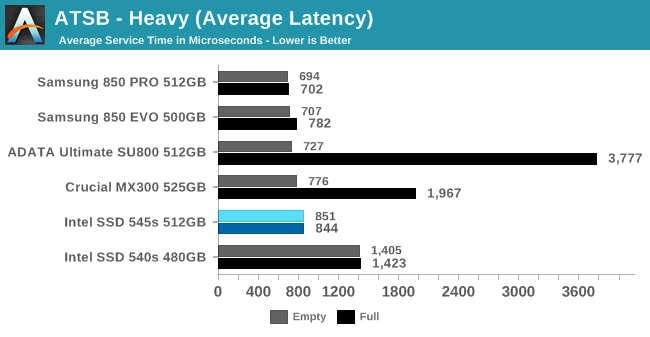
The latency measurements for the Intel 545s on the Heavy test tell a similar story to the average data rates. Intel is now in the same league as the other 3D NAND SSD, though still in last place. When the test is run on a full drive, the Crucial and ADATA drives fall apart and average latency spikes to the 2–4ms range while the latency of the Intel 545s is unaffected and remains well below 1ms.
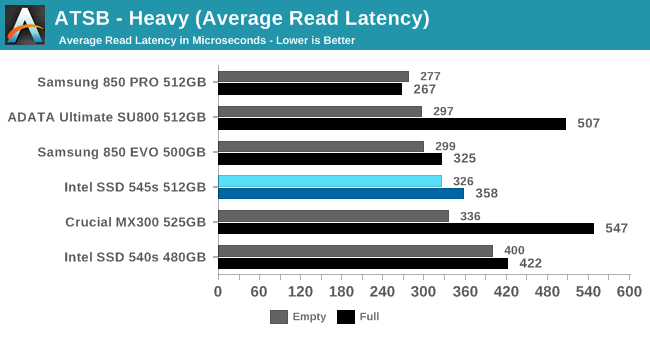
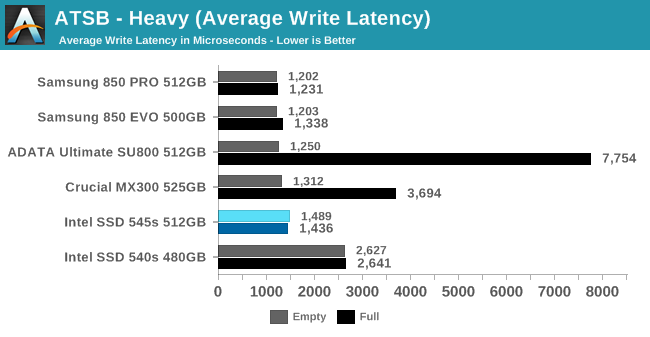
The read latency of the older Intel 540s is not too far behind the 3D NAND drives and it handles being full with no trouble, but its write latency in either case is almost twice as high as the 3D NAND drives. The biggest improvement of the Intel 545s comes from cutting that write latency. The read latency also improved enough to surpass the Crucial MX300.
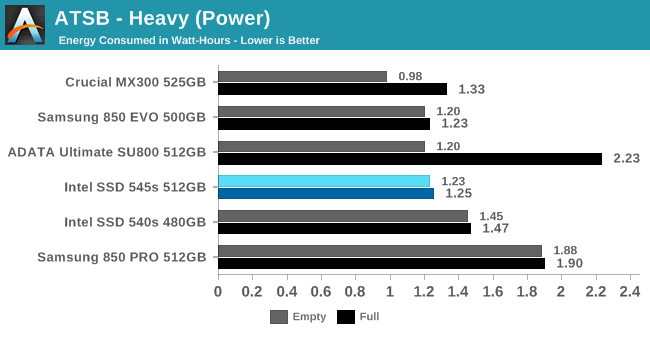
The energy usage of the Intel 545s during the Heavy test has it essentially tied for second place with the Samsung 850 EVO, while the Crucial MX300 has the clear lead when the test is run on an empty drive. The MX300's advantage disappears when the test is run on a full drive and the SU800's energy usage almost doubles.
Originally published at https://www.anandtech.com/show/11571/the-intel-ssd-545s-512gb-review-64layer-3d-tlc-nand-hits-retail (Wayback Machine).