
Sizing Up Servers: Intel's Skylake-SP Xeon versus AMD's EPYC 7000 - The Server CPU Battle of the Decade?
Multi-core SPEC CPU2006
For the record, we do not believe that the SPEC CPU "Rate" metric has much value for estimating server CPU performance. Most applications do not run lots of completely separate processes in parallel; there is at least some interaction between the threads. But since the benchmark below caused so much discussion, we wanted to satisfy the curiosity of our readers.
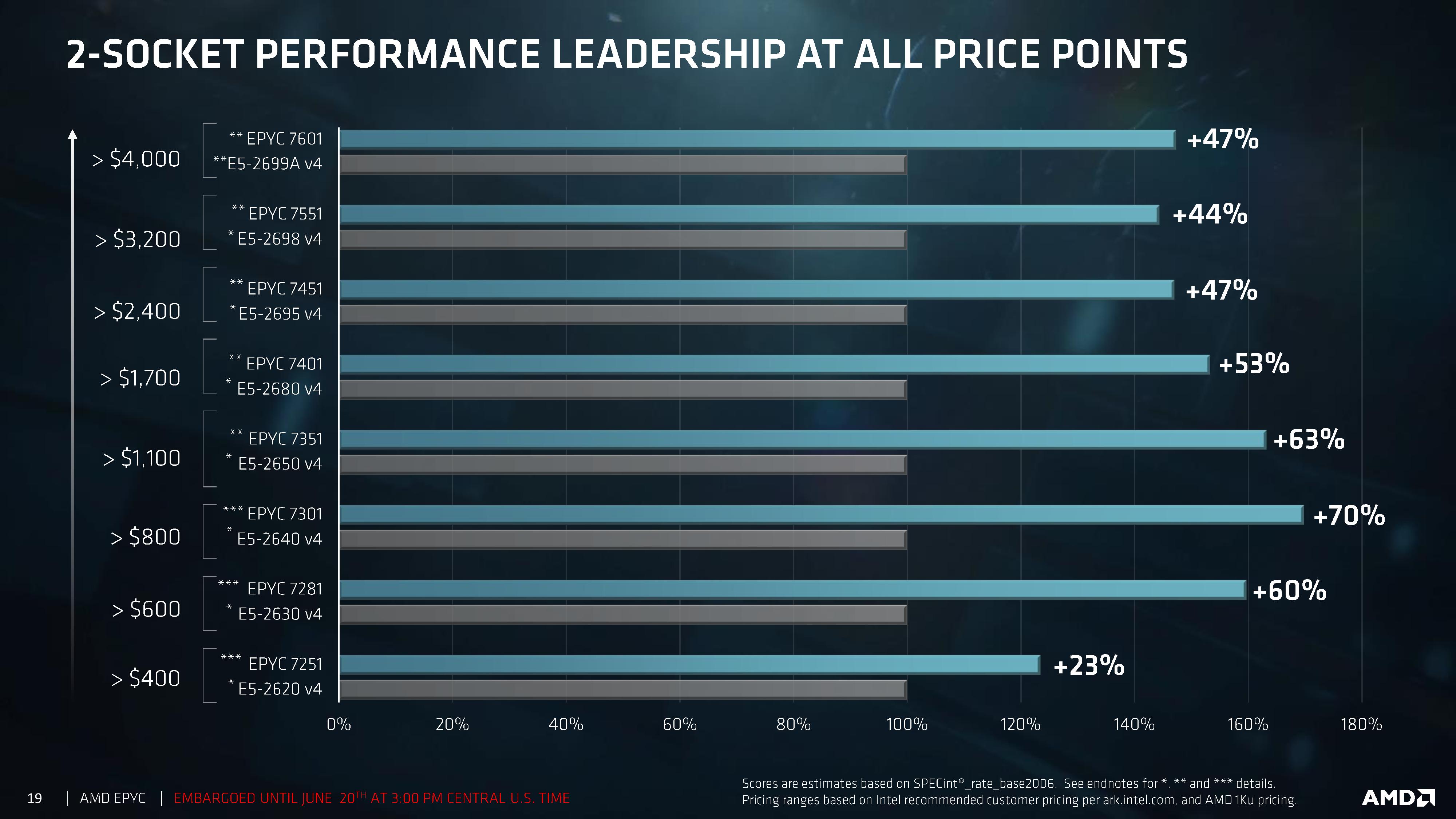
Does the EPYC7601 really have 47% more raw integer power? Let us find out. Though please note that you are looking at officially invalid base SPEC rate runs, as we still have to figure out how to tell the SPEC software that our "invalid" flag "-Ofast" is not invalid at all. We did the required 3 iterations though.
| Subtest | Application type | Xeon E5-2699 v4 @ 2.8 |
Xeon 8176 @ 2.8 |
EPYC 7601 @2.7 |
EPYC Vs Broadwell EP |
EPYC vs Skylake SP |
| 400.perlbench | Spam filter | 1470 | 1980 | 2020 | +37% | +2% |
| 401.bzip2 | Compression | 860 | 1120 | 1280 | +49% | +14% |
| 403.gcc | Compiling | 960 | 1300 | 1400 | +46% | +8% |
| 429.mcf | Vehicle scheduling | 752 | 927 | 837 | +11% | -10% |
| 445.gobmk | Game AI | 1220 | 1500 | 1780 | +46% | +19% |
| 456.hmmer | Protein seq. analyses | 1220 | 1580 | 1700 | +39% | +8% |
| 458.sjeng | Chess | 1290 | 1570 | 1820 | +41% | +16% |
| 462.libquantum | Quantum sim | 545 | 870 | 1060 | +94% | +22% |
| 464.h264ref | Video encoding | 1790 | 2670 | 2680 | +50% | -0% |
| 471.omnetpp | Network sim | 625 | 756 | 705 (*) | +13% | -7% |
| 473.astar | Pathfinding | 749 | 976 | 1080 | +44% | +11% |
| 483.xalancbmk | XML processing | 1120 | 1310 | 1240 | +11% | -5% |
(*) We had to run 471.omnetpp with 64 threads on EPYC: when running at 128 threads, it gave errors. Once solved, we expect performance to be 10-20% higher.
Ok, first a disclaimer. The SPECint rate test is likely unrealistic. If you start up 88 to 128 instances, you create a massive bandwidth bottleneck and a consistent CPU load of 100%, neither of which are very realistic in most integer applications. You have no synchronization going on, so this is really the ideal case for a processor such as the AMD EPYC 7601. The rate test estimates more or less the peak integer crunching power available, ignoring many subtle scaling problems that most integer applications have.
Nevertheless, AMD's claim was not farfetched. On average, and using a "neutral" compiler with reasonable compiler settings, the AMD 7601 has about 40% (42% if you take into account that our Omnetpp score will be higher once we fixed the 128 instances issue) more "raw" integer processing power than the Xeon E5-2699 v4, and is even about 6% faster than the Xeon 8176. Don't expect those numbers to be reached in most real integer applications though. But it shows how much progress AMD has made nevertheless...
Originally published at https://www.anandtech.com/show/11544/intel-skylake-ep-vs-amd-epyc-7000-cpu-battle-of-the-decade (Wayback Machine).