
Previewing Maxiotek's MK8115 SSD Controller: Can DRAM-less Drives Make The Cut?
AnandTech Storage Bench - Heavy
Our Heavy storage benchmark is proportionally more write-heavy than The Destroyer, but much shorter overall. The total writes in the Heavy test aren't enough to fill the drive, so performance never drops down to steady state. This test is far more representative of a power user's day to day usage, and is heavily influenced by the drive's peak performance. The Heavy workload test details can be found here.
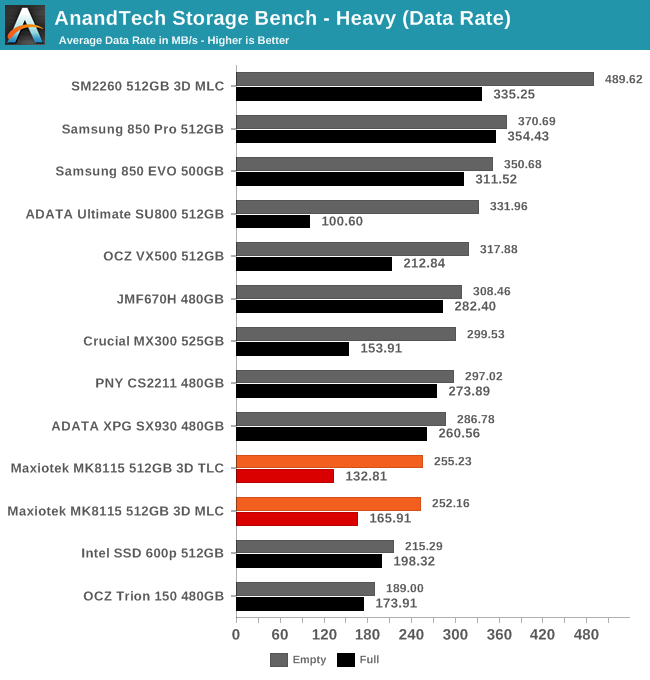
The average data rates of the two MK8115 drives on the Heavy test are almost exactly the same when the test is run on an empty drive. Unfortunately that puts both of them quite near the bottom of the charts, behind the older JMicron drives and the other SATA SSDs using Micron 3D NAND.
When the test is run on a full drive, the MK8115 drives' performance suffers greatly, which has also been true of the other two SATA SSDs with Micron 3D NAND that we've tested. Most other SSDs show a far smaller degradation in performance from a full drive.
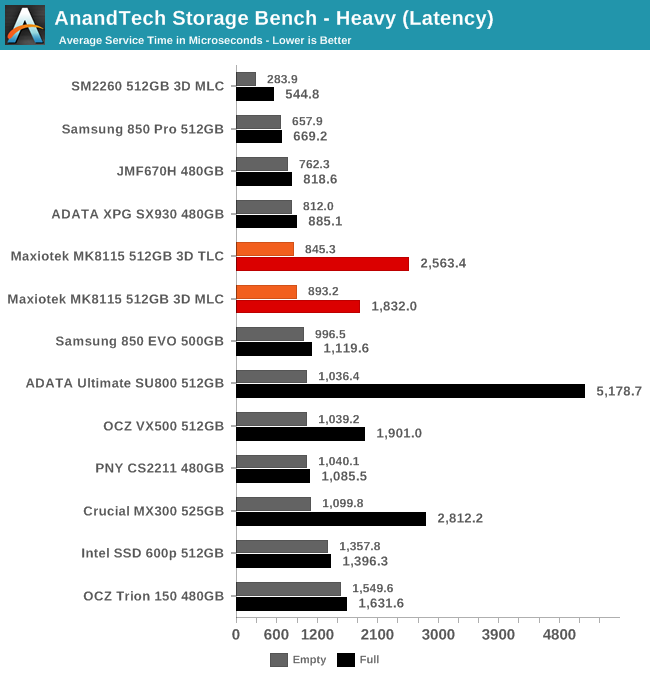
As on The Destroyer, average service times from the MK8115 drives aren't bad at all, if the test is run on an empty SSD. When the drive starts out full, average service time more than doubles, putting the MLC drive only slightly ahead of the OCZ VX500 and the TLC drive a little ahead of the Crucial MX300.
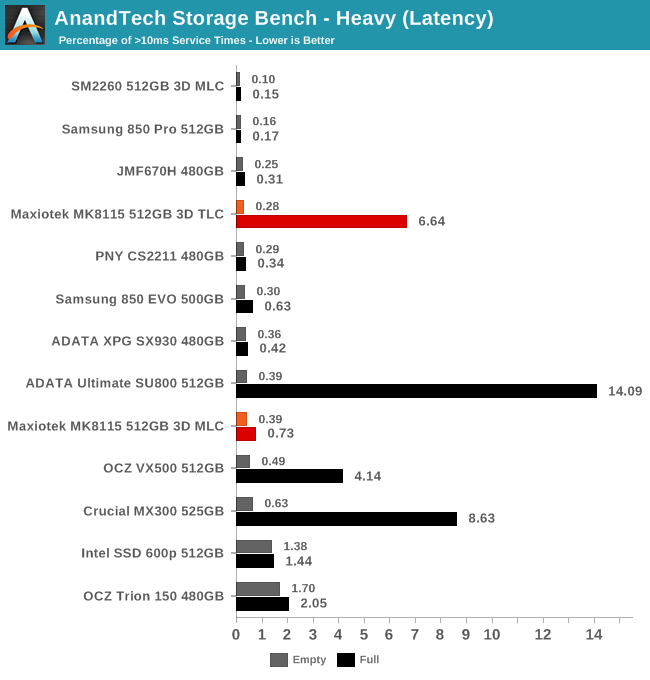
Both MK8115 drives have good control over high latency outliers when the Heavy test is run on an empty drive. The TLC sample surprisingly scores a bit better than the MLC sample. However, when the test is run on a full drive, the MLC sample's performance degradation is moderate while the TLC drive falls apart, though not quite to the extent of the Crucial MX300 or ADATA SU800.
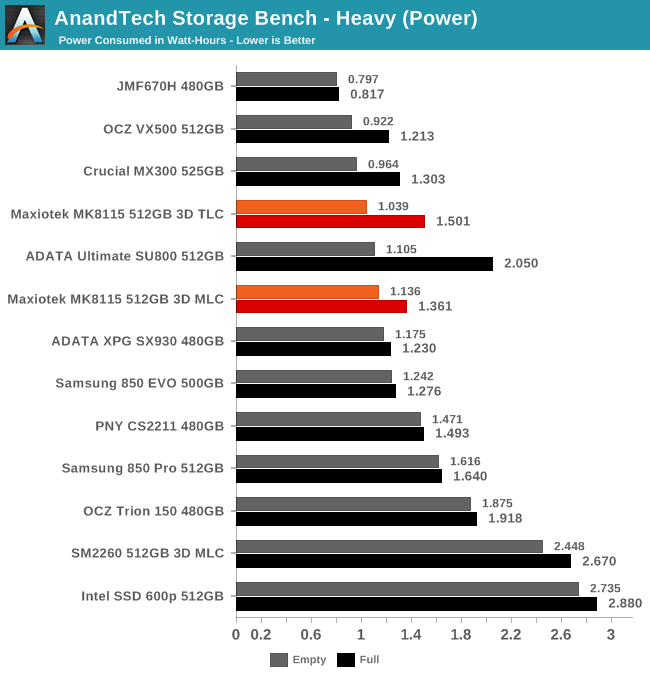
The energy usage scores of the MK8115 drives on the Heavy test are good. The Crucial MX300 is still a bit better overall, but the Micron 3D NAND drives in general are all fairly efficient. They also all suffer noticeably when the test is run on a full drive, but it's not enough to make them worse than the slowest planar TLC SSDs or the fastest MLC SSDs that prioritize performance over power efficiency.
Originally published at https://www.anandtech.com/show/11339/previewing-maxiotek-mk8115-dramless-ssd-controller (Wayback Machine).