
OCZ 3700 GOLD: Building High-Performance Memory
- Posted in
- Memory
Post-Laser Performance
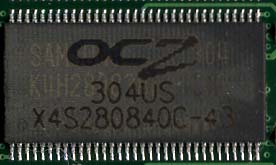
The lasering process includes the removal of a small amount of surface from the Samsung chips, and OCZ remarking the chips.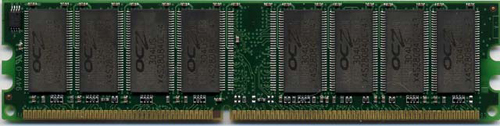
The OCZ remark indicates a performance rating of 4.3ns, which is quite an improvement from the original Samsung rating.
We have already seen the Samsung chips perform well beyond their rated performance and timings, so what effect does the Laser process have on performance and timings? Is the claimed 4.3ns rating after laser treatment justified?
To offer a better comparison to the finished product, we looked at the HIGHEST overclock at SPD timings, the required voltage at OCZ 3700 GOLD rating of 2.5-7-3-3 and DDR466, and the lowest voltage required for SPD 3-8-4-4 rating at DDR466.
| OCZ Lasered Samsung DS Performance Intel 875 Chipset, Dual-Channel, Maximum Overclock |
|||
| DDR Memory Speed | Memory Timings | Memory Voltage (vDIMM) |
UNBuffered Sandra 2003 Memory Test (MB/Second) |
| 466 | 3-8-4-4 | Minimum SPD voltage 2.5V |
2877 INT 2923 FLT |
| 466 | 2.5-7-3-3 | Minimum GOLD-Spec Voltage 2.65V |
3003 INT 3102 FLT |
| 500 | Maximum SPD 3-8-4-4 |
2.8V | 3064 INT 3158 FLT |
As OCZ claims, the laser process seems to have a significant effect on performance in two areas. First, it allows the memory chips to achieve a higher overclock. In our tests, the maximum overclock went from 476 to DDR500 – just with the laser process. Second, and more important, lasering appears to allow the use of lower voltages at the same memory speeds. In our test at DDR466 and 2.5-7-3-3, the laser process reduced the required memory voltage (vDIMM) for stable performance from 2.8V to 2.65V. This is a significant improvement in specifications.
Originally published at https://www.anandtech.com/show/1126 (Wayback Machine).