
The NVIDIA GeForce GTX 1080 Ti Founder's Edition Review: Bigger Pascal for Better Performance
Synthetics
As always we’ll also take a quick look at synthetic performance. As a pretty straightforward and wider implementation of Pascal, GTX 1080 Ti shouldn't offer too many surprises here.
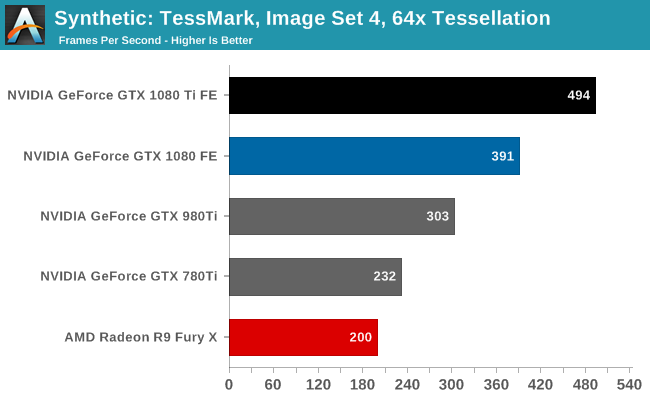
With TessMark, we find that the that the GTX 1080 Ti offers 26% better tessellation performance than the GTX 1080, and 63% better performance than the GTX 980 Ti. NVIDIA has always built their architectures geometry-heavy, and GTX 1080 Ti further adds to that lead.
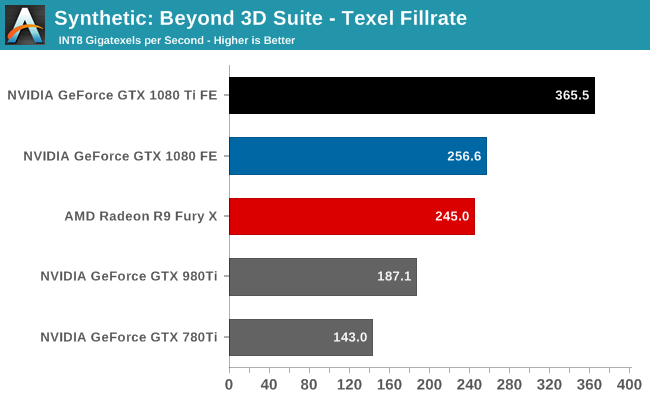
Finally, for looking at texel and pixel fillrate, we have the Beyond3D Test Suite. This test offers a slew of additional tests – many of which use behind the scenes or in our earlier architectural analysis – but for now we’ll stick to simple pixel and texel fillrates.
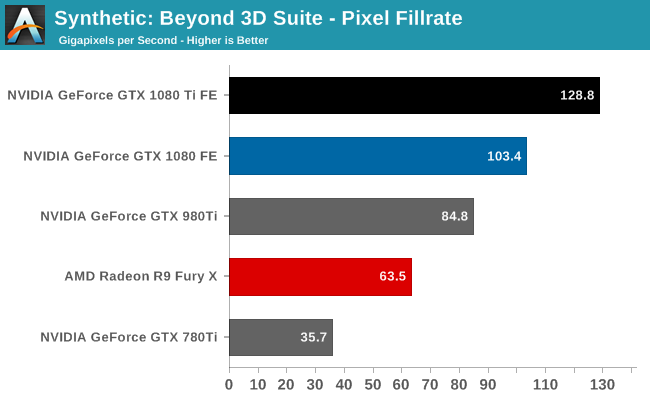
As it turns out, the pixel fillrate results for the GTX 1080 Ti are a bit surprising. The GTX 1080 Ti doesn’t dominate by as much as I would have expected given the massive memory bandwidth advantage and additional ROP throughput. Not that a 25% increase over the GTX 1080 is anything to sneeze at, but I wonder if we’re looking at one of the consequences of the unusual way NVIDIA has cut-down GP102 for GTX 1080 Ti. We haven’t seen NVIDIA disable a single ROP/memory channel at the high-end before in this manner.
As for texel fillrate, the GTX 1080 Ti excels. In fact it does a bit better than I’d otherwise expect based on the specifications. This could be a sign that GTX 1080 is a bit bandwidth limited at times when it comes to texel throughput, as that’s the facet of performance the GTX 1080 Ti has improved upon the most.
Originally published at https://www.anandtech.com/show/11180/the-nvidia-geforce-gtx-1080-ti-review (Wayback Machine).